Neobanks in the Digital Economy: Challenges and Prospects (Економіка та суспільство)
SaveSummary
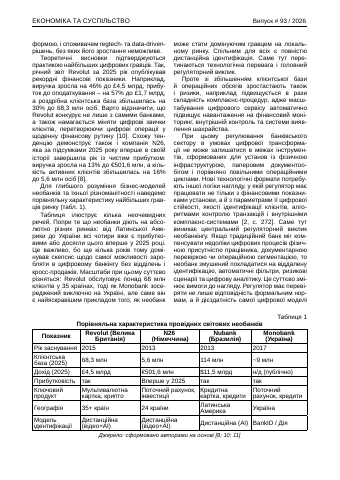
- Revolut's 2025 annual report showed revenue up 46% to £4.5 billion.p.4
- Revolut's profit before tax grew 57% to £1.7 billion in 2025.p.4
- Revolut's retail customer base grew 30% to 68.3 million.p.4
- N26 ended 2025 with a net profit for the first time, with revenue up 13% to €501.6 million and active customers up 16% to 5.6 million.p.4
- Financial monitoring is the most sensitive area for neobanks because the speed and scale of operations make suspicious schemes harder to detect.p.5
- Further neobank growth is expected to bring market consolidation around large technology-driven players.p.6
Key insights
- Neobanks build their service around a mobile app and automated operations rather than branches, raising questions on remote customer due diligence and AML.p.2
- Revolut's 2025 revenue rose 46% to £4.5 billion and its profit before tax rose 57% to £1.7 billion.p.4
- N26 reported its first net profit in 2025, with revenue up 13% to €501.6 million.p.4
- Fully remote customer identification is where technological advantage meets the main regulatory challenge.p.4
- Scaling a digital service raises the load on financial monitoring, internal control and fraud detection.p.4
- Digitalisation gives banks more tools to analyse large data sets, but the speed and mass of operations complicate detection of suspicious activity.p.5
- In Ukraine, martial law raised the importance of remote financial services, making continuous account access an element of financial resilience.p.5
- Ukrainian neobanking, led by Monobank, developed as a component of the country's infrastructure resilience.p.6
Pages
 p.1
 p.2
 p.3
 p.4
 p.5
 p.6
 p.7
Funders mentioned
Topics and entities
Summary and figures generated from the document and checked automatically: every number shown appears on the cited page. Publishers can request removal.