Institutional Architecture, Risk Governance, and Commercial Pathways in Decentralized Finance (Zenodo)
SaveSummary
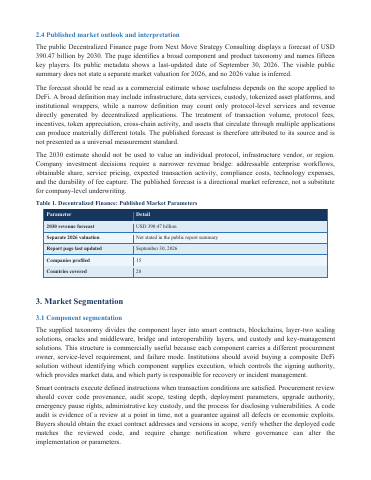
- Next Move Strategy Consulting forecasts the decentralized finance market to reach USD 390.47 billion by 2030.p.1
- The market taxonomy covers 15 profiled companies across 28 countries.p.6
- A FATF survey revealed that 132 of 143 responding jurisdictions had not implemented FATF standards for qualifying DeFi arrangements.p.13
- The FATF survey indicated that only 2 of 142 jurisdictions had licensed or registered a DeFi arrangement in practice.p.13
- ESMA noted that transitional periods under MiCA expired on July 1, 2026, requiring unauthorized crypto-asset service providers to wind down operations.p.19
- The UK FCA opened its cryptoasset authorization gateway on September 30, 2026, setting an application deadline of February 28, 2027.p.19
- U.S. banking agencies issued interagency FAQs on March 5, 2026, clarifying that eligible tokenized securities receive the same capital treatment regardless of technology.p.18
Key insights
- Decentralized finance operates as a layered financial infrastructure integrating programmable contracts, distributed ledgers, liquidity protocols, and middleware services.p.1
- Institutional adoption depends on creating explicit service boundaries that connect protocol-level execution to regulated balance sheets and compliance rules.p.2
- Financial Action Task Force guidelines focus on governance concentration, administrative privileges, and upgrade powers to assign regulatory accountability.p.11
- DeFi liquidity risks are highly non-linear and susceptible to accelerated collateral liquidation feedback loops under severe market stress.p.12
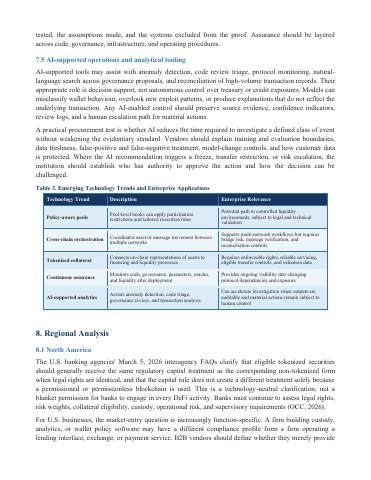
- Permissioned liquidity pools using protocol hooks allow institutions to enforce access restrictions directly within smart-contract environments.p.16
- U.S. banking agencies confirmed that permissioned or permissionless blockchain execution does not alter the regulatory capital status of eligible tokenized securities.p.18
- Regulatory implementation across global jurisdictions remains highly uneven, creating supervisory fragmentation for international institutions.p.13
Pages
 p.1
 p.2
 p.3
 p.4
 p.5
 p.6
 p.7
 p.8
 p.9
 p.10
 p.11
 p.12
 p.13
 p.14
 p.15
 p.16
 p.17
 p.18
 p.19
 p.20
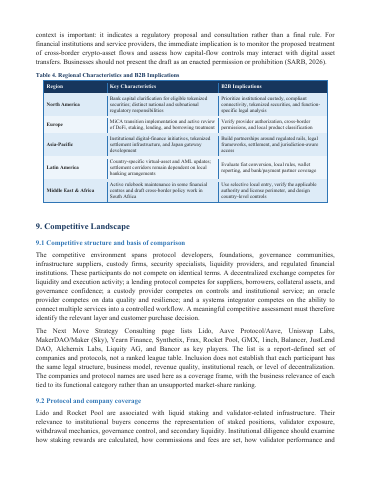 p.21
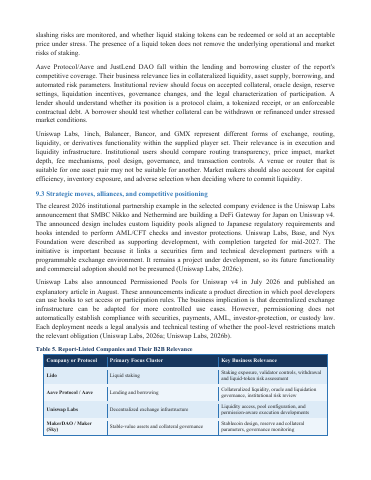 p.22
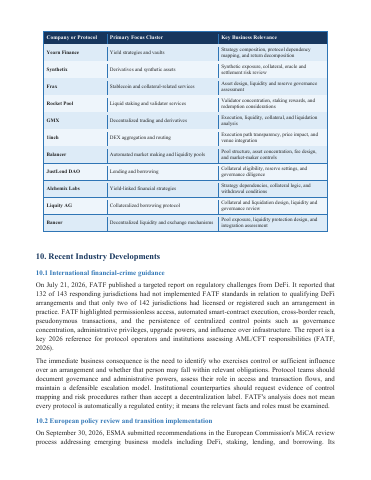 p.23
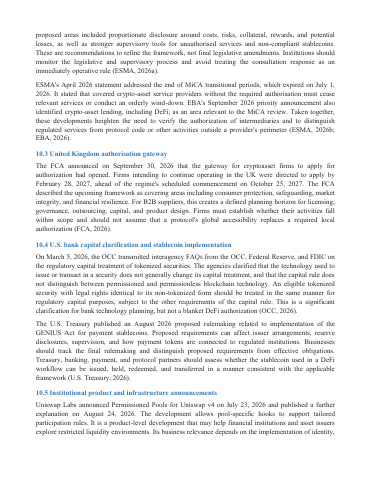 p.24
 p.25
 p.26
 p.27
 p.28
 p.29
Funders mentioned
Topics and entities
EuropeGlobalUKUSBankingCrypto and stablecoinsInfrastructure investmentRegulationAaveBanco Central do BrasilEuropean Securities and Markets AuthorityFinancial Action Task ForceFinancial Conduct AuthorityHong Kong Monetary AuthorityLidoMonetary Authority of SingaporeNext Move Strategy ConsultingOffice of the Comptroller of the CurrencySMBC NikkoSouth African Reserve BankUniswap Labs
Summary and figures generated from the document and checked automatically: every number shown appears on the cited page. Publishers can request removal.