Fintech and the Profitability of Deposit Money Banks in Nigeria (Zenodo)
SaveSummary
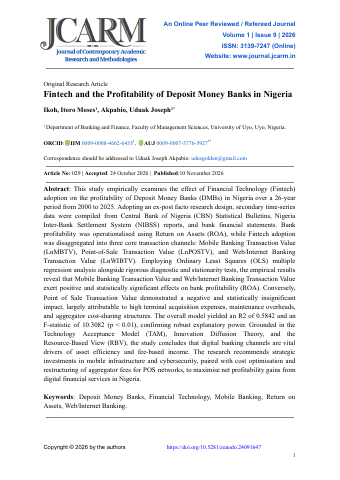
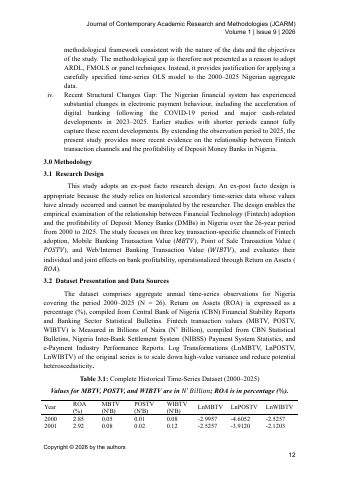
- The study empirically evaluates the effect of Fintech adoption on the profitability of Deposit Money Banks (DMBs) in Nigeria over a 26-year period from 2000 to 2025.p.1
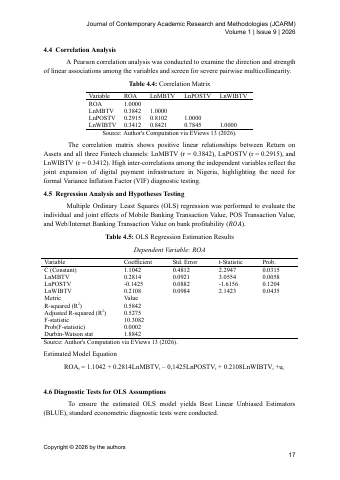
- The operationalised baseline regression model yields an R2 of 0.5842 and an F-statistic of 10.3082 (p < 0.01), showing high joint explanatory power.p.1
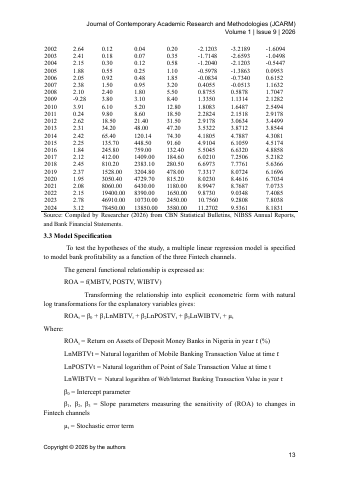
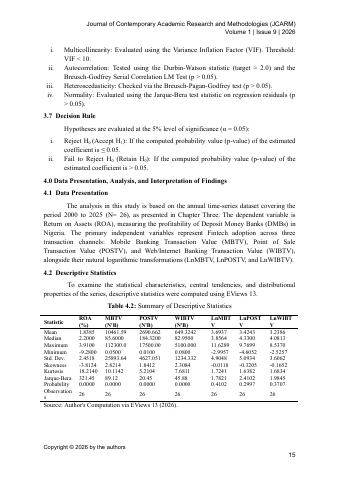
- The average bank ROA over the 26-year period is 1.84%, reaching a peak of 3.91% in 2010 and dropping to a minimum of -9.28% in 2009.p.16
Key insights
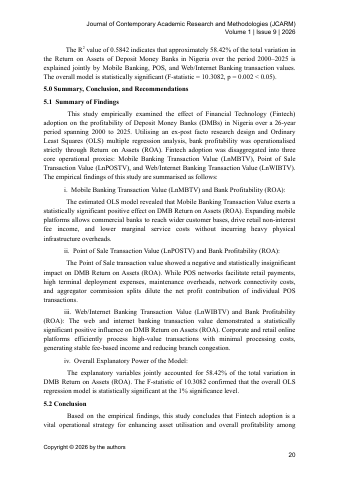
- Mobile banking platforms drive asset efficiency and non-interest income by expanding customer reach at very low marginal service costs.p.20
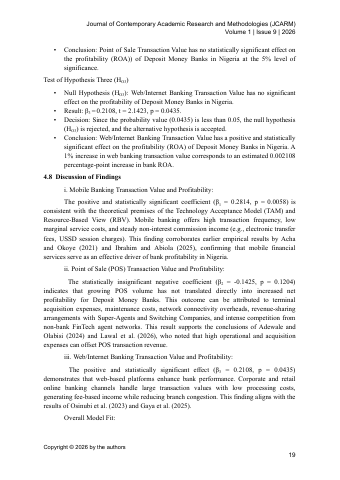
- Web and internet banking channels enhance bank performance by processing high-value corporate and retail transactions with minimal operational costs.p.20
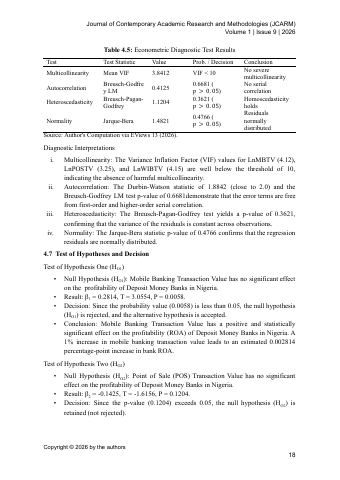
- POS transactions fail to generate significant net profitability for banks due to high terminal acquisition expenses, maintenance overheads, and aggregator fee-sharing structures.p.20
- The natural logarithmic transformations of mobile, POS, and web transaction values successfully normalize the positive skewness found in raw e-payment figures.p.16
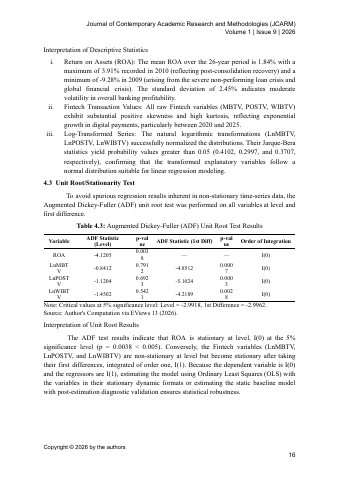
- Return on Assets (ROA) is integrated of order zero I(0), whereas the logarithmic Fintech transaction variables are non-stationary at level and integrated of order one I(1).p.16
- Mobile banking, POS, and web banking transaction values jointly account for 58.42% of the variation in the Return on Assets of Nigerian Deposit Money Banks.p.20
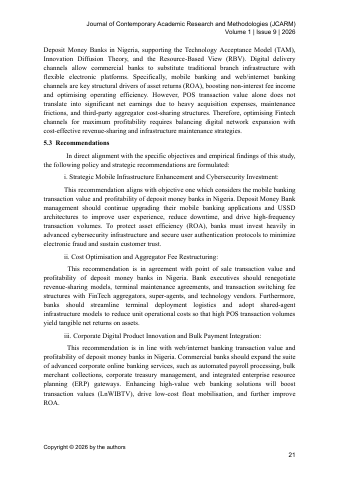
- To protect asset efficiency, banks must balance continuous digital network expansion with cybersecurity investments and restructured aggregator cost-sharing agreements.p.21
Pages
 p.1
 p.2
 p.3
 p.4
 p.5
 p.6
 p.7
 p.8
 p.9
 p.10
 p.11
 p.12
 p.13
 p.14
 p.15
 p.16
 p.17
 p.18
 p.19
 p.20
 p.21
 p.22
 p.23
Funders mentioned
Topics and entities
Summary and figures generated from the document and checked automatically: every number shown appears on the cited page. Publishers can request removal.