Examining SME Owners' Willingness to Submit Personal and Business Documents as a Proxy for Trust and Creditworthiness: The Psychological Collateral Paradigm
SMEs represent about 90% of businesses and more than 50% of employment worldwide.
Central bank · NI · 20 documents
SMEs represent about 90% of businesses and more than 50% of employment worldwide.
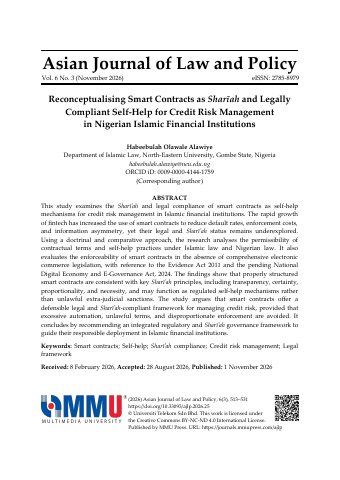
The study analyzed Shariah governance using a sample of 180 respondents from Islamic asset management institutions in Nigeria and Malaysia.
In March 2024, the Central Bank of Nigeria launched a major regulatory overhaul in the Bureau De Change sector, revoking the licenses of over 4000 BDC operators to curb financial malfeasance.
The paper investigates the dynamic relationships between headline inflation, official naira/US-dollar exchange rate, and returns of five cryptocurrencies using a seven-variable structural vector autoregressive (SVAR) model.
The study analyzes quarterly time-series macroeconomic data for Nigeria covering 2010Q1 to 2024Q4, comprising up to 60 observations.
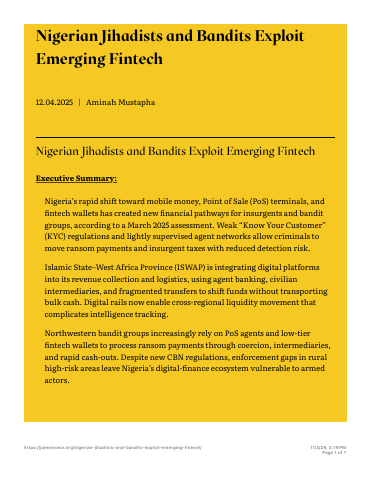
In a March 2025 assessment, the Nigerian Financial Intelligence Unit reported that kidnapping ransom payments increasingly move through mobile-money platforms, PoS terminals, and fintech wallets.
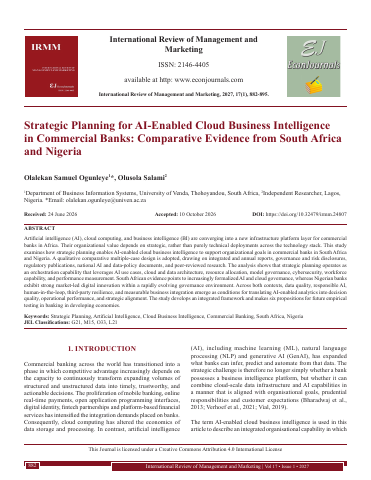
The research examines how strategic planning connects artificial intelligence and cloud-scale data infrastructure in commercial banking across South Africa and Nigeria.
Islamic Fintech volume within OIC countries was 49 billion dollars in 2020, representing 0.7% of total market share.
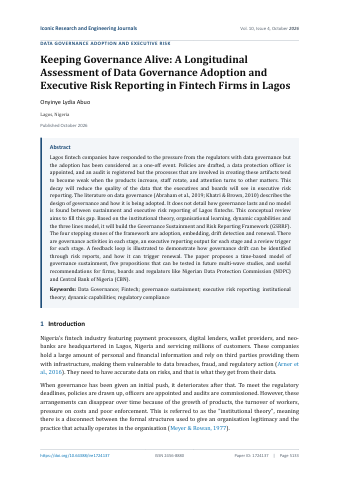
The conceptual Governance Sustainment and Risk Reporting Framework (GSRRF) establishes 4 stepping stones to prevent data governance decay in Lagos fintech firms.
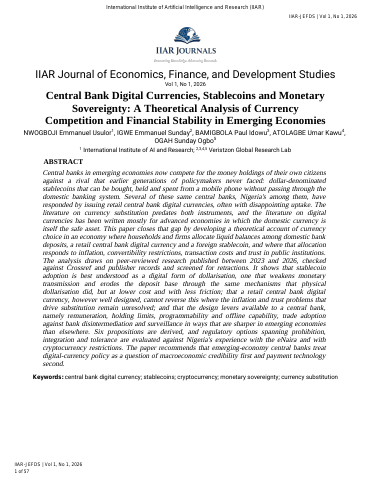
The Central Bank of Nigeria launched the retail eNaira CBDC in October 2021 following a February 2021 directive restricting cryptocurrency transactions in commercial banking.
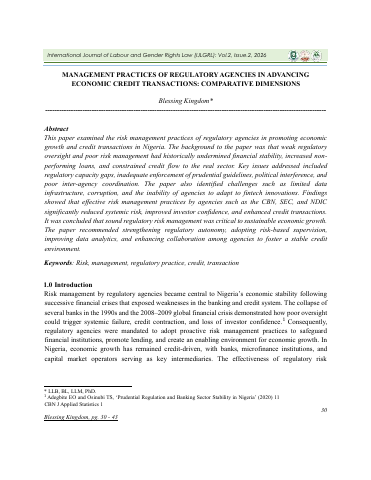
The implementation of regulatory risk-based supervision helped lower Nigeria's banking sector non-performing loans ratio from 34.4% in 2010 to 5.2% in 2023.
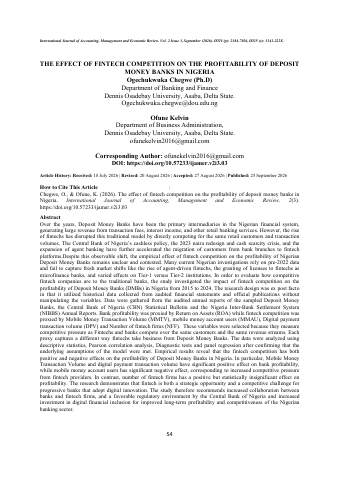
During H1 2022, 10 Nigerian Deposit Money Banks expended N81.92 billion on ICT, representing a 58.7% rise from 2021 to construct digital channels and connect with fintechs.
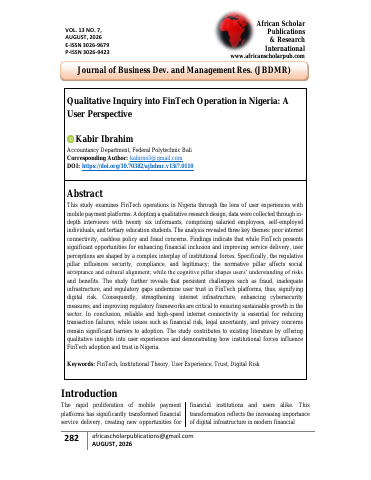
The study conducted qualitative in-depth interviews with 26 FinTech users across Kano (14) and Abuja (12) to examine digital payment experiences.
Nigeria attracted more than $1 billion in FinTech-related investments between 2020 and 2023.
Over 90 percent of surveyed central banks are engaged in some form of CBDC work, with more than half involved in experiments or pilot projects.
In a 2023 BIS survey, almost all surveyed central banks reported considering offline CBDC payments to be vital or advantageous.
As of late 2023, 94 percent of 86 surveyed central banks were actively exploring CBDCs, moving from research to experiments.
In Nigeria, 98.5 percent of eNaira wallets remained unused one year after launch.
The framework analyzes cross-border retail CBDC payments across 5 core elements: access, communication, currency conversion, compliance, and settlement.
Thirty of the 33 central banks in sub-Saharan Africa responded to the regional survey on digital currencies and payments.