Financial and Credit System Under Digital Transformation and Criminal-Law Risks of Payment Fraud (Financial and credit activity problems of theory and practice)
SaveKey number
approximately 90%
Share of payment-card fraud losses attributed to social engineering in 2025 (published estimate) p.6
What changed
UAH 2,200 to UAH 5,536
Average value of a single illicit transaction over the four-year period p.5
Summary
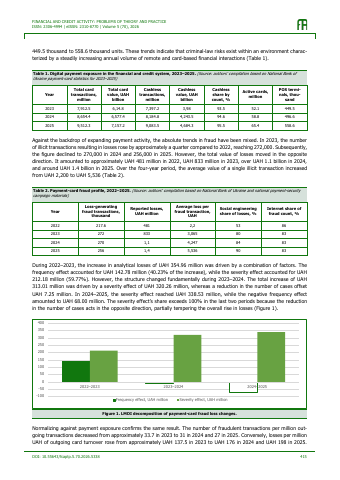
- Loss-generating illicit transactions reached 272,000 in 2023, then declined to 270,000 in 2024 and 256,000 in 2025.p.5
- Reported losses were approximately UAH 481 million in 2022, UAH 833 million in 2023, over UAH 1.1 billion in 2024 and around UAH 1.4 billion in 2025.p.5
- The average value of a single illicit transaction rose from UAH 2,200 to UAH 5,536.p.5
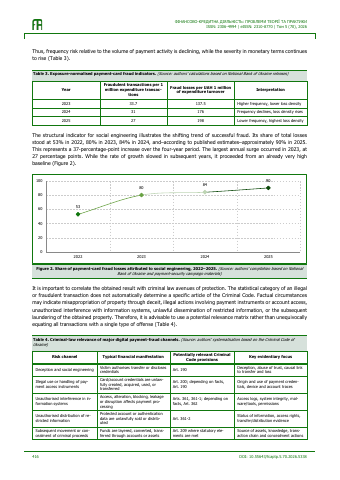
- Social engineering accounted for 53% of fraud losses in 2022, 80% in 2023, 84% in 2024 and approximately 90% in 2025.p.6
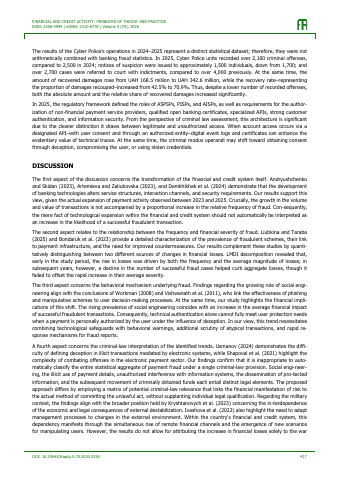
- Cyber Police recovered damages rose from UAH 168.5 million to UAH 342.6 million, with the recovery rate up from 42.5% to 70.9%.p.7
Key insights
- A decline in the number of fraud incidents may coincide with a rise in average loss, worsening the aggregate impact.p.2
- Frequency risk relative to payment activity is declining while severity in monetary terms continues to rise.p.6
- Social engineering's share of losses represents a 37-percentage-point increase over the four-year period.p.6
- Cyber Police recorded over 2,100 criminal offenses in 2025, compared to 2,500 in 2024.p.7
- The 2025 open banking framework defined the roles of ASPSPs, PISPs and AISPs and required strong customer authentication.p.7
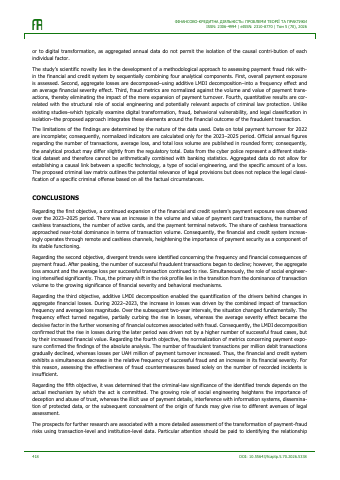
- Annual data do not permit isolating the causal contribution of each individual factor.p.8
Pages
 p.1
 p.2
 p.3
 p.4
 p.5
 p.6
 p.7
 p.8
 p.9
 p.10
Topics and entities
Summary and figures generated from the document and checked automatically: every number shown appears on the cited page. Publishers can request removal.