Digital Financial Inclusion and Youth Entrepreneurship: The Role of Fintech Innovation in Employment Creation and Economic Development, A Comparative Study of Germany and Italy (Global Journal of Multidisciplinary Academic Research)
SaveSummary
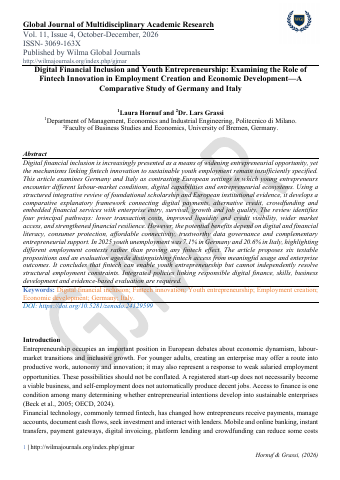
- In 2025 youth unemployment was 7.1% in Germany and 20.6% in Italy, showing different employment contexts.p.1
- The review identifies four pathways: lower transaction costs, improved liquidity and credit visibility, wider market access, and strengthened financial resilience.p.1
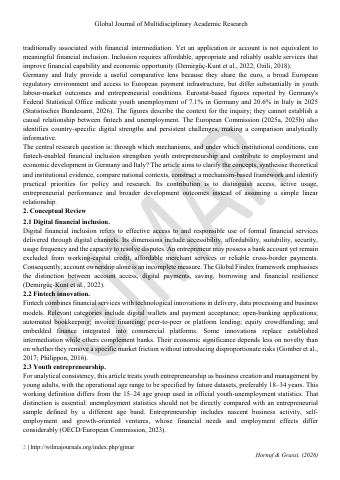
- The youth unemployment figures describe context and cannot establish a causal relationship between fintech and unemployment.p.2
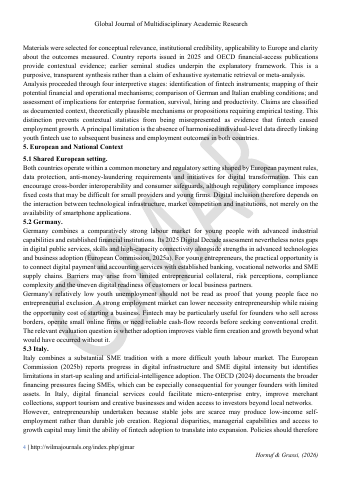
- A principal limitation is the absence of harmonised individual-level data linking youth fintech use to later business and employment outcomes.p.4
- Employment creation should be assessed on net rather than gross jobs, including survival, earnings and job security.p.3
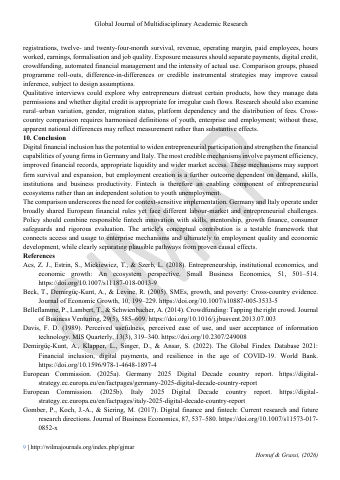
- Fintech is an enabling component of entrepreneurial ecosystems rather than an independent solution to youth unemployment.p.9
Key insights
- Germany and Italy share the euro and European regulation but differ substantially in youth labour-market outcomes and entrepreneurial conditions.p.2
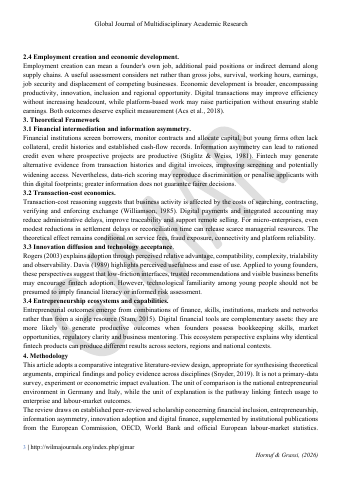
- Young firms often lack collateral and credit histories, and fintech may use transaction histories and digital invoices to widen access.p.3
- Data-rich credit scoring may reproduce discrimination or penalise applicants with thin digital footprints.p.3
- Digital payments can improve cash-flow predictability, but merchants may face chargebacks, cybersecurity threats and cumulative fees.p.5
- Germany's policy challenge may emphasise innovation finance and scaling, while Italy's may emphasise broad-based entrepreneurial capability and regional access.p.5
- Financial education should be integrated with practical entrepreneurship training linked to real business decisions.p.7
- Policy should match fintech instruments to business models rather than offer generic digital-finance incentives to all young entrepreneurs.p.8
Pages
 p.1
 p.2
 p.3
 p.4
 p.5
 p.6
 p.7
 p.8
 p.9
 p.10
Funders mentioned
Topics and entities
Summary and figures generated from the document and checked automatically: every number shown appears on the cited page. Publishers can request removal.