Crowd-funding and Alternative Finance for African Development Projects: Implications for Regional Integration
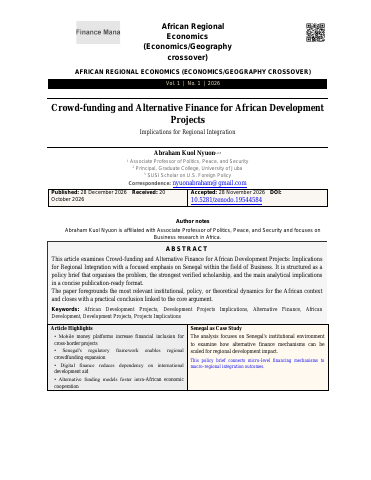
Mobile money platforms increase financial inclusion for cross-border development projects in Africa.
82 documents
Mobile money platforms increase financial inclusion for cross-border development projects in Africa.
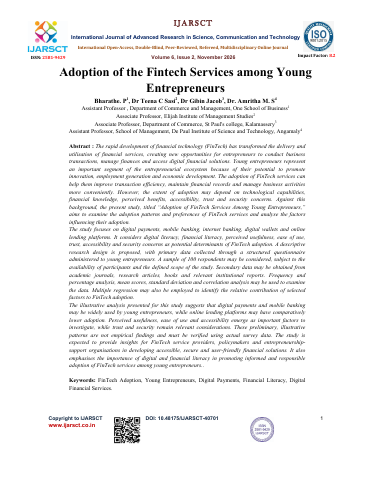
Digital wallets are used by 54% of respondents, and online lending platforms show an adoption rate of 28%.
High costs of credit, lack of collateral, and elevated agricultural risks restrict small and medium producers from accessing capital for modernization.
Asset tokenization serves as a digital financing mechanism converting real asset rights into blockchain-based tokens (page 2).
SWIFT diffusion among nearly 7,000 banks demonstrated that profitability benefits materialized only after several years of adoption.
Islamic crowdfunding currently accounts for only 3-5% of total FinTech funding in the Arab Gulf region.
During the period from February to March 2024, Satgas PASTI identified 537 illegal online lending entities operating through unofficial websites and mobile applications.
Investors submitting funding requests during crowdfunding campaigns are entitled to a 48-hour withdrawal period under Communiqué III-35/A.2.
A PRISMA 2020-guided Systematic Literature Review screened 312 initial records down to 38 verified sources across five academic databases and regulatory repositories.
As of August 2025, Indonesia recorded approximately 17.6 million Single Investor Identification (SID) accounts in its capital market.
India's MSMEs generate 31.1% of GDP and 48.58% of exports, yet face an addressable credit gap of roughly ₹30 lakh crore.
The share of innovative products in Ukraine's total output does not exceed 2%, compared to 85% in the US, 75% in Japan, and 55% in Germany.
OJK Regulation Number 17 of 2025 entered into force on 25 July 2025, revoking OJK Regulation 57/POJK.04/2020 as amended by Regulation 16/POJK.04/2021.
Institutional investors such as pension funds and insurance companies represent around 28% of assets under management in European private impact markets.
Outstanding P2P loans in Indonesia grew by 29.1% from Rp 59.64 trillion in December 2023 to Rp 77.02 trillion in December 2024.
Fintech investment in the Asia-Pacific region grew to almost US$3.5 billion in 2015, highlighting rapid digital transformation.
Global Sharia-compliant financial assets have expanded into an architecture with total assets exceeding US$3 trillion.
In Indonesia, Islamic Equity Crowdfunding (IEC) is governed by POJK No. 17 of 2025 and DSN-MUI Fatwa No. 140/DSN-MUI/VIII/2021.
Fintech activity in Indonesia is highly geographically skewed, with approximately 89% concentrated in the Java–Bali region and only 11% distributed across other regions.
Satgas PASTI stopped 242 illegal investment entity offers between January and August 2026.
A bibliometric and integrative review analyzed 256 documents indexed in Scopus and Web of Science published up to July 2024.
The research analyzes digital green bonds and ESG-linked platforms through 3 theoretical lenses: financial inclusion theory, institutional innovation theory, and sustainability transition framework.
The study analyzes Shariah governance challenges facing non-bank Islamic financial technology platforms operating outside standard banking regulatory oversight.
The national FinTech ecosystem reached 1,200 companies with daily transactions of USD 890 million or around Rp 14 trillion, growing 62% year-on-year per May 2025.
A total of 3,691 documents indexed in the Web of Science database between 1989 and 2025 were analyzed to evaluate academic output in FinTech.
The study gathered data on 1,274 active Latin American startups after excluding 533 inactive companies.
As of June 30, 2021, equity crowdfunding activities in Malaysia had raised RM294.21 million through 214 successful campaigns involving 203 issuers.
An estimated 49.4% of new businesses close within their first five years, with financial strain and capital shortages accounting for 38% of venture failures.
In 2024, MSMEs constituted a vital component of Malaysia's economy, accounting for 39.5% of GDP and 48.7% of total employment.
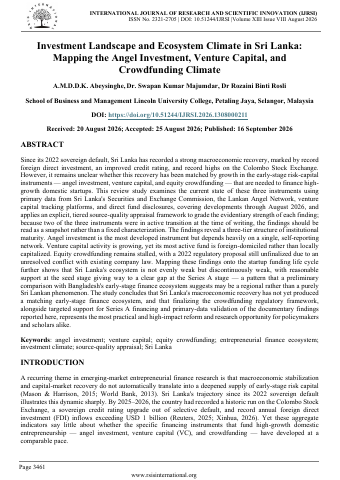
Sri Lanka recorded record foreign direct investment inflows reaching $1.04–1.06 billion in 2025, up from $759 million in 2024, alongside stock market record highs.