An Analytical Study of Crowdfunding as an Alternative Source of Finance for Startups (Zenodo (CERN European Organization for Nuclear Research))
Summary
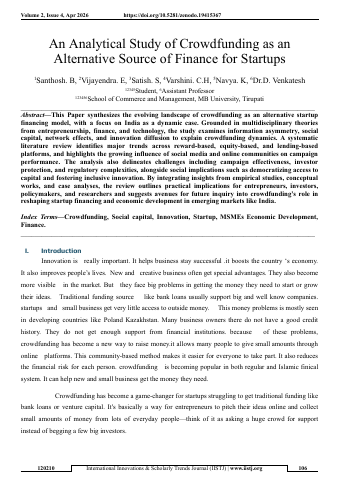
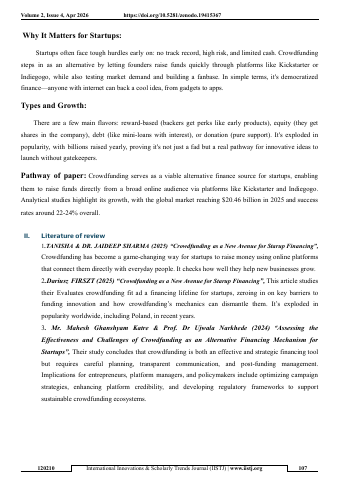
- The global crowdfunding market reached $20.46 billion in 2025, with overall platform success rates ranging between 22-24%.p.2
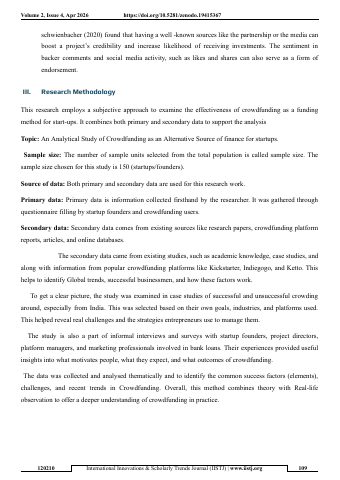
- The empirical study evaluated primary survey data collected from a sample size of 150 startup founders and crowdfunding users.p.4
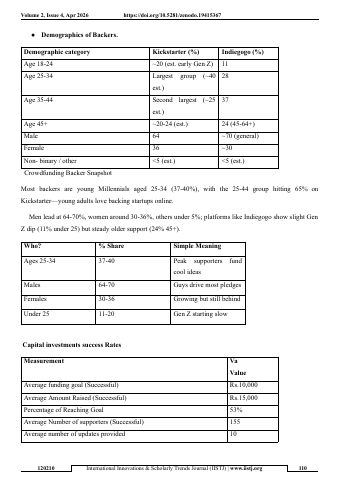
- Successful crowdfunding campaigns achieved an average goal completion rate of 53%, raising an average of Rs.15,000 against a target of Rs.10,000.p.5
- Successful campaigns attracted an average of 155 supporters and provided approximately 10 progress updates.p.5
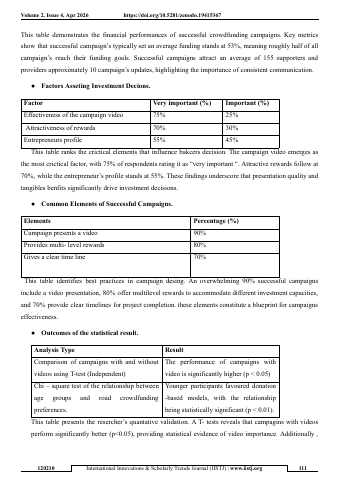
- Campaign video effectiveness was rated as very important by 75% of backers, with 90% of successful campaigns utilizing video content.p.6
- Offering multi-level rewards was featured in 80% of successful campaigns, while 70% provided clear project timelines.p.6
Key insights
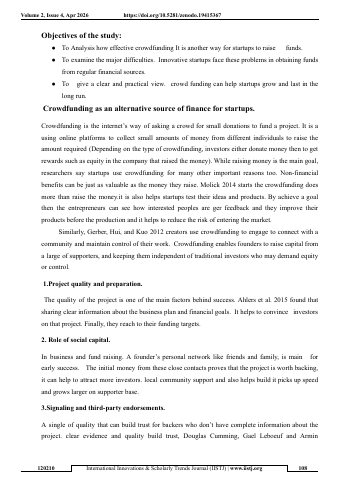
- Crowdfunding provides critical non-financial benefits including product testing, market demand validation, and community engagement.p.3
- Early pledges from a founder's personal network build momentum and serve as key credibility signals for external backers.p.3
- Supporters aged 25 to 44 account for 65% of the backer population on Kickstarter.p.5
- Male backers dominate participation levels across platforms, representing 64% on Kickstarter and ~70% on Indiegogo.p.5
- Reward attractiveness is rated as very important by 70% of backer respondents when choosing to fund projects.p.6
- Independent T-test analysis proves that campaigns incorporating video presentations perform significantly better (p < 0.05).p.6
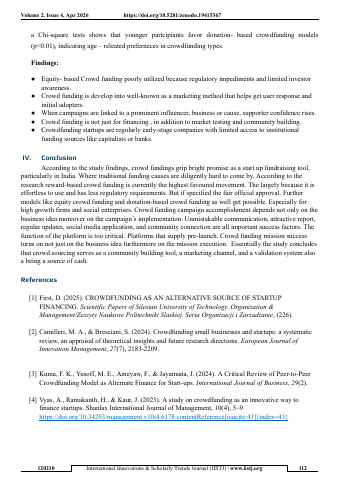
- Chi-square analysis reveals that younger age groups statistically prefer donation-based crowdfunding models (p < 0.01).p.7
- Equity-based crowdfunding remains underutilized in markets like India due to regulatory barriers and limited investor awareness.p.7
Pages
 p.1
 p.2
 p.3
 p.4
 p.5
 p.6
 p.7
 p.8
Topics and entities
Summary and figures generated from the document and checked automatically: every number shown appears on the cited page. Publishers can request removal.