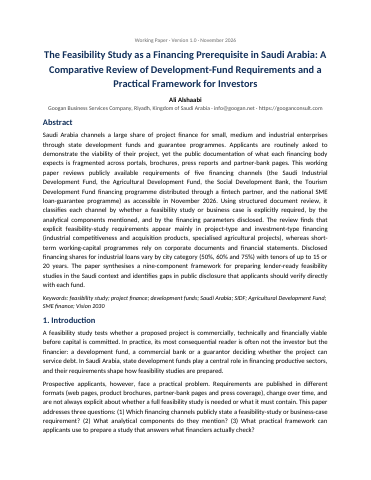
The Feasibility Study as a Financing Prerequisite in Saudi Arabia: A Comparative Review of Development-Fund Requirements and a Practical Framework for Investors (Zenodo (CERN European Organization for Nuclear Research))
Summary
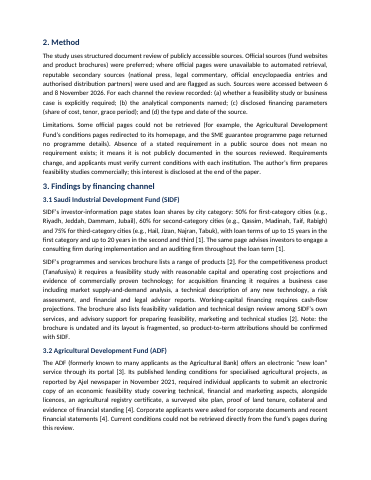
- The Saudi Industrial Development Fund (SIDF) provides loan shares of 50%, 60%, and 75% based on city category, with loan tenors reaching up to 15 to 20 years.p.2
- SIDF mandates a feasibility study for its competitiveness product (Tanafusiya) and a full business case for acquisition financing.p.2
- The Agricultural Development Fund (ADF) required individual applicants for specialised projects to submit an economic feasibility study covering technical, financial, and marketing aspects.p.2
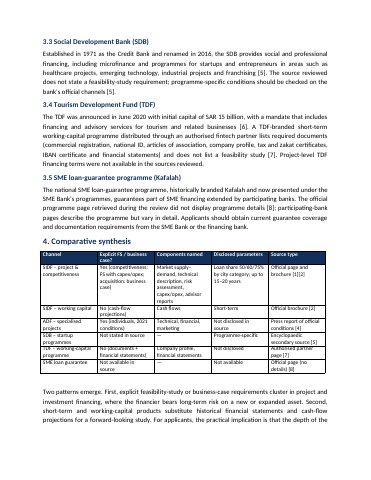
- The Tourism Development Fund (TDF) was established in June 2020 with an initial capital of SAR 15 billion.p.3
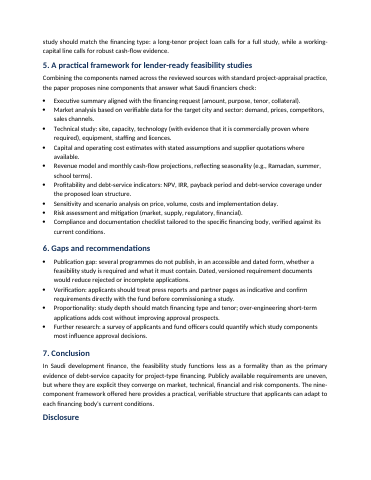
- A nine-component framework is synthesised to help project applicants address the technical, market, financial, and risk dimensions assessed by Saudi development financiers.p.4
Key insights
- Explicit feasibility-study requirements in Saudi Arabia primarily cluster in project and investment financing where financiers bear long-term asset risk.p.3
- SIDF finances 50% of project costs in first-category cities, 60% in second-category cities, and 75% in third-category cities.p.2
- Industrial loan repayment terms reach up to 15 years in first-category cities and up to 20 years in second- and third-category cities.p.2
- Short-term working-capital programmes substitute full forward-looking feasibility studies with historical financial statements and cash-flow projections.p.3
- The Social Development Bank, established in 1971 as the Credit Bank and renamed in 2016, provides microfinance and startup programmes for emerging sectors.p.3
- Several public financing channels present a publication gap where detailed feasibility requirements are not publicly accessible in dated formats.p.4
Pages
 p.1
 p.2
 p.3
 p.4
 p.5
Topics and entities
Summary and figures generated from the document and checked automatically: every number shown appears on the cited page. Publishers can request removal.