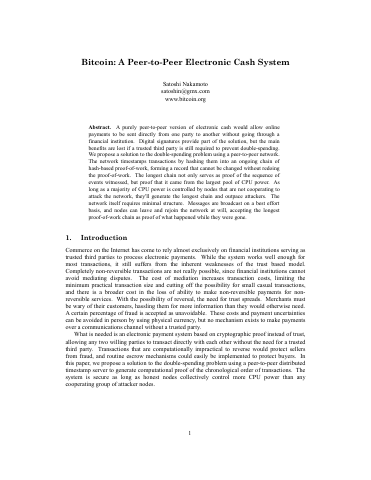
Bitcoin: A Peer-to-Peer Electronic Cash System
A block header without any transactions requires approximately 80 bytes of storage.
Product · 35 documents
A block header without any transactions requires approximately 80 bytes of storage.
The DRL-PPO strategy generated an annualized return of 37.22% under a 0.1% transaction cost constraint.
Financial fraud imposes estimated annual global losses exceeding $5.1 trillion, while digital payment fraud grows at over 30% per year.
The study conducts a structured review of literature spanning from 2018 to 2025 to synthesize how behavioral and contextual factors influence cryptocurrency payment adoption in African economies.
Under the EU Markets in Crypto-Assets Regulation (MiCAR), supplementary sustainability reporting is triggered when annual energy consumption exceeds 500,000 kWh per year.
The empirical analysis examines 26 FOMC rate-change announcements from 2017 through 2024, comprising 18 rate hikes and 8 rate cuts.
The paper investigates the dynamic relationships between headline inflation, official naira/US-dollar exchange rate, and returns of five cryptocurrencies using a seven-variable structural vector autoregressive (SVAR) model.
Virtual currency crimes in China reached a scale of RMB 430.7 billion in 2023.
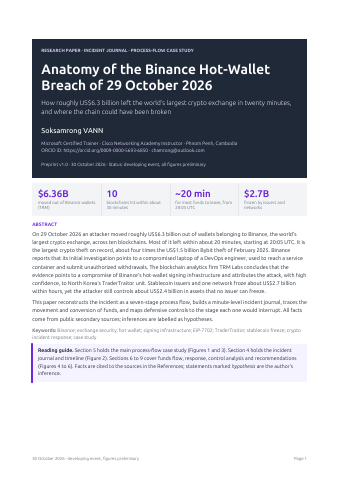
An attacker moved roughly US$6.3 billion out of Binance wallets across ten blockchains, with most funds leaving within about 20 minutes starting at 20:05 UTC on 29 October 2026.
The Elliptic benchmark dataset contains roughly 204 thousand Bitcoin transactions linked by about 234 thousand payment-flow edges across 49 time steps.
The dataset used for fraud recognition research contains 50,000 samples, consisting of 47,573 normal transactions, 2,423 fraudulent transactions, and four unlabeled samples.
The experimental results show that the proposed K-Means clustering model achieved a classification accuracy of 98.07% and an F1-score of 98.08%.
More than 10.000 types of cryptocurrencies exist worldwide, with Bitcoin being the most widely recognized and capitalized digital asset.
The study collected and analyzed data from 407 respondents using multiple linear regression in R via the Kaggle platform to examine blockchain-integrated digital payment systems.
Turkey ranks 3’üncü globally in crypto asset ownership according to industry data cited in the article.
The dataset includes 1,095 daily observations per cryptocurrency, generating a total of 6,570 observations for analysis in EViews.
The study examines Twitter and Telegram data between July 19, 2023, and July 19, 2024, to evaluate social media sentiment impacts on Bitcoin, Ether, and Binance returns.
The paper introduces a permissionless asynchronous lending protocol offering fixed-rate, fixed-duration loans with mathematical performance guarantees [p.1].
The paper synthesizes cryptocurrency literature using a curated reference base of 84 scholarly and foundational sources.
The paper demonstrates that real-world asset tokenization gives birth to a third category of standardized asset market beyond stock and futures markets (page 2).
The study analyzes weak-form efficiency across 8,970 assets and 690 weekly cross-sections from 2013 to 2026, evaluating mobility across market capitalisation deciles.
Predicting cryptocurrency return levels out-of-sample is highly challenging, with every model producing a negative out-of-sample R², where Random Forest performs best at -0.29% and OLS records -1.28%.
Primary microdata was collected from 1,653 university students to evaluate the determinants of Generation Z financial literacy across Spain and Ecuador.
Retail banking delivered an annual return of 15.83 percent compared to minus 23.18 percent for FinTech disruptors.
Digital payment transactions in the European Union increased from 4.8% of total transactions in 2007 to 73.3% in 2014.
Bitcoin's rolling three-month volatility averaged around 38% after US spot ETFs launched in January 2024, compared to close to 60% before 2024.
In 2024, Bitcoin rose 123% to an all-time high of over $108,000, propelled by spot Bitcoin ETFs in the U.S. gathering more than $35 billion in assets.
Only 39% of financial advisors believe a spot bitcoin ETF will be approved in 2024, compared to Bloomberg ETF analysts who estimate a 90% chance of a January approval.
Total crypto asset market capitalization peaked at around $3 trillion in November 2021 before falling below $1 trillion.
The IMF mandate is governed by the central banks and finance ministries of 190 member countries.
Fifteen percent of advisors reported allocating to crypto in client accounts in the 2023 survey, compared to 16% in the previous year.
The global payment system is estimated to consume 47.3 TWh of energy annually, accounting for roughly 0.2 percent of total global electricity consumption.
Globally, the scale of crypto assets remains relatively small at $2–$3 trillion, or about 1 percent of total market value of financial assets.
Bitcoin block rewards fell from 12.5 Bitcoins to 6.25 Bitcoins in May 2020.
E-money and i-money represent new forms of digital money competing directly with traditional cash and bank deposits.