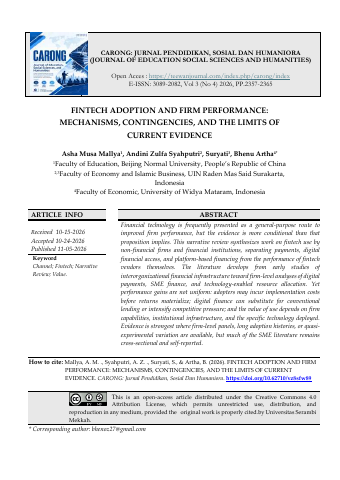
Analysis of Fintech Application Utilization on Financial Inclusion: A Literature Review
Indonesia's 2024 National Survey on Financial Literacy and Inclusion reported a 75.02% financial inclusion index.
Research index · 685 documents · Website
Indonesia's 2024 National Survey on Financial Literacy and Inclusion reported a 75.02% financial inclusion index.
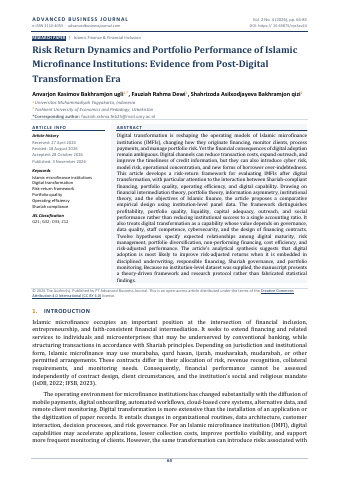
The research article published in Vol. 2 No. 4 (2026) develops a theoretical risk-return framework to evaluate Islamic microfinance institutions in the post-digital transformation era.
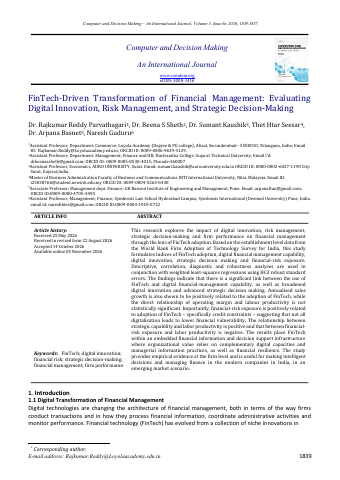
The World Bank Firm Adoption of Technology Survey analytical dataset for India comprises 1,519 establishments and 987 variables.
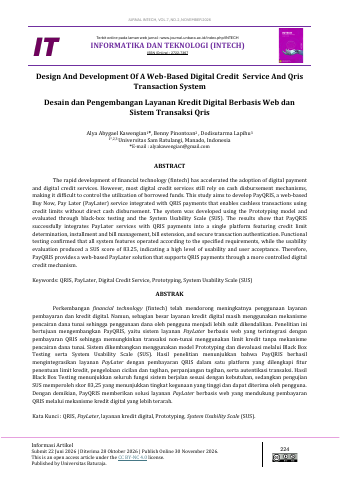
The PayQRIS system achieved a System Usability Scale (SUS) score of 83.25, indicating high usability.
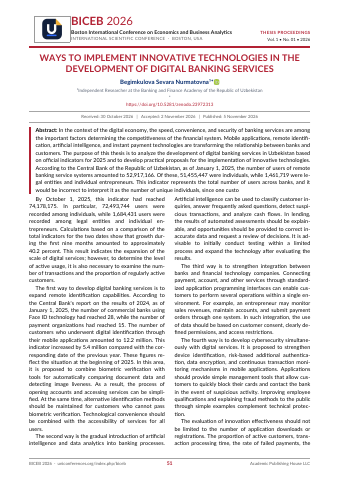
As of January 1, 2025, the total number of users of remote banking service systems in Uzbekistan reached 52,917,166, comprising 51,455,447 individuals and 1,461,719 legal entities and individual entrepreneurs.
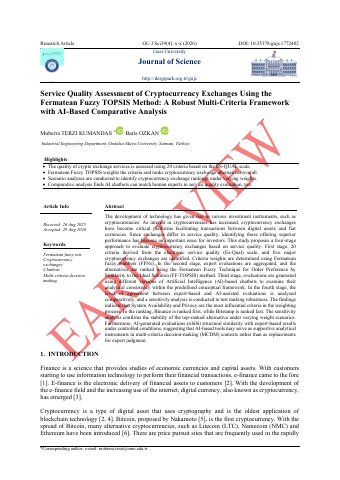
The study evaluates cryptocurrency exchange service quality across 20 sub-criteria derived from 4 main dimensions of the ES-QUAL scale.
SWIFT diffusion among nearly 7,000 banks demonstrated that profitability benefits materialized only after several years of adoption.
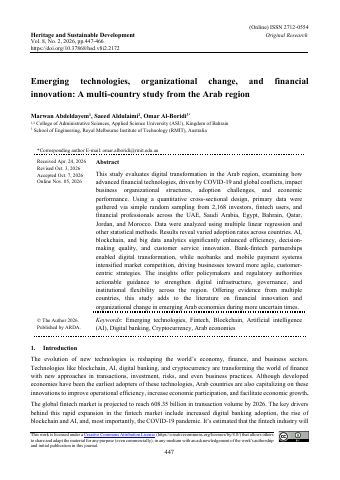
Primary data was gathered from 2,168 investors, fintech users, and financial professionals across seven Arab countries to evaluate regional digital transformation.
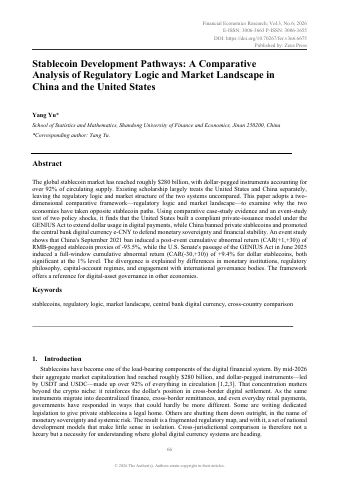
By mid-2026, the aggregate global stablecoin market capitalization reached roughly $280 billion, with dollar-pegged instruments comprising over 92% of circulating supply.
Smallholders cultivating less than 2 hectares make up the majority of the rural agricultural workforce in India.
A study recorded 3,069 fintechs in Latin America and the Caribbean at the end of 2023, up from 703 in 2017.
Title V of Regulation (EU) 2023/1114 governs crypto-asset service providers across all Member States starting from 20 December 2024.
The study evaluates a balanced panel of 6 digital banks listed on the Indonesia Stock Exchange covering 108 quarterly observations from 2021Q4 to 2026Q1.
The research paper published in Volume 15, Number 1 examines the core digital technologies revolutionising global investment management.
The study evaluated fifty (50) clients with active loan accounts in Gubat, Sorsogon to assess the impact of credit institution digitalization on client behavior.
The study evaluates the impact of deploying artificial intelligence techniques to predict financial and administrative risks at the International Development Bank for Investment and Finance over the period 2015–2024.
In the first quarter of 2026, Uzbekistan had 176 audit firms and 1,337 certified auditors, reflecting year-on-year increases of 10 per cent and 9 per cent, respectively.
The study integrated the Ethereum Fraud Detection Dataset containing 9,841 transactions and 51 attributes with digital waqf system behavioral data.
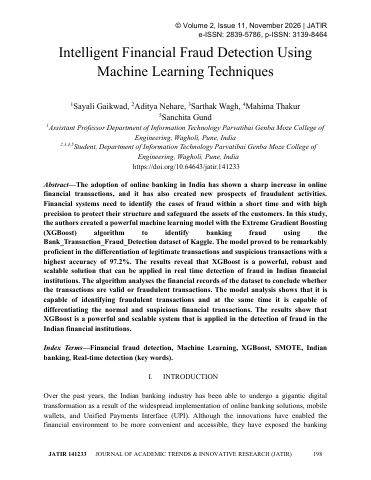
The proposed Extreme Gradient Boosting (XGBoost) model achieved a highest accuracy of 97.2% in differentiating legitimate and suspicious banking transactions.
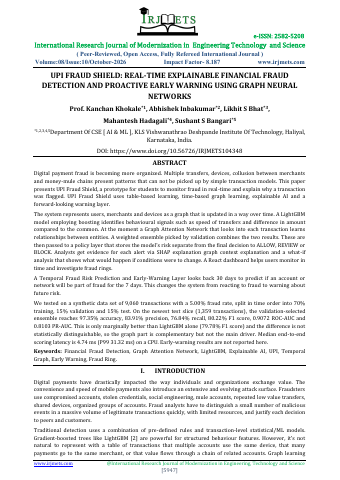
UPI Fraud Shield is a prototype designed to monitor digital payment fraud in real time using tabular learning, graph neural networks, explainable AI, and an early-warning layer.
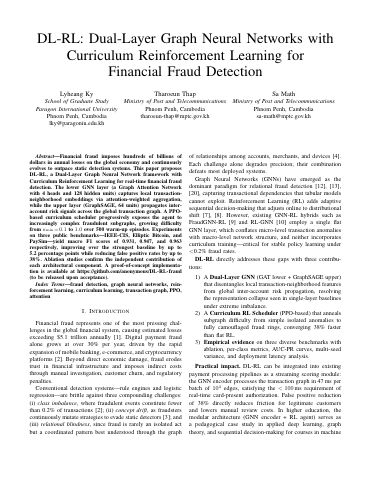
Financial fraud imposes estimated annual global losses exceeding $5.1 trillion, while digital payment fraud grows at over 30% per year.
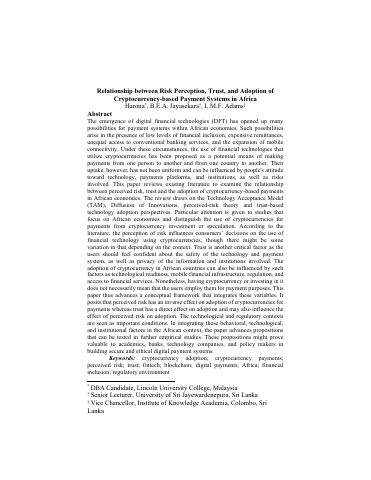
The study conducts a structured review of literature spanning from 2018 to 2025 to synthesize how behavioral and contextual factors influence cryptocurrency payment adoption in African economies.
The study draws on a high-frequency analytic panel of 2.52 million block-level observations across two matched 5 bp ETH–USDC pools on Ethereum and Base.
The empirical study surveyed 256 corporate employees in Bengaluru to examine how trust in generative AI shapes financial decision-making.
The Non-Compensatory Multimetric Framework (NCMF) is validated on 2 real technology initiatives of a leading insurance group [p.1].
The study analyzed data from a questionnaire distributed to 250 employees of commercial banks to evaluate the impact of financial information systems on financial sustainability.
O’mari Zimbabwe was launched in 2023 by Old Mutual Zimbabwe through Old Mutual Digital Services as an interoperable digital financial platform.
Internet penetration in Africa rose from 28% in 2019 to over 44% in 2024, while mobile money users surpassed 700 million.
By end-2025, the global stablecoin market grew from approximately $25 billion in 2020 to over $300 billion.
The study selected a sample of 86 respondents from a target population of 109 employees at Equity Bank Rwanda Plc, achieving a response rate of 98.8%.