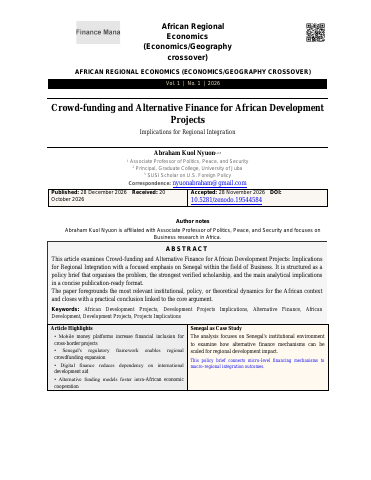
Crowd-funding and Alternative Finance for African Development Projects: Implications for Regional Integration
Mobile money platforms increase financial inclusion for cross-border development projects in Africa.
39 documents
Mobile money platforms increase financial inclusion for cross-border development projects in Africa.
The Saudi Industrial Development Fund (SIDF) provides loan shares of 50%, 60%, and 75% based on city category, with loan tenors reaching up to 15 to 20 years.
China's low-altitude economy market reached 505.95 billion yuan in 2023 and expanded to 670.25 billion yuan in 2024, with projections of 1.5 trillion yuan in 2025 and over 3.5 trillion yuan by 2035.
Official lending rates across the Caribbean range from 5% to 15%, with public debt burdens exceeding 100% of GDP in several states.
The research analyzes cross-border Real-World Asset (RWA) financing structures originating in Mainland China and issued via a Special Purpose Vehicle (SPV) in Hong Kong.
Global climate finance reached approximately USD 1.46 trillion in 2022 according to Climate Policy Initiative estimates.
By the end of 2025, Vietnamese investors held 1,991 valid overseas investment projects across 85 countries and territories, with cumulative registered capital exceeding US$23.7 billion.
An initial database search yielded 198 records concerning renewable energy financing in Sub-Saharan Africa.
China committed over $1.3 trillion in development finance to the Global South between 2000 and 2021.
In 2023, roughly 666 million people lived without access to electricity, with 85 percent of them located in Sub-Saharan Africa.
Indonesian bank lending grew by 10.39% year-on-year to IDR 7,827 trillion as of December 2024, while maintaining a gross non-performing loan ratio of 2.08%.
OpenAI disclosed $122 billion in committed financing at an $852 billion post-money valuation in March 2026.
SECA represents the Swiss private equity, venture capital, and corporate finance industries with a base of more than 550 members.
The EU requires an additional €750–800 billion per year for the green and digital transitions, energy security, and modern infrastructure.
Europe faces €750–800 billion in additional annual investment needed according to the Draghi report.
Clean-energy investment needs are predicted to rise by around 40% by 2030 from current levels.
The empirical research dataset evaluates green bond activity across 46 countries for the period from 2000 to 2025.
The Ukraine Facility provides external financial support amounting to EUR 50 billion tied to obligations in the Ukraine Plan.
Data centers in the United States consumed approximately 176 TWh in 2023, representing 4.4 percent of national electricity consumption.
Vietnam's Law on Public-Private Partnerships 2020 defines 5 eligible sectors but omits specialized financial, digital data, and legal sandbox infrastructure.
Holding carbon dioxide removal at 9.5 GtCO₂ per year after 2183 in the FaIR ensemble returns median atmospheric CO₂ to 280 ppm in 2300.
Only 4 (21%) of reviewed jurisdictions are fully compliant with KA 6, while 8 (42%) are materially non-compliant.
The research analyzes digital green bonds and ESG-linked platforms through 3 theoretical lenses: financial inclusion theory, institutional innovation theory, and sustainability transition framework.
European insurers hold over EUR 10 trillion in assets, while Institutions for Occupational Retirement Provision (IORPs) manage roughly EUR 3 trillion.
Decentralized autonomous governments (GADs) in Ecuador are subject to debt limits where total public debt balance cannot exceed 200% of annual total revenues.
Introduced in December 2024 by Rob Murray, the Defence, Security and Resilience Bank (DSR Bank) is designed as a multilateral development bank with an initial capital of around €117 billion.
Europe requires an estimated additional annual investment of approximately €1.4 trillion, equivalent to around 7% of GDP, to finance its growth, digital, energy, defence, and transition goals.
The IEA and COP31 Presidency proposed a global ambition to raise electrification to 35% of final energy demand by 2035.
Copenhagen Infrastructure Partners manages 12 investment funds with total capital exceeding €30 billion from over 180 institutional investors worldwide.
An exploratory study based on 19 semi-structured interviews analyzes the financial instruments and stakeholder expectations surrounding Italian energy communities.