Responsible Credit-Line Increase: A Fairness-Aware, Explainable, and Governed Machine-Learning Framework for Socio-Technical Lending Systems (Research Square)
SaveSummary
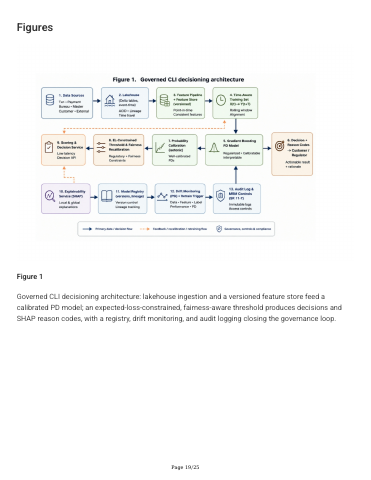
- The study formalizes proactive credit-line increases (CLI) as a constrained incremental-profit maximization problem governed by expected loss budgets and explicit fairness tolerances.p.2
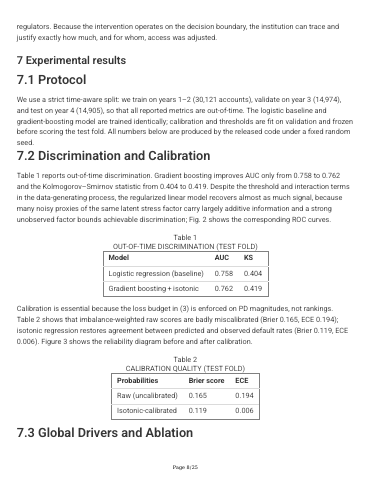
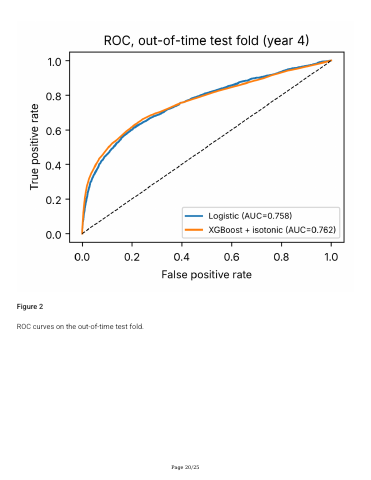
- Evaluated on a synthetic portfolio of 60,000 accounts, gradient boosting and a logistic baseline demonstrate nearly equal out-of-time discrimination with AUCs of 0.762 and 0.758, respectively.p.2
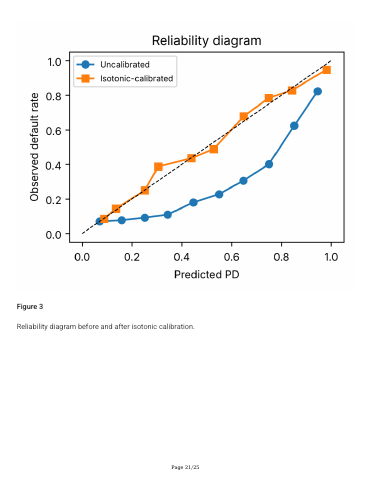
- Applying isotonic score calibration to raw boosted probabilities reduces the expected calibration error (ECE) from 0.194 to 0.006.p.2
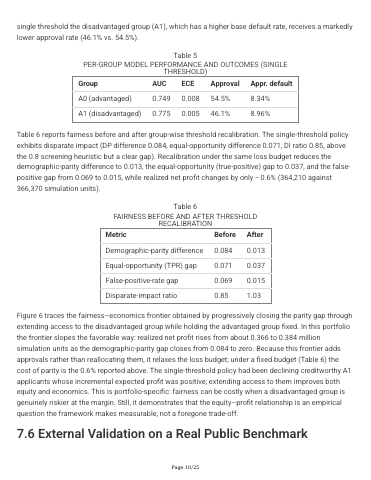
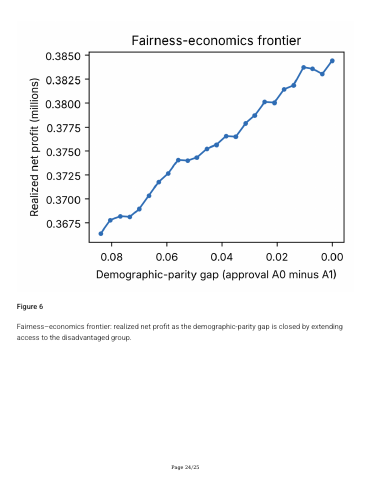
- While a single threshold creates a demographic-parity gap of 0.084 and a disparate-impact ratio of 0.85, group-wise threshold recalibration lowers the parity gap to 0.013 at a 0.6% cost in realized profit.p.2
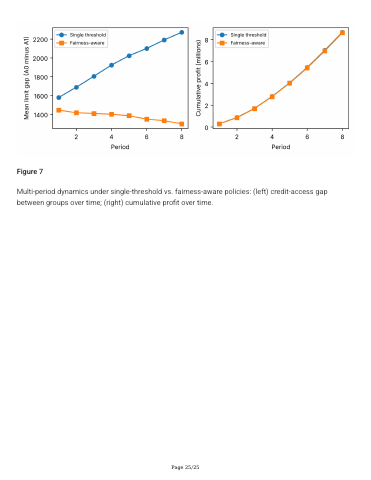
- Multi-period cohort simulations indicate that sustaining fairness over eight periods narrows the long-term credit-access gap between groups by 43% with a cumulative profit cost of 0.6%.p.2
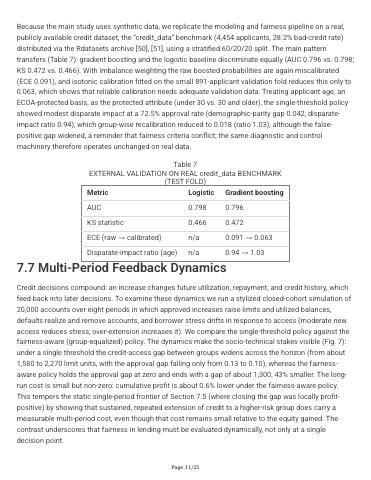
- External validation on the public 'credit_data' benchmark (4,454 applicants) confirms similar baseline-versus-boosting discrimination performance (AUC 0.798 vs 0.796).p.11
Key insights
- Gradient boosting marginally improves AUC over a simple logistic regression model (0.762 vs 0.758), indicating that advanced model complexity yields limited predictive gain over structured data with unobserved stress drivers.p.8
- Isotonic recalibration effectively aligns raw probability outputs with empirical default rates, lowering the Brier score from 0.165 to 0.119.p.8
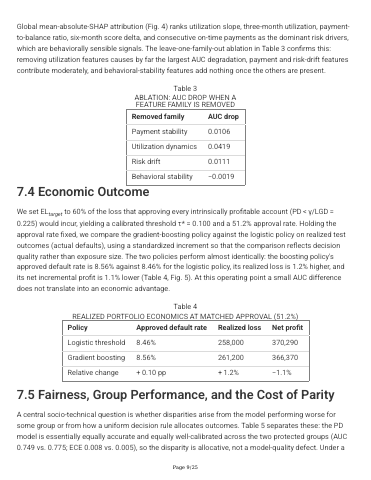
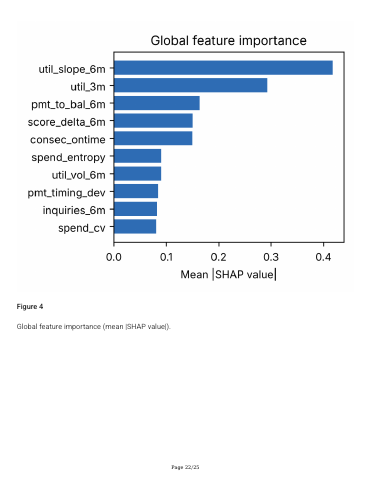
- Ablation tests show that utilization dynamics features cause the largest degradation in model AUC (0.0419) when removed, making them the primary risk drivers.p.9
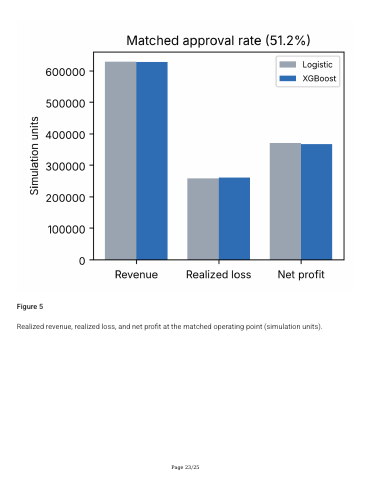
- At a fixed 51.2% approval rate, the gradient boosting model yields an approved default rate of 8.56% compared to 8.46% for logistic regression, demonstrating that small AUC gains do not necessarily yield economic advantages.p.9
- Closing the demographic parity gap by extending credit access to creditworthy individuals in a disadvantaged group increases realized net profit from 0.366 million to 0.384 million simulation units under unconstrained expansion.p.10
- A multi-period simulation reveals that single-threshold policies expand long-term credit gaps from 1,580 to 2,270 limit units across eight cycles.p.11
Pages
 p.1
 p.2
 p.3
 p.4
 p.5
 p.6
 p.7
 p.8
 p.9
 p.10
 p.11
 p.12
 p.13
 p.14
 p.15
 p.16
 p.17
 p.18
 p.19
 p.20
 p.21
 p.22
 p.23
 p.24
 p.25
Funders mentioned
Topics and entities
Summary and figures generated from the document and checked automatically: every number shown appears on the cited page. Publishers can request removal.