No Trail, No Trust? Digital Record Auditability and Lender Decision-Use in SME Finance: A Focused Critical Review and Evidence Mapping (Economics and Business Journal (ECBIS))
Summary
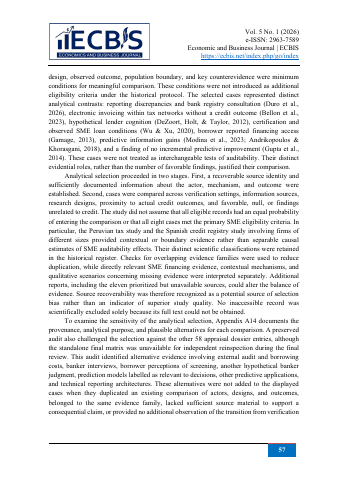
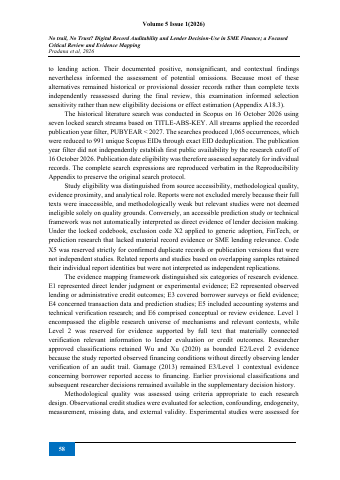
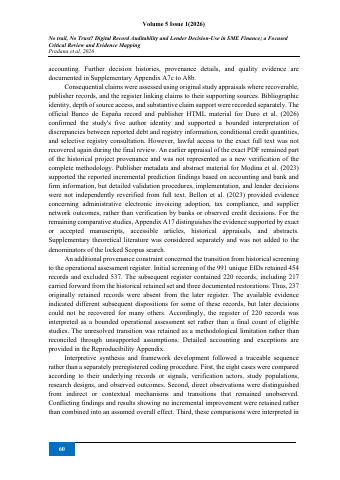
- The critical review assesses evidence on digital record auditability in SME lending, analyzing 8 maximum-contrast analytical cases out of an assessment register of 220 study records.p.9
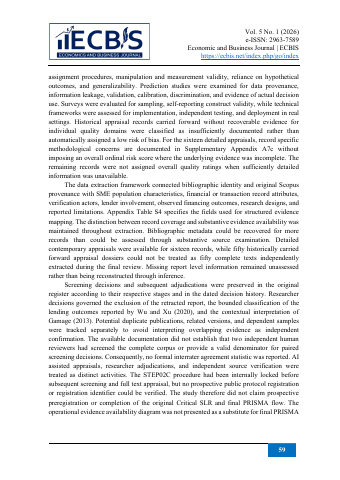
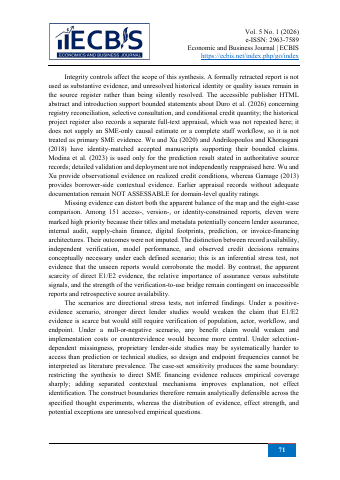
- Detailed design and domain-level quality appraisals were available for 16 records, while 151 reports were constrained by access, identity, or version barriers.p.9
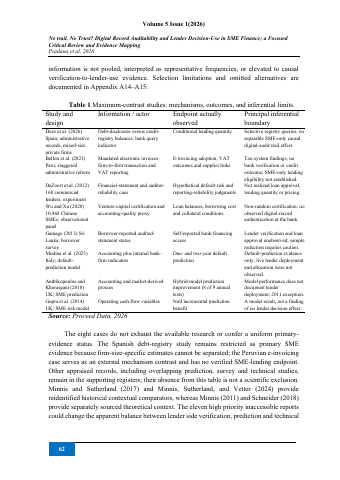
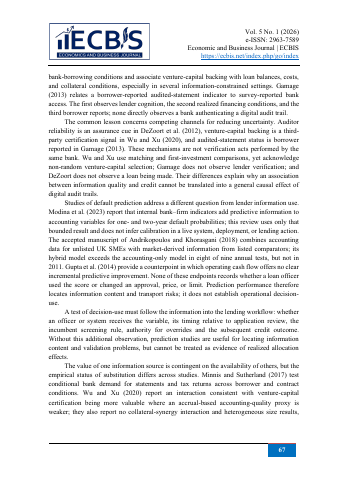
- Examined studies include an experimental evaluation of 168 commercial lenders' hypothetical risk judgments and an observational panel of 10,468 Chinese SMEs.p.10
- Prediction research shows hybrid models outperforming accounting-only default models in 8 of 9 annual tests, but fails to document actual lender deployment.p.10
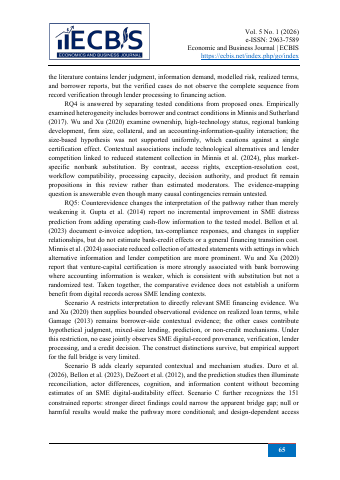
- Survey evidence on credit access includes a frame of 610 enterprises reduced to a logistic model sample of N=452 firms after removing 109 large enterprises.p.12
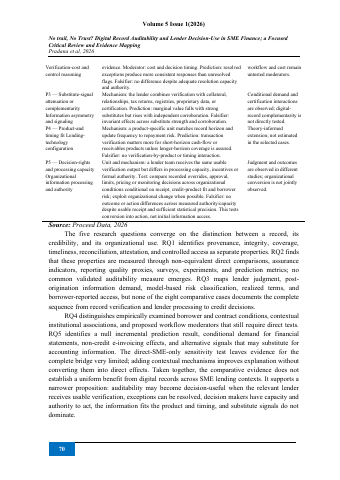
- The review formulates 5 falsifiable propositions (P1 to P5) covering access alignment, exception resolution, substitute signals, product fit, and decision rights.p.18
Key insights
- Digital record availability does not inherently demonstrate data credibility, verifiable auditability, or organizational deployment by SME lenders.p.1
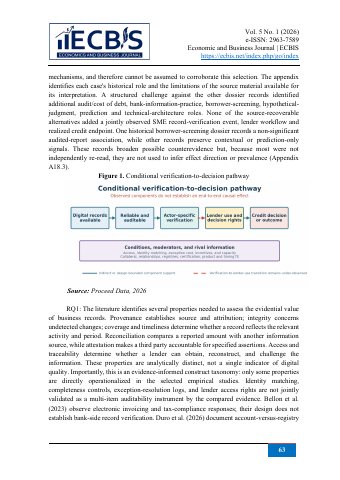
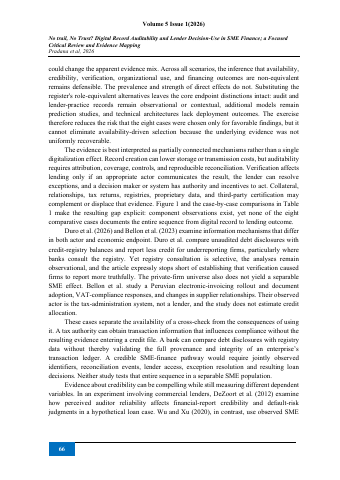
- No reviewed empirical study jointly observes the entire chain from digital record creation and third-party verification to workflow ingestion and credit allocation.p.4
- Registry cross-checks reveal reporting discrepancies and associate with conditional lending quantities, but do not isolate a causal digital audit trail effect specifically for SMEs.p.2
- Mandated electronic invoicing reforms demonstrate tax compliance and supply-chain adjustments without documenting bank verification or loan approval outcomes.p.2
- Auditor reliability cues alter hypothetical credit risk judgments in experimental settings without capturing realized lending volumes or contract pricing.p.10
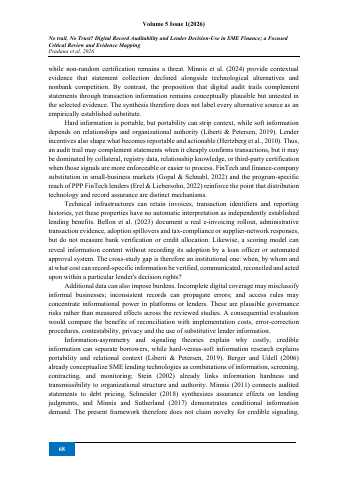
- Third-party certification such as venture capital backing is associated with improved borrowing terms, potentially acting as a substitute for weaker accounting quality rather than direct digital record authentication.p.3
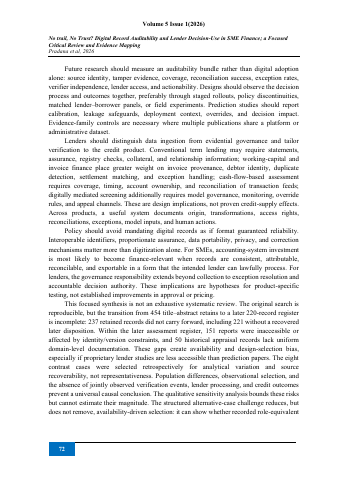
- Default prediction accuracy indicates statistical information content rather than live underwriting adoption, limit setting, or loan pricing adjustments.p.3
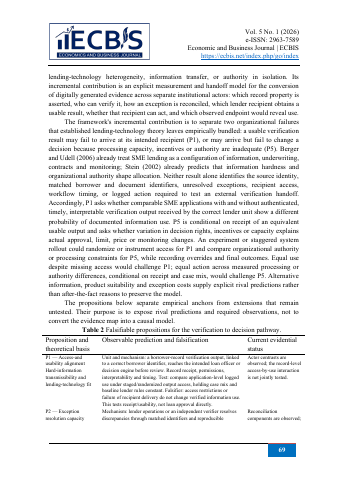
- Organizational friction, lack of processing capacity, and misaligned decision rights can prevent verified information from translating into credit decisions.p.17
Pages
 p.1
 p.2
 p.3
 p.4
 p.5
 p.6
 p.7
 p.8
 p.9
 p.10
 p.11
 p.12
 p.13
 p.14
 p.15
 p.16
 p.17
 p.18
 p.19
 p.20
 p.21
 p.22
 p.23
 p.24
Topics and entities
Summary and figures generated from the document and checked automatically: every number shown appears on the cited page. Publishers can request removal.