Enhancing the Practice of Lending to the Real Sector by Commercial Banks: Evidence and Improvement Pathways from Uzbekistan (American Journal of Economics and Business Management)
SaveSummary
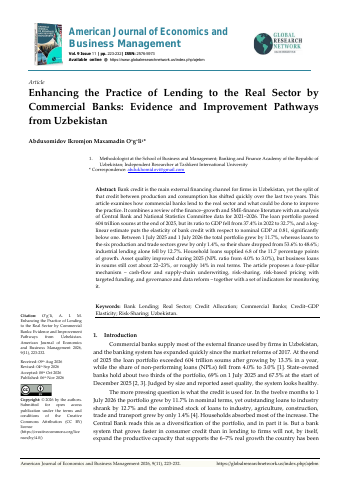
- The total bank loan portfolio in Uzbekistan exceeded 604 trillion soums at the end of 2025, but the credit-to-GDP ratio declined from 37.4% in 2022 to 32.7% in 2025.p.1
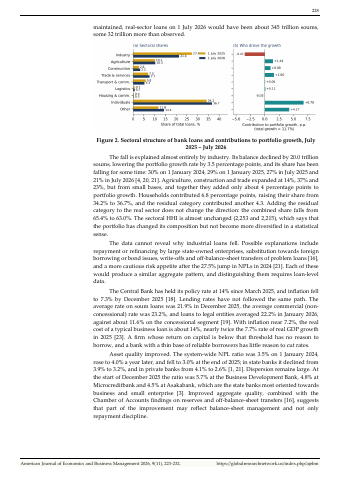
- Between 1 July 2025 and 1 July 2026, the total portfolio expanded by 11.7%, whereas outstanding loans to six real-sector categories grew by only 1.4%.p.1
- The share of real-sector lending in the total credit portfolio fell from 53.6% on 1 July 2025 to 48.6% on 1 July 2026.p.1
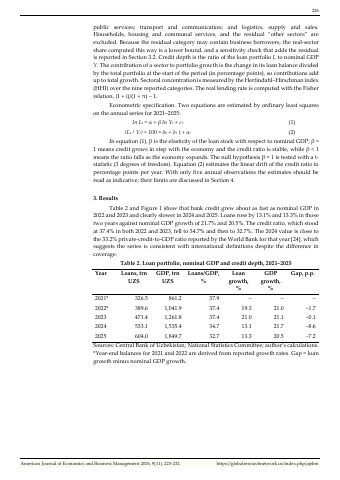
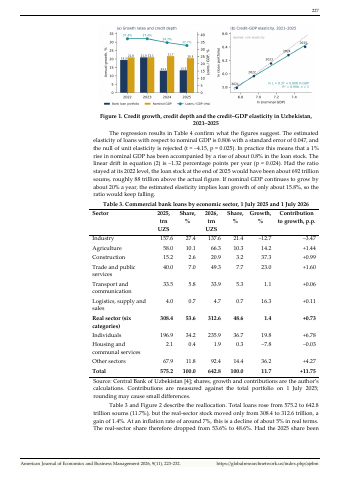
- The log-linear elasticity of bank credit relative to nominal GDP was estimated at 0.81 for 2021–2025, indicating that credit growth lagged nominal economic growth.p.1
- Although the system-wide non-performing loan ratio declined from 4.0% to 3.0% during 2025, business loans in soums carried average commercial interest rates of 22–23%.p.1
Key insights
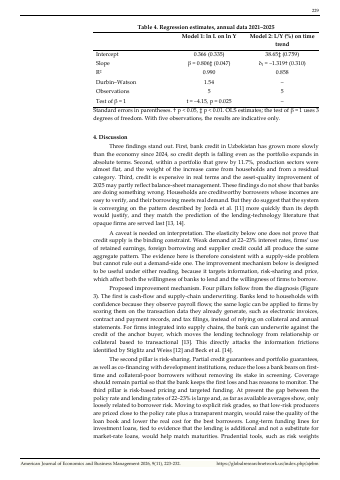
- Log-linear regression estimates indicate an elasticity of bank credit with respect to nominal GDP of 0.806, significantly below unit elasticity.p.5
- Outstanding bank loans to industry contracted by 20.0 trillion soums between 1 July 2025 and 1 July 2026.p.6
- The average real commercial cost of borrowing for businesses stood at approximately 14% in early 2026, exceeding real GDP growth of 7.7%.p.6
- State-owned banks accounted for 67.5% of total commercial bank lending in Uzbekistan as of December 2025.p.1
- System-wide non-performing loans dropped to 3.0% at year-end 2025, though state-owned business lenders reported higher rates up to 5.7%.p.6
Pages
 p.1
 p.2
 p.3
 p.4
 p.5
 p.6
 p.7
 p.8
 p.9
 p.10
Funders mentioned
Topics and entities
Summary and figures generated from the document and checked automatically: every number shown appears on the cited page. Publishers can request removal.