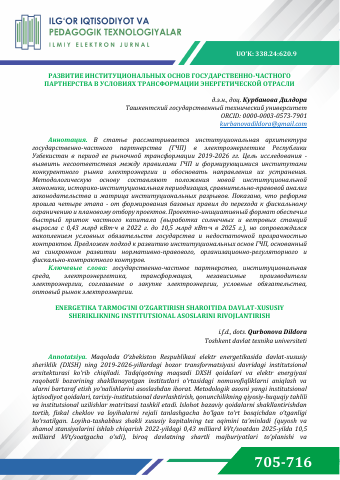
Development of Institutional Foundations of Public-Private Partnership in the Context of Energy Sector Transformation (Ilgʻor iqtisodiyot va pedagogik texnologiyalar.)
SaveSummary
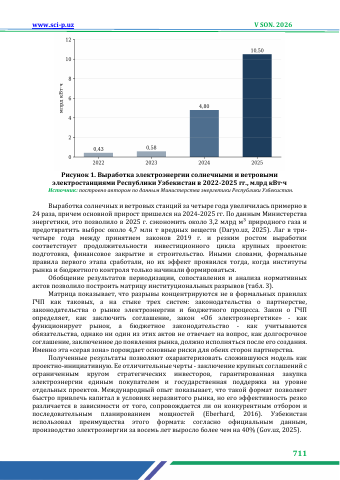
- Solar and wind power output in Uzbekistan grew rapidly from 0.43 billion kWh in 2022 to 10.5 billion kWh in 2025 under a project-initiative public-private partnership (PPP) model.p.1
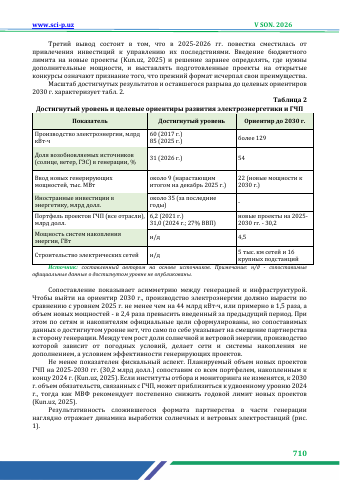
- Overall electricity production increased from 60 billion kWh in 2017 to 85 billion kWh in 2025, driven by about $35 billion in foreign investment.p.3
- The nationwide PPP project portfolio expanded from $6.2 billion in 2021 to $31 billion in 2024, reaching 27% of GDP.p.3
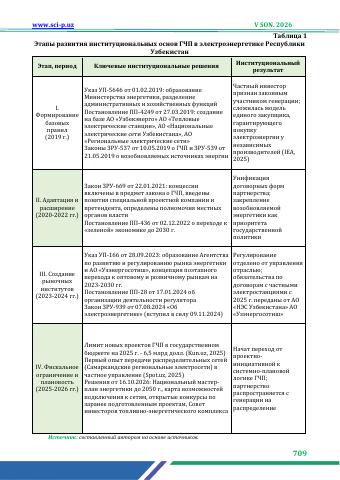
- A state budget ceiling of $6.5 billion for new PPP projects was introduced for 2025 to limit fiscal exposure and contingent liabilities.p.5
- Renewables accounted for an estimated 31% of total electricity generation in October 2026, targeting 54% by 2030.p.3
- Planned new PPP projects from 2025 to 2030 total $30.2 billion, matching the entire accumulated portfolio up to the end of 2024.p.6
- The country plans to expand overall generation by setting a 2030 target of more than 129 billion kWh alongside adding 22 thousand MW of new capacity.p.6
Key insights
- The rapid expansion of PPP projects in electricity generation created an institutional gap because early long-term contracts preceded the establishment of an independent market regulator and wholesale rules.p.4
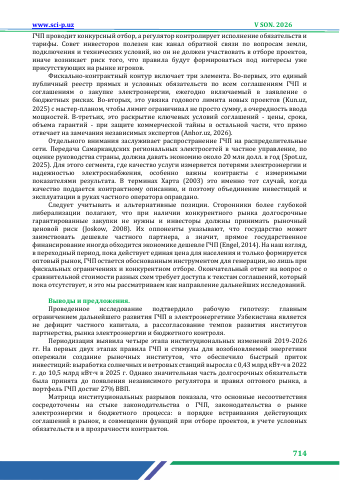
- Uzbekistan's energy PPP framework evolved through four main phases from basic rule creation in 2019 to fiscal capping and planned project selection in 2025–2026.p.5
- Solar and wind generation growth helped save about 3.2 billion m³ of natural gas and prevented roughly 4.7 million tons of harmful emissions in 2025.p.7
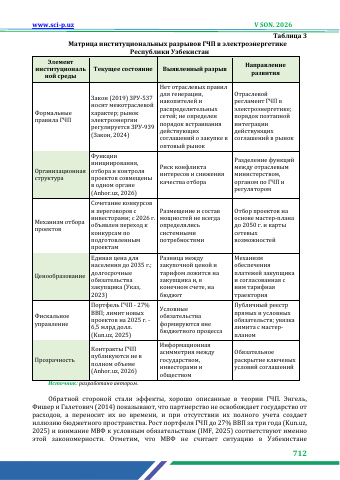
- Institutional risks stem from combining project initiation, selection, and monitoring within a single state body while contracts remain partially un-disclosed.p.8
- State guarantees requiring unified retail power prices for populations until 2035 create fiscal pressures by leaving off-take price differentials on the state buyer and budget.p.8
- The government is transitioning from an investor-led project-initiative model to a state-planned competitive framework based on a National Energy Master Plan to 2050.p.9
- Transferring regional distribution networks, such as Samarkand Regional Electric Networks, to private management is estimated by national leadership to yield about $20 million in annual savings.p.10
Pages
 p.1
 p.2
 p.3
 p.4
 p.5
 p.6
 p.7
 p.8
 p.9
 p.10
 p.11
 p.12
Funders mentioned
Topics and entities
Summary and figures generated from the document and checked automatically: every number shown appears on the cited page. Publishers can request removal.