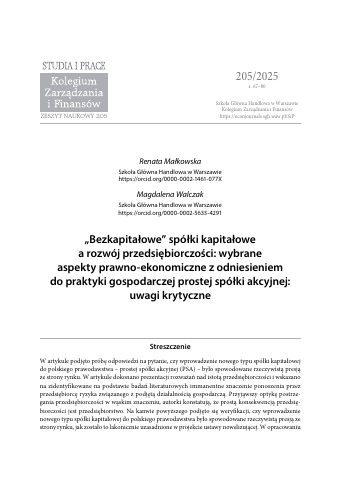
Capital-less Joint-Stock Companies and Entrepreneurship Development: Critical Remarks on the Simple Joint-Stock Company in Poland (Studia i Prace Kolegium Zarządzania i Finansów / Szkoła Główna Handlowa)
SaveLargest segment
614,8 thousand
Registered Limited Liability Companies (Sp. z o.o.) in Poland at end of 2024 p.10
Summary
- Before the reform, 73% of survey respondents expressed a need for a new company type for innovative activities, and 78,6% supported lowering capital requirements for the planned simplified company.p.9
- By the end of 2021, there were 393 simple joint-stock companies registered in the Polish REGON register.p.9
- The count of registered PSA companies in Poland grew to 1,3 thousand by the end of 2022 and reached 3 thousand by the end of 2024.p.9
- Compared to the 3 thousand PSAs registered by the end of 2024, traditional limited liability companies (Sp. z o.o.) totaled 614,8 thousand.p.10
- In Germany, the simplified UG form saw rapid adoption with 1202 entities created in its first two months in 2008 and 141 553 registered by 2018.p.11
Key insights
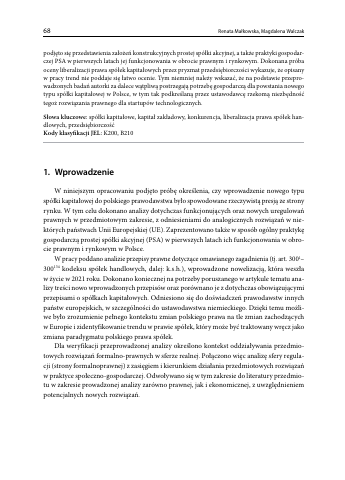
- The authors question whether market demand truly called for the introduction of the Simple Joint-Stock Company (PSA) in Poland, particularly for tech startups.p.2
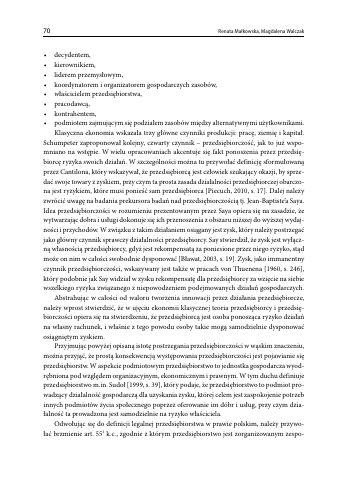
- Classic economic theory holds that an entrepreneur accepts business risks in exchange for the right to retain earned profits.p.4
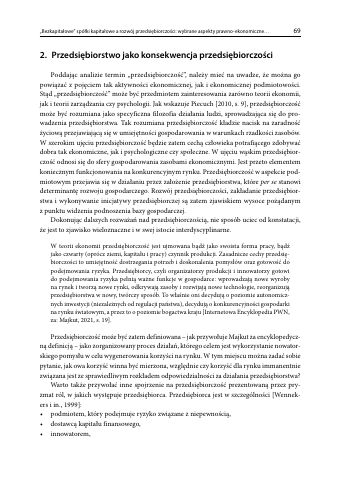
- Historically, minimum capital requirements for limited liability entities date back to the British Act of 1855 and the German Act of 1892.p.6
- Legal experts argued that private law frameworks were not the primary barrier to startup growth, pointing instead to administrative and tax uncertainties.p.7
- The PSA replaces traditional fixed initial capital with share capital and protects creditors through a six-month solvency test.p.8
- Zero liquidations of PSAs were recorded during the reported periods of 2022 and the first three quarters of 2023.p.9
- Scholars note that prominent startup hubs such as the US and Israel did not create special company legal types specifically for startups.p.11
- Critics caution that removing capital protection mechanisms in a PSA may transfer operational business risks away from founders onto creditors and counterparties.p.11
Pages
 p.1
 p.2
 p.3
 p.4
 p.5
 p.6
 p.7
 p.8
 p.9
 p.10
 p.11
 p.12
 p.13
 p.14
Topics and entities
Summary and figures generated from the document and checked automatically: every number shown appears on the cited page. Publishers can request removal.