Barriers, Risks, and Critical Success Factors of Digital Transformation Initiatives on Organisational Performance in the Nigerian Banking Industry (Zenodo)
SaveSummary
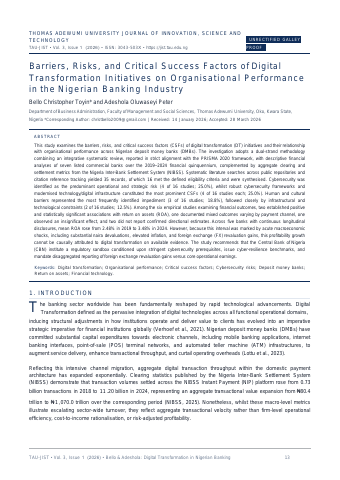
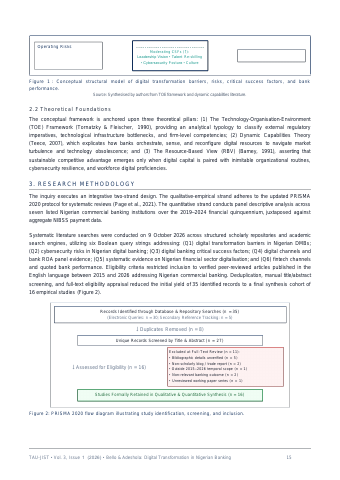
- The systematic synthesis evaluated 16 eligible empirical studies on digital transformation in Nigerian deposit money banks (DMBs) selected from an initial pool of 35 records.p.1
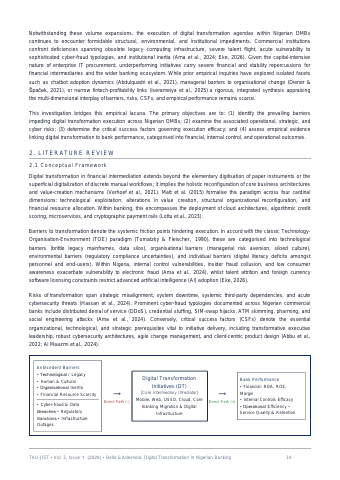
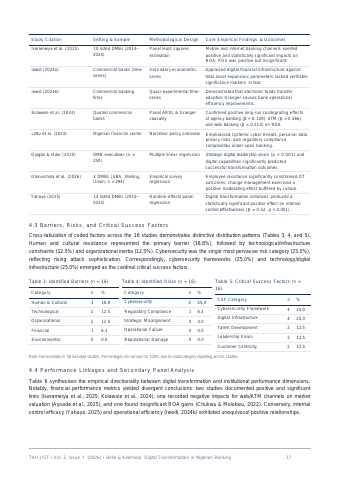
- Cybersecurity was identified as the primary operational and strategic risk, highlighted by 4 out of 16 studies (25.0%).p.1
- Robust cybersecurity frameworks and modernised digital infrastructure were the top critical success factors, each found in 4 of 16 studies (25.0%).p.1
- Human and cultural barriers represented the most frequent impediment to digital transformation, appearing in 3 of 16 studies (18.8%).p.1
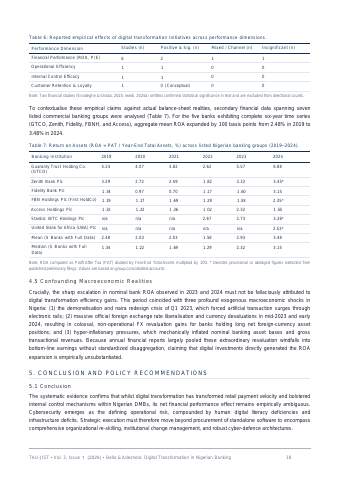
- Mean return on assets (ROA) across five Nigerian commercial banks with full continuous disclosures increased from 2.48% in 2019 to 3.48% in 2024.p.6
Key insights
- Human and cultural resistance constitutes the single largest barrier category to digital transformation in Nigerian banking at 18.8%.p.5
- Cybersecurity frameworks and digital infrastructure are the leading critical success factors for transformation, each cited in 25.0% of the reviewed studies.p.5
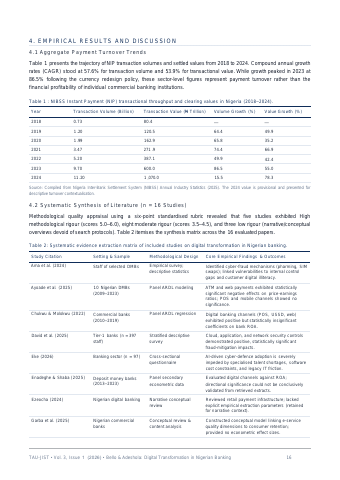
- Out of six empirical studies assessing financial performance, two found positive and statistically significant impacts on ROA, while one found mixed outcomes depending on the channel.p.6
- Annual NIP volume growth peaked in 2023 at 86.5%, largely driven by the currency redesign policy.p.4
- A study confirmed that digital transformation initiatives had a statistically significant positive effect on internal control effectiveness (β = 0.52, p < 0.001).p.5
- The observed ROA growth between 2019 and 2024 cannot be causally attributed to digital transformation due to confounding factors like foreign exchange revaluation gains and inflation.p.1
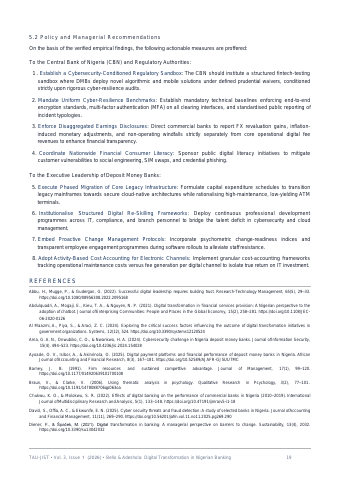
- The Central Bank of Nigeria is recommended to mandate disaggregated reporting to separate core operational digital fee revenues from non-operating FX revaluation windfalls.p.7
Pages
 p.1
 p.2
 p.3
 p.4
 p.5
 p.6
 p.7
 p.8
Funders mentioned
Topics and entities
Summary and figures generated from the document and checked automatically: every number shown appears on the cited page. Publishers can request removal.