Assessing Blockchain Transactions Using GATv2 and Graph-SMOTE (Radiotekhnika)
SaveSummary
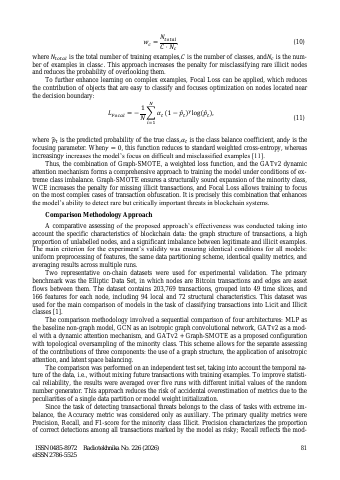
- For the Elliptic dataset, the illicit minority class accounts for about 2 % of labelled nodes.p.1
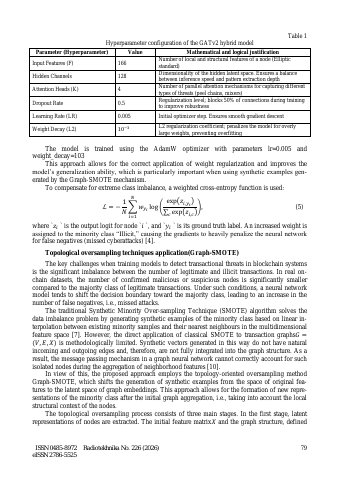
- The optimal configuration for Bitcoin transaction graphs is K=4 attention heads, with 166 input features per node.p.3
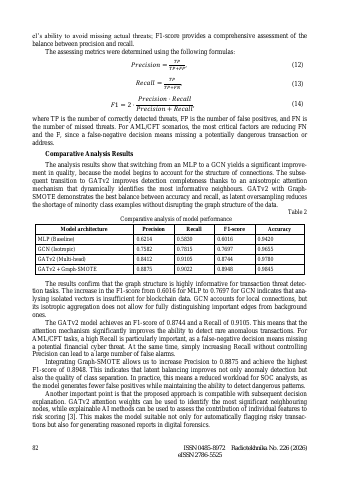
- The F1-score rises from 0.6016 for MLP to 0.7697 for GCN, showing that graph structure is informative.p.7
- GATv2 with multi-head attention reaches recall 0.9105 and F1-score 0.8744.p.7
- The model uses 128 hidden channels, a dropout rate of 0.5 and a learning rate of 0.005.p.4
Key insights
- Blockchain ledgers have a natural graph structure, so the context of connections with neighbouring nodes matters.p.1
- Standard SMOTE was developed for tabular data and can create isolated synthetic objects in transaction graphs.p.2
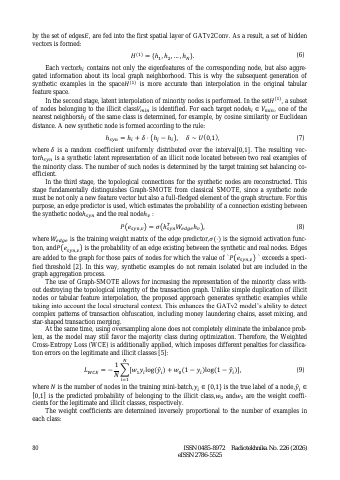
- Graph-SMOTE reconstructs topological connections for synthetic nodes with an edge predictor.p.5
- Switching from an MLP to a GCN yields a significant improvement because the model accounts for connection structure.p.7
- GATv2 with Graph-SMOTE shows the best balance between precision and recall.p.7
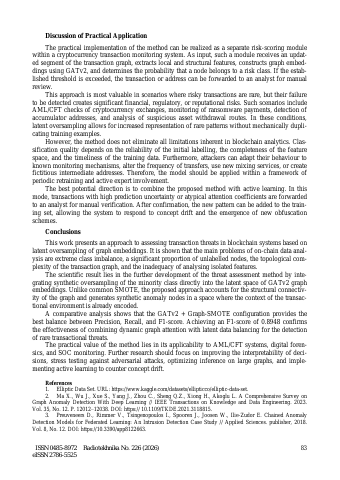
- The method can serve as a risk-scoring module for AML/CFT checks of cryptocurrency exchanges and ransomware payment monitoring.p.8
- Attackers can adapt their behaviour, so the model needs periodic retraining and expert involvement.p.8
Pages
 p.1
 p.2
 p.3
 p.4
 p.5
 p.6
 p.7
 p.8
 p.9
Funders mentioned
Topics and entities
Summary and figures generated from the document and checked automatically: every number shown appears on the cited page. Publishers can request removal.