NumTrace: Auditing the Number Provenance of Financial Analyst Agents
NumTrace introduces a benchmark with 540 questions over 2,163 SEC EDGAR documents to evaluate numerical claim provenance for financial analyst agents.
Research index · 685 documents · Website
NumTrace introduces a benchmark with 540 questions over 2,163 SEC EDGAR documents to evaluate numerical claim provenance for financial analyst agents.
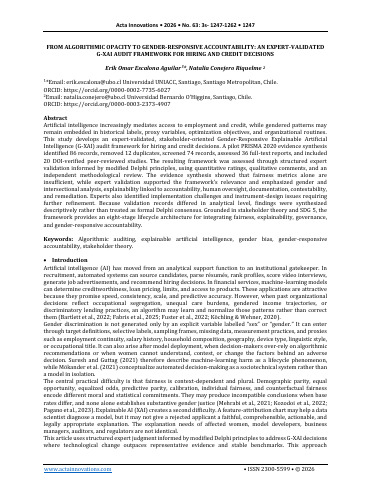
A pilot PRISMA 2020 evidence synthesis identified 86 records, removed 12 duplicates, screened 74 records, assessed 36 full-text reports, and included 20 DOI-verified peer-reviewed studies.
The initial dataset collection gathered 8,387 records from 27 Ethiopian FinTech applications, yielding 7,148 records after quality control procedures.
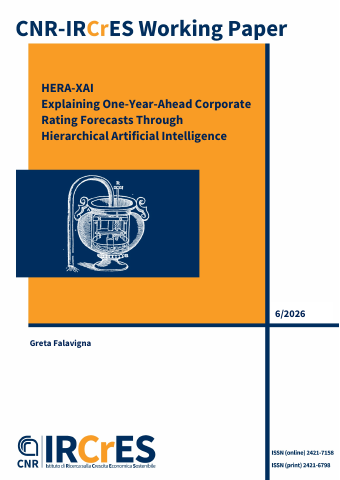
The HERA-XAI framework extends hierarchical corporate rating forecasting using 9 interconnected Random Forest classification nodes across Production, Trade, and Services sectors.
The conceptual framework of sustainable development finance integrates economic, environmental, and social dimensions into financial decision-making based on 10 bibliographic foundations
Global Sharia-compliant financial assets have expanded into an architecture with total assets exceeding US$3 trillion.
Artificial intelligence adoption in fintech enhances operational speed in credit scoring, insurance risk assessment, and fraud detection, but creates algorithmic opacity known as the black box dilemma.
Data from the Ministry of Cooperatives shows that the number of active cooperatives in Indonesia declined from 209,448 in 2014 to 130,119 in 2023.
An estimated 49.4% of new businesses close within their first five years, with financial strain and capital shortages accounting for 38% of venture failures.
In 2024, MSMEs constituted a vital component of Malaysia's economy, accounting for 39.5% of GDP and 48.7% of total employment.
The paper synthesizes cryptocurrency literature using a curated reference base of 84 scholarly and foundational sources.
The SafePack business plan in Chapinero requires an estimated initial investment of $550 million pesos, funded 60% through own resources ($330 million) and 40% through bank credit ($220 million) over 4 years at a 20% annual interest rate.
The empirical study analyzes a panel dataset of 32 listed commercial banks in India across a ten-year period from 2016 to 2025.
The Indian MSME sector contributes approximately 30% of India's Gross Domestic Product (GDP), 45% of manufacturing output, and over 40% of total exports.
Among internet users in Malaysia, individuals in their 20s account for 30 percent while those in their 30s make up 25.9 percent.
The quantitative study surveyed 406 loan department staff across 14 Zimbabwean commercial banks, achieving an 81.2% response rate from 500 distributed questionnaires.
The study analyzes the impact of Big Data and AI-based financial technology on expanding financial inclusion across Indonesian provinces for the 2019–2024 period.
The Tax Justice Network estimates that between $21 trillion and $32 trillion in private assets are concealed in global tax havens.
The number of neobank users worldwide has grown from approximately 146 million in 2021 to an estimated 350 million or more by 2026.
MSMEs in Indonesia comprise more than 65 million business units, contributing around 61% to national GDP and absorbing up to 97% of the national workforce.
In 2019, Brazil invested R$ 89.5 billion in science and technology, representing about 1.2% of GDP according to OECD data.
The study analyzes survey data from 331 university students in Valencia, Spain, to examine funding source preferences at the pre-early stage of entrepreneurship.
The relationship between financial technology firms and traditional banks has evolved through a three-phase progression from initial competition to cooperation and convergence.
The worldwide share of family businesses is around 80%, with only 30% making the transition from the first to the second generation and only 15% reaching the third generation.
Morgan Stanley deployed its OpenAI-backed AI assistant for roughly 16,000 wealth advisers, reaching an active adoption rate near 98 per cent.
The paper demonstrates that real-world asset tokenization gives birth to a third category of standardized asset market beyond stock and futures markets (page 2).
Personnel accounts for 46% of IT expenses in TOP 10 banks in 2025, whereas software and licenses represent 40% of IT spending for banks ranked 51 to 100.
Egyptian FinTech investment is projected to increase from $15M – $20M in 2020 to $350M – $600M in 2025.
The study uses an integrative literature review across 5 core insurance value-chain stages to analyze digital transformation and governance.
Vietnam's Law on Public-Private Partnerships 2020 defines 5 eligible sectors but omits specialized financial, digital data, and legal sandbox infrastructure.