The RegTech Paradox: Balancing Compliance Costs and Digital Synergies in Indian Banking (Research Square)
Summary
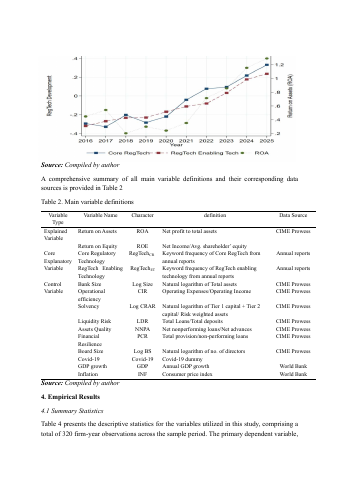
- The empirical study analyzes a panel dataset of 32 listed commercial banks in India across a ten-year period from 2016 to 2025.p.6
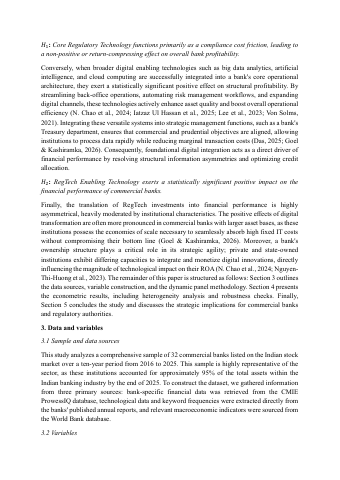
- The 32 sampled banks accounted for approximately 95% of total assets within the Indian banking industry by the end of 2025.p.6
- The panel dataset comprises 320 firm-year observations across the observation period.p.9
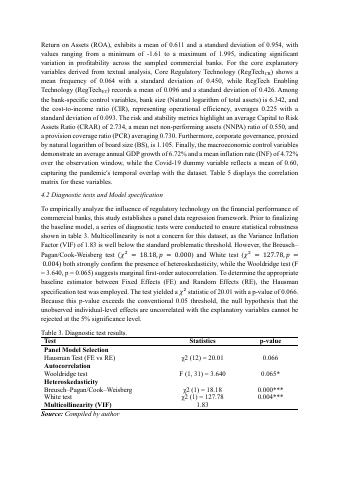
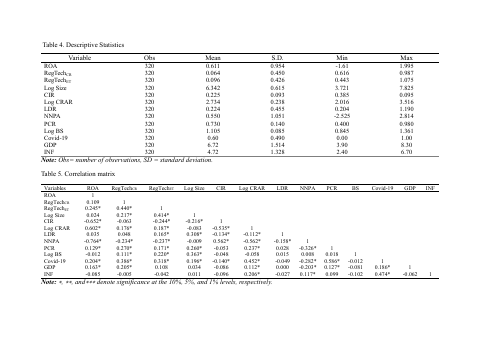
- The primary dependent variable, Return on Assets (ROA), exhibits a mean of 0.611 and a standard deviation of 0.954.p.10
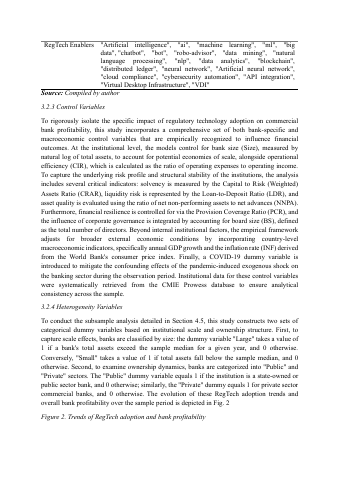
- Macroeconomic control variables across the sample window show an average annual GDP growth of 6.72% and a mean inflation rate of 4.72%.p.10
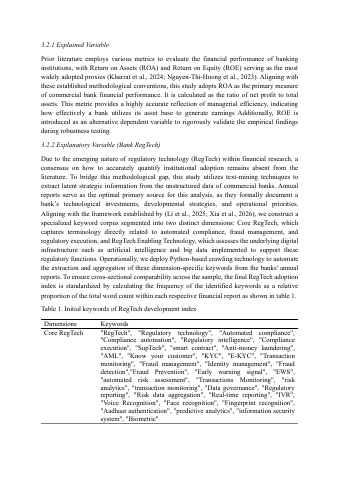
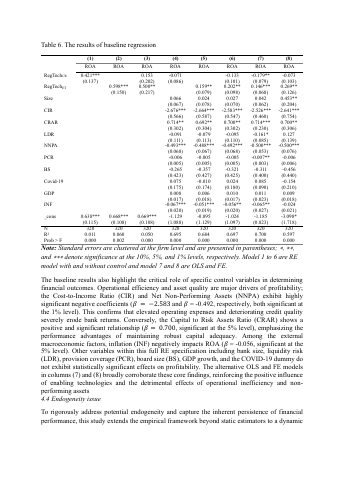
- Core Regulatory Technology exhibits a mean keyword frequency of 0.064, while RegTech Enabling Technology records a higher mean frequency of 0.096.p.10
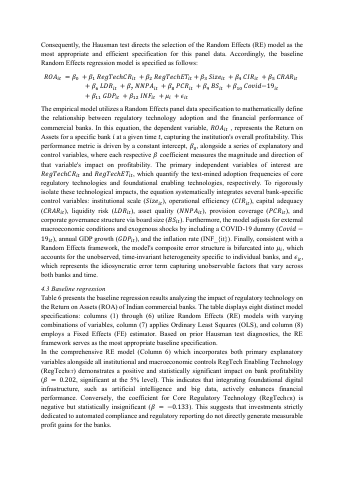
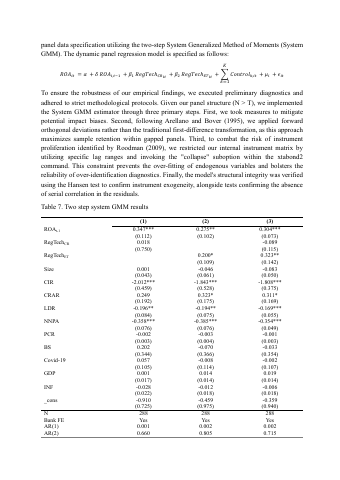
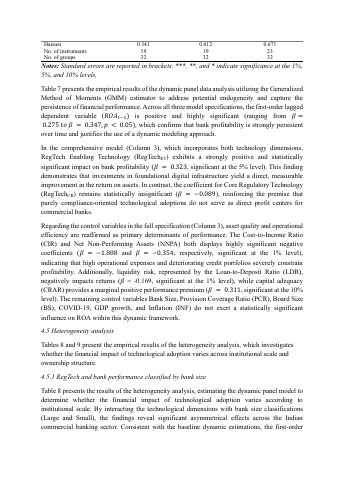
- In the dynamic System GMM regression model, RegTech Enabling Technology demonstrates a positive impact on ROA with a coefficient of 0.323.p.15
Key insights
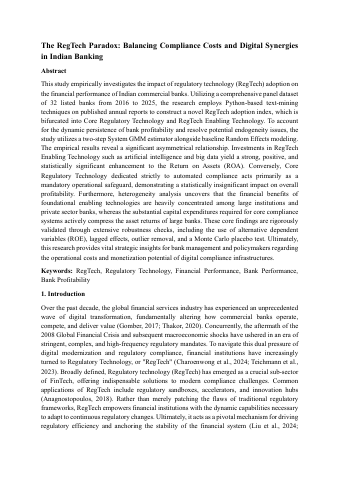
- Investments in RegTech Enabling Technology such as artificial intelligence and big data yield a strong, positive, and statistically significant enhancement to bank Return on Assets.p.2
- Core Regulatory Technology dedicated strictly to automated compliance acts primarily as a mandatory operational safeguard with a statistically insignificant impact on overall profitability.p.2
- The financial performance benefits of foundational enabling technologies are heavily concentrated among large institutions and private sector banks.p.2
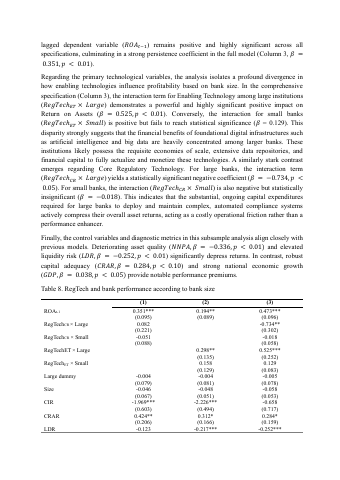
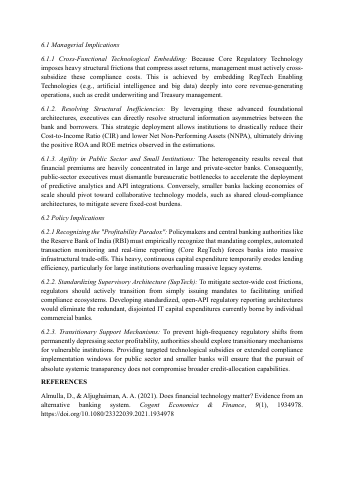
- Substantial capital expenditures required for large banks to deploy complex core compliance systems actively compress asset returns, yielding a negative interaction coefficient of -0.734.p.16
- Dynamic System GMM estimations confirm strong profitability persistence, with a first-order lagged dependent ROA coefficient ranging from 0.275 to 0.347.p.15
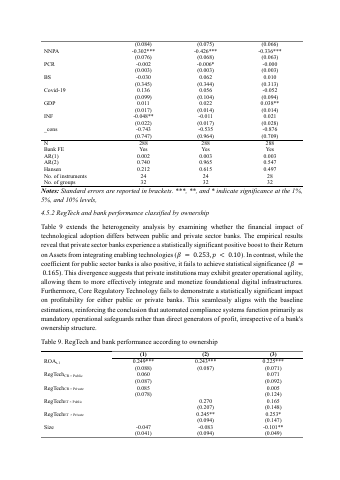
- Private sector commercial banks achieve a statistically significant positive boost to ROA from enabling technologies with a coefficient of 0.253, whereas public sector banks do not.p.17
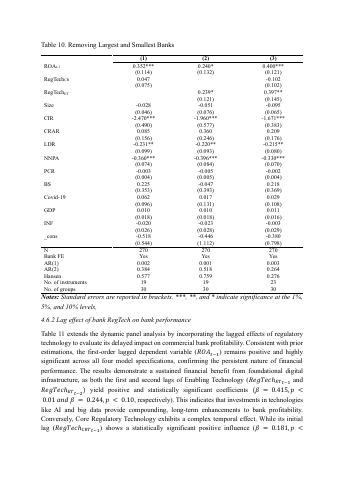
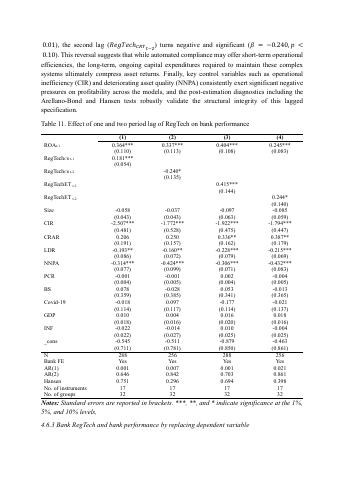
- Lagged estimations show that both one-period and two-period lags of Enabling Technology yield positive, statistically significant enhancements to bank returns.p.19
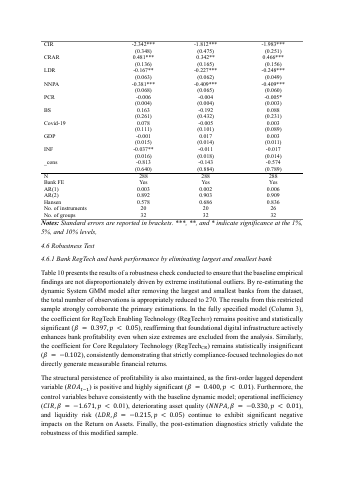
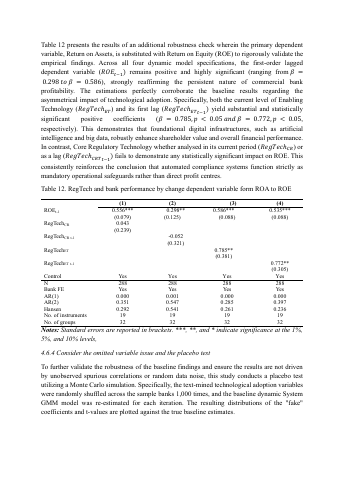
- Robustness testing substituting ROA with Return on Equity confirms that enabling technology significantly boosts shareholder returns with a coefficient of 0.785.p.21
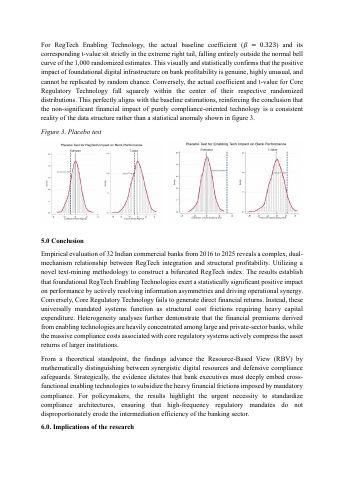
- A Monte Carlo placebo test involving 1,000 random iterations confirms that the positive performance impact of enabling digital infrastructure is not driven by spurious noise.p.21
Pages
 p.1
 p.2
 p.3
 p.4
 p.5
 p.6
 p.7
 p.8
 p.9
 p.10
 p.11
 p.12
 p.13
 p.14
 p.15
 p.16
 p.17
 p.18
 p.19
 p.20
 p.21
 p.22
 p.23
 p.24
 p.25
 p.26
Topics and entities
Summary and figures generated from the document and checked automatically: every number shown appears on the cited page. Publishers can request removal.