Digital Financial Platforms: Consumer Trust, Information Security, and Regulatory Compliance
The number of neobank users worldwide has grown from approximately 146 million in 2021 to an estimated 350 million or more by 2026.
442 documents
The number of neobank users worldwide has grown from approximately 146 million in 2021 to an estimated 350 million or more by 2026.
The study builds an agent-based simulation model using annual-report text and financial panel data on 3,133 A-share listed firms from 2021–2024.
Morgan Stanley deployed its OpenAI-backed AI assistant for roughly 16,000 wealth advisers, reaching an active adoption rate near 98 per cent.
South Africa recorded the highest Regulatory Readiness Index score of 75.0% among the four African jurisdictions evaluated.
The study examines 744 early-stage healthcare ventures entering private financing between 2011–2024.
Vietnam's Law on Public-Private Partnerships 2020 defines 5 eligible sectors but omits specialized financial, digital data, and legal sandbox infrastructure.
The study analyzes a balanced panel dataset of 27 countries covering a total of 135 annual observations.
The paper demonstrates that real-world asset tokenization gives birth to a third category of standardized asset market beyond stock and futures markets (page 2).
Egyptian FinTech investment is projected to increase from $15M – $20M in 2020 to $350M – $600M in 2025.
The study uses an integrative literature review across 5 core insurance value-chain stages to analyze digital transformation and governance.
Cryptoasset seizures in criminal investigations by Brazil's Federal Police reached a record R$ 71 million in 2025.
Africa's financial landscape is defined by fragmented regulation across 54 sovereign nation-states and an informal economy employing 72% of the working population on average.
A literature review of 51 studies on insurance human-resource transformation revealed that digital literacy and skills development was the most prominent research theme, appearing in 68.6% of publications.
By 2025, the market capitalisation of digital assets exceeded $2 trillion, with daily trading volumes matching traditional stock markets.
Bancassurance gross written premiums in Kenya grew from KES 19.5 billion in 2019 to KES 35 billion in 2023, representing a growth of 79.4%.
The study analyzes weak-form efficiency across 8,970 assets and 690 weekly cross-sections from 2013 to 2026, evaluating mobility across market capitalisation deciles.
In 2022, Indonesia's Single Investor Identification count reached 9.87 million investors, representing a 31.85% increase from 7.49 million in 2021.
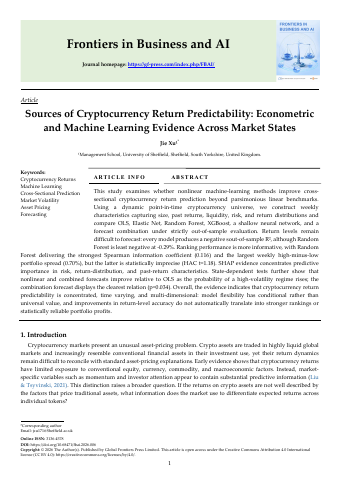
Predicting cryptocurrency return levels out-of-sample is highly challenging, with every model producing a negative out-of-sample R², where Random Forest performs best at -0.29% and OLS records -1.28%.
Holding carbon dioxide removal at 9.5 GtCO₂ per year after 2183 in the FaIR ensemble returns median atmospheric CO₂ to 280 ppm in 2300.
The Financial Stability Board (FSB) identified 12 sound practices to help all financial institutions realise the benefits of AI while managing its risks responsibly.
Global fintech investments reached $33.7 billion in 2024, while the average deal size in innovative financial services for banking increased by 70% to $8.5 million.
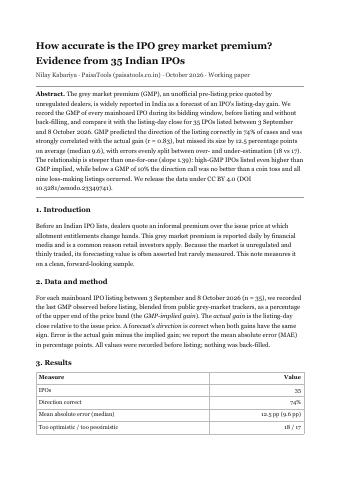
The study analyzed 35 mainboard IPOs listed between 3 September and 8 October 2026 to evaluate the forecasting value of the grey market premium (GMP).
Total tokenized assets reached $346.1 billion across 47 asset classes in September 2026, with stablecoins comprising 86% of the total.
Global cross-border payment transactions are projected to expand from over $150 trillion in 2017 to more than $250 trillion by 2027.
The IMR review working group was established in 2024 to evaluate the implementation status of international financial reforms and recommend improvements to monitoring.
A stocktake conducted by the FSB gathered 126 modernisation efforts from 24 jurisdictions and 3 SSBs across various financial sectors and entity types.
Total stablecoin market capitalization surpassed $300 billion in 2025.
Total costs for stablecoin cross-border remittances range between 0.5% and 3.0%, compared to 9.50% for traditional banking channels.
Digital payment adoption reduces transaction costs and administrative duties, but introduces risks of resource centralization without institutional checks [p.1].
The empirical study evaluated 1,722 investment portfolios over short-term (3-month) and long-term (10-year) horizons to test systemic resilience.