The Impact of Digital Technology Development on Economic Stability Under Commercial Bank Competition and Directions for Its Improvement (Zenodo)
SaveSummary
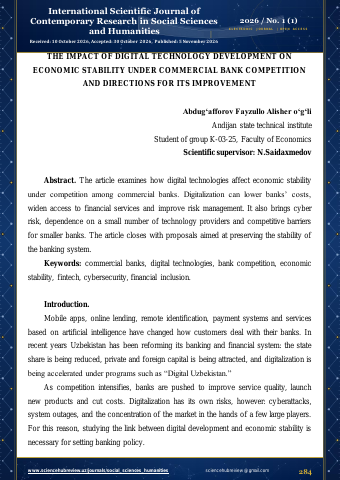
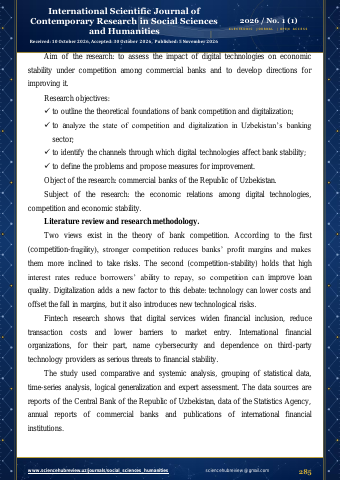
- Digitalization can lower banks' costs, widen access to financial services and improve risk management.p.1
- It also brings cyber risk, dependence on a small number of technology providers and competitive barriers for smaller banks.p.1
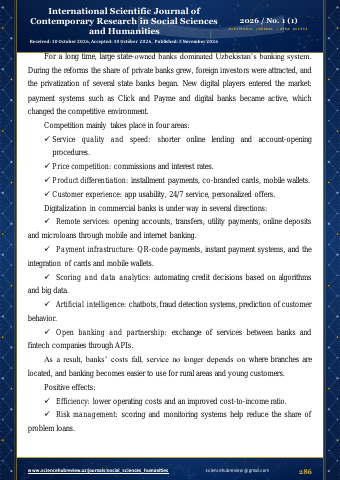
- Competition among Uzbekistan's banks takes place in service quality and speed, price, product differentiation and customer experience.p.3
- Digitalization proceeds through remote services, payment infrastructure, scoring and data analytics, artificial intelligence, and open banking partnerships.p.3
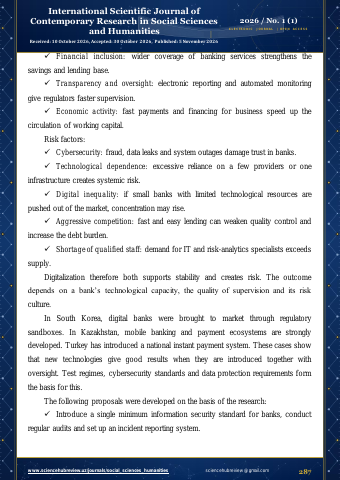
- Listed risk factors are cybersecurity, technological dependence, digital inequality, aggressive competition and a shortage of qualified staff.p.4
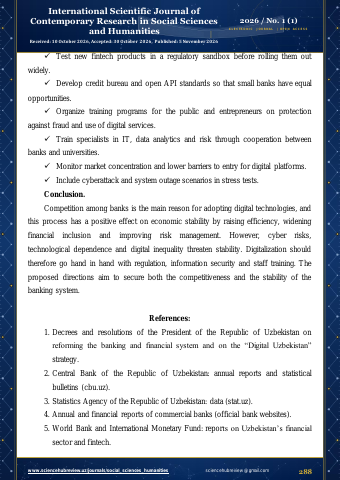
- The paper concludes that digitalization should go hand in hand with regulation, information security and staff training.p.5
Key insights
- Competition among banks is described as the main reason for adopting digital technologies, with a positive effect on economic stability.p.5
- Digital players such as Click and Payme and digital banks have changed the competitive environment in Uzbekistan.p.3
- Digitalization supports stability and creates risk; the outcome depends on technological capacity, quality of supervision and risk culture.p.4
- South Korea brought digital banks to market through regulatory sandboxes, and Turkey introduced a national instant payment system.p.4
- The paper proposes testing new fintech products in a regulatory sandbox before wide rollout.p.5
- It recommends developing credit bureau and open API standards so that small banks have equal opportunities.p.5
- It recommends including cyberattack and system outage scenarios in stress tests.p.5
Pages
 p.1
 p.2
 p.3
 p.4
 p.5
 p.6
Topics and entities
Summary and figures generated from the document and checked automatically: every number shown appears on the cited page. Publishers can request removal.