The effects of investor sentiment and business cycles on the systematic risk of an ESG portfolio (PLoS ONE)
SaveSummary
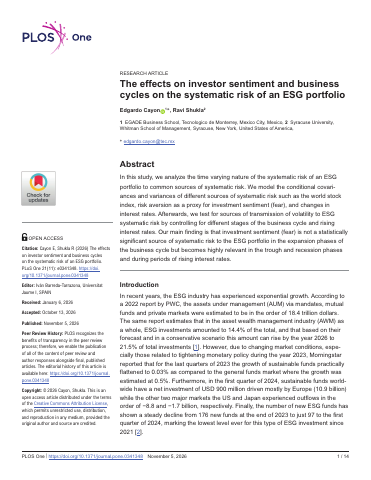
- Global ESG assets under management across mandates, mutual funds, and private markets were estimated at $18.4 trillion in 2022.p.1
- ESG investments represented 14.4% of asset wealth management in 2022, with projections indicating a potential rise to 21.5% by 2026.p.1
- Growth in sustainable funds slowed to 0.03% in the final quarters of 2023, compared to 0.5% growth across the general funds market.p.1
Key insights
- Investor sentiment proxied by fear is not a statistically significant source of systematic risk during economic expansions but becomes highly significant during recessions and rising interest rate cycles.p.1
- Sustainable fund growth virtually flattened to 0.03% in late 2023 while general funds grew at 0.5%.p.1
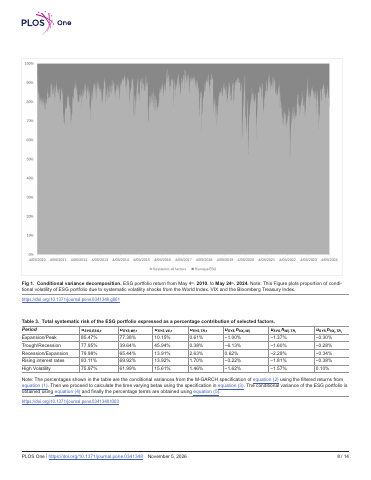
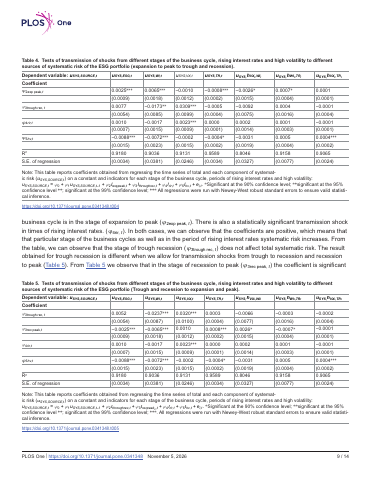
- The World Index is the primary driver of ESG systematic risk during economic expansion phases, contributing 77.38%.p.8
- Investor sentiment becomes the dominant contributor to systematic risk in ESG portfolios during economic troughs and recessions at 45.94%.p.8
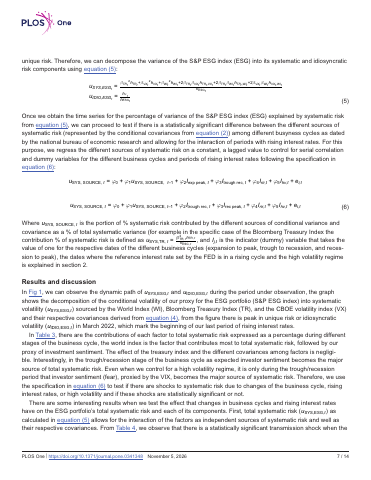
- Idiosyncratic volatility for the ESG portfolio peaked in March 2022, aligning with the initiation of Federal Reserve interest rate increases.p.7
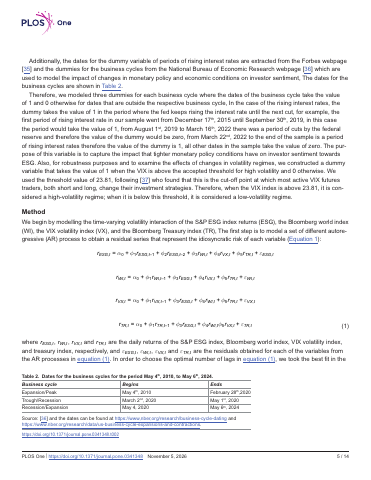
- A threshold VIX level of 23.81 serves as the regime cut-off point where active VIX futures traders alter investment strategies.p.5
Pages
 p.1
 p.2
 p.3
 p.4
 p.5
 p.6
 p.7
 p.8
 p.9
 p.10
 p.11
 p.12
 p.13
 p.14
Funders mentioned
Topics and entities
Summary and figures generated from the document and checked automatically: every number shown appears on the cited page. Publishers can request removal.