Testing Bitcoin's Deviation from Gold's Safe-Haven Effect (Journal of fintech and business analysis.)
SaveSummary
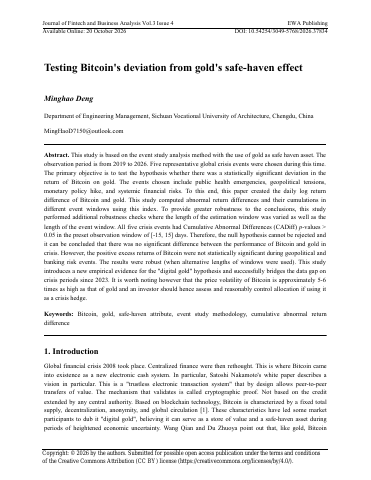
- An event study uses gold as the safe-haven benchmark to test whether Bitcoin's returns deviate significantly from gold's during crises between 2019 and 2026.p.1
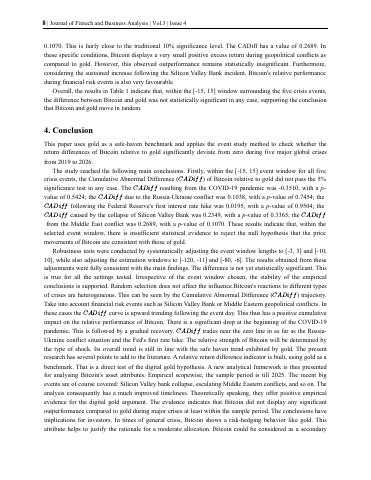
- All five crisis events had CADiff p-values above 0.05 in the [-15, 15] day window, so the null hypothesis cannot be rejected.p.1
- For the Middle East conflict escalation, CADiff was 0.2689 with a p-value of 0.1070, a small positive but insignificant excess return.p.8
Key insights
- Smales argues Bitcoin is more volatile, less liquid and costlier to trade than traditional safe-haven assets.p.2
- The sample covers 5 major global crisis events between 2019 and 2026.p.3
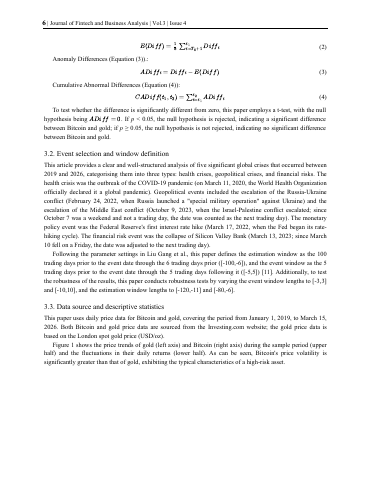
- The events include the WHO pandemic declaration on March 11, 2020, the Fed's first rate hike on March 17, 2022, and the Silicon Valley Bank collapse on March 13, 2023.p.6
- None of the five events showed a statistically significant difference between Bitcoin and gold at the 95% confidence level.p.7
- Bitcoin's relative performance after the Silicon Valley Bank incident was favourable but statistically insignificant.p.8
- The authors note the study uses only 5 crisis events and short windows, so long-term effects are not captured.p.9
Pages
 p.1
 p.2
 p.3
 p.4
 p.5
 p.6
 p.7
 p.8
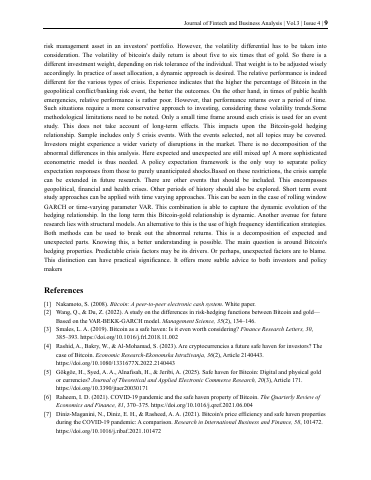 p.9
 p.10
Funders mentioned
Topics and entities
Summary and figures generated from the document and checked automatically: every number shown appears on the cited page. Publishers can request removal.