Short- and Long-Term Debt and SME Performance: A Panel Data Analysis of the Moroccan Construction Sector (International Journal of Accounting, Finance, Auditing, Management and Economics)
SaveSummary
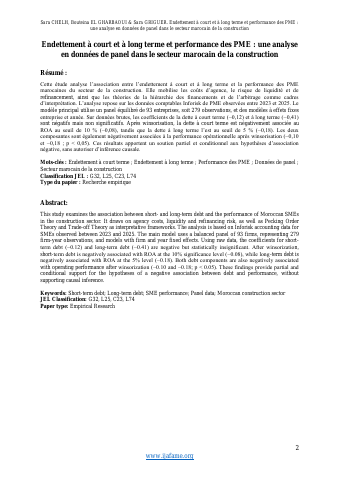
- The study analyzes how short- and long-term debt levels correlate with SME performance across 93 Moroccan construction companies between 2023 and 2025.p.2
- The construction sector in Morocco showed economic relevance by adding 64,000 jobs in 2025.p.3
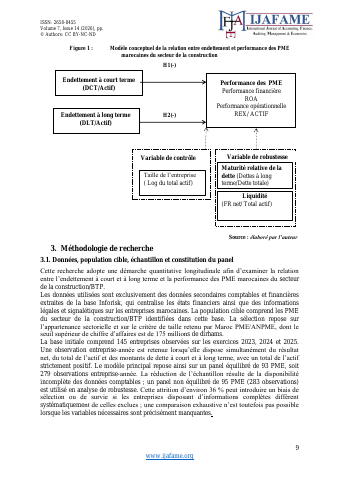
- The main empirical specification relies on a balanced panel dataset of 93 SMEs yielding 279 firm-year observations over three years.p.9
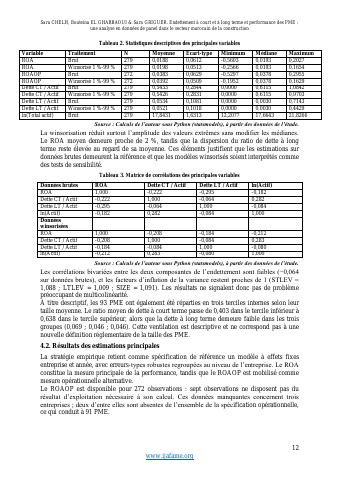
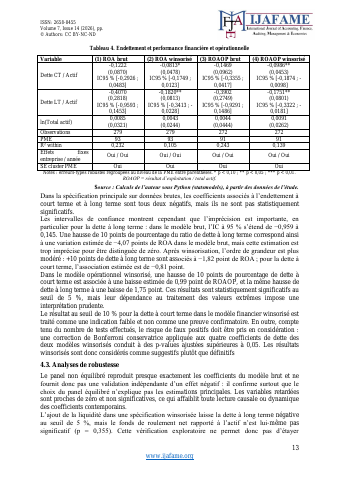
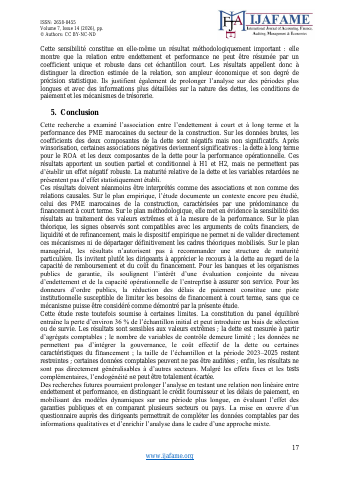
- Using raw data, short-term debt (-0.1222) and long-term debt (-0.4070) show negative associations with ROA, but these coefficients are not statistically significant.p.13
- After winsorization, short-term debt is negatively associated with ROA at -0.0813 (p < 0.10) and long-term debt at -0.1820 (p < 0.05).p.13
Key insights
- Raw baseline econometric models show negative coefficients for short-term and long-term leverage, but neither achieves statistical significance.p.13
- Operating performance (ROAOP) after winsorization displays significant negative associations with both short-term (-0.0986) and long-term debt (-0.1751).p.13
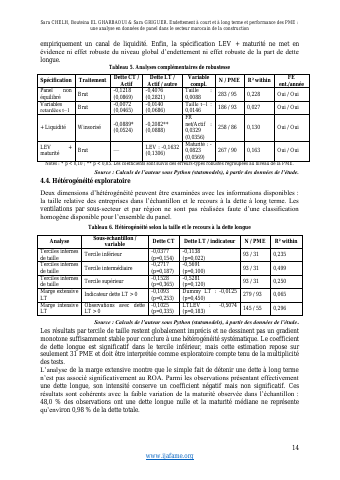
- Adding liquidity indicators based on net working capital does not alter the negative directional pattern between leverage and performance.p.14
- Lagged debt variables from previous periods lose statistical significance and show near-zero coefficients relative to firm profitability.p.14
- Size sub-sample breakdowns reveal a statistically significant negative long-term debt coefficient (-0.1138) only within the smallest firm size tercile.p.14
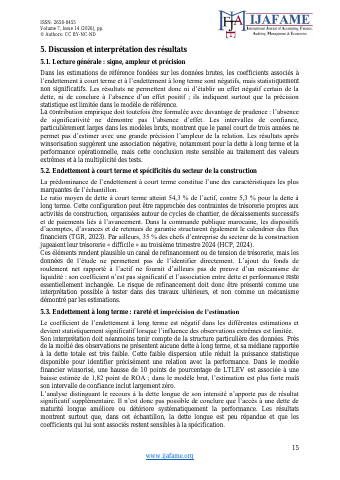
- Sector-level treasury strains are evident, with 35% of construction managers reporting challenging cash positions in late 2024.p.15
Pages
 p.1
 p.2
 p.3
 p.4
 p.5
 p.6
 p.7
 p.8
 p.9
 p.10
 p.11
 p.12
 p.13
 p.14
 p.15
 p.16
 p.17
 p.18
 p.19
 p.20
Topics and entities
Summary and figures generated from the document and checked automatically: every number shown appears on the cited page. Publishers can request removal.