Remittances Inflow and Economic Growth in Nigeria (British Journal of Contemporary Research)
SaveLargest segment
65%
Nigeria's share of officially recorded remittance inflows to sub-Saharan Africa p.2
Summary
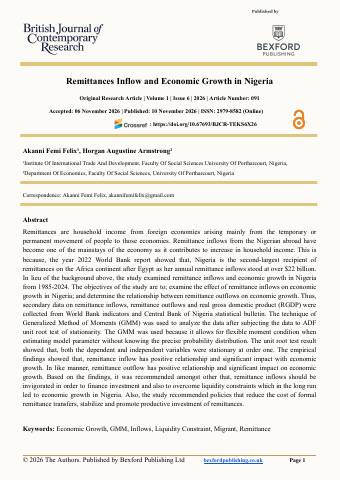
- Nigeria is the second-largest recipient of remittances in Africa after Egypt, with annual inflows over $22 billion according to a 2022 World Bank report.p.1
- The study examines remittance inflows and economic growth in Nigeria from 1985-2024 using World Bank and Central Bank of Nigeria data.p.1
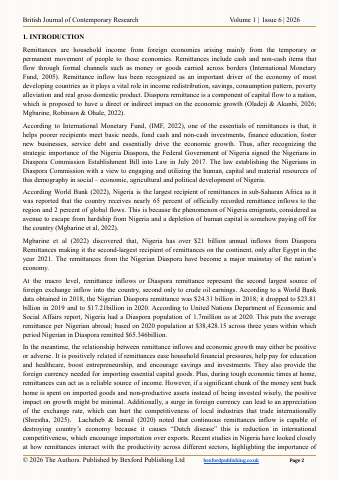
- Nigeria receives nearly 65 percent of officially recorded remittance inflows to sub-Saharan Africa and 2 percent of global flows.p.2
- The Nigerians in Diaspora Commission Establishment Bill was signed into law in July 2017.p.2
Key insights
- Remittances are household income from foreign economies arising mainly from temporary or permanent movement of people.p.1
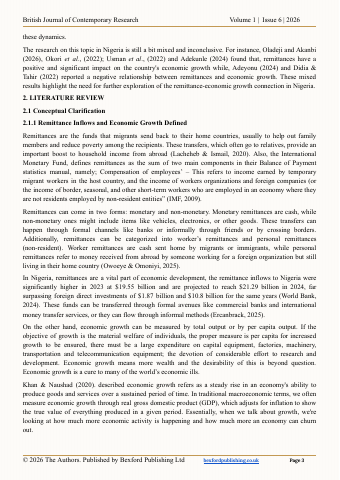
- Research on remittances and growth in Nigeria is mixed, with some studies finding positive and others negative effects.p.3
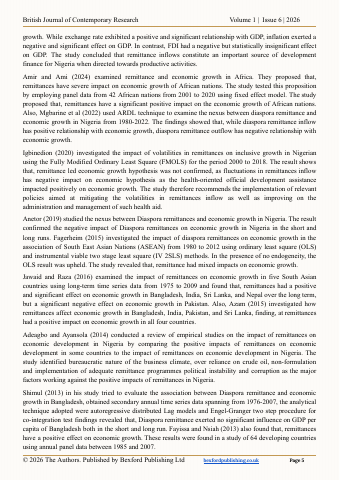
- Amir and Ami used panel data from 42 African nations from 2001 to 2020 and found a significant positive effect of remittances on growth.p.5
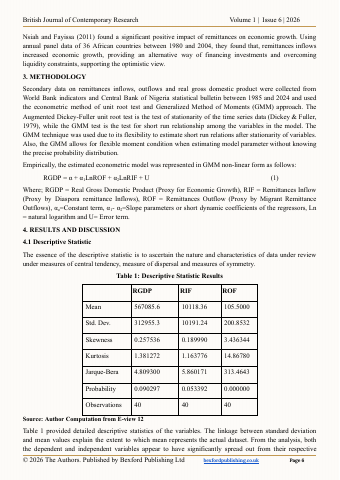
- Nsiah and Fayissa used panel data from 36 African countries between 1980 and 2004 and found remittances increased growth.p.6
- The model regresses real GDP on log remittance inflows and outflows using the Generalized Method of Moments.p.6
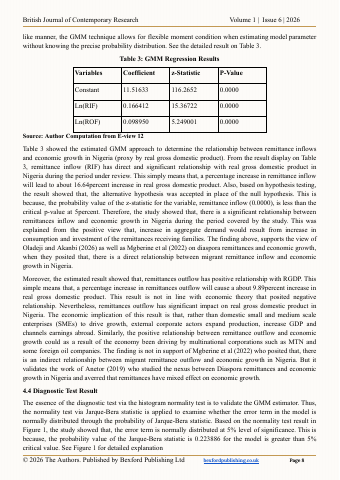
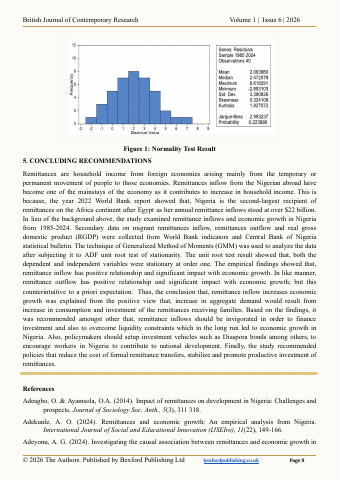
- The authors explain the positive result through higher aggregate demand from consumption and investment by recipient families.p.9
Pages
 p.1
 p.2
 p.3
 p.4
 p.5
 p.6
 p.7
 p.8
 p.9
 p.10
 p.11
 p.12
Funders mentioned
Topics and entities
Summary and figures generated from the document and checked automatically: every number shown appears on the cited page. Publishers can request removal.