Regulation of Securities Offering Through Equity Crowdfunding: A Juridical Comparison Between Indonesia and Singapore (Zenodo (CERN European Organization for Nuclear Research))
Summary
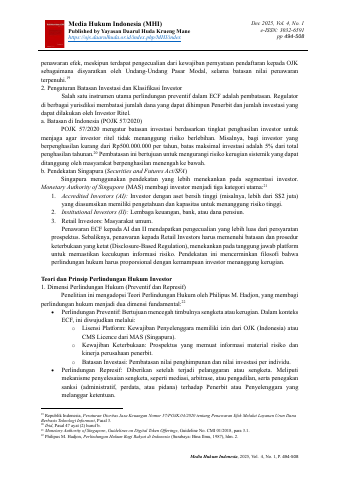
- In Indonesia, individual investors with an annual income below Rp500.000.000 face a maximum investment cap of 5% of their annual earnings under POJK 57/2020.p.5
- Under Singapore's Securities and Futures Act, Accredited Investors are defined as individuals with net assets exceeding S$2 million, allowing broader exemptions from prospectus requirements.p.5
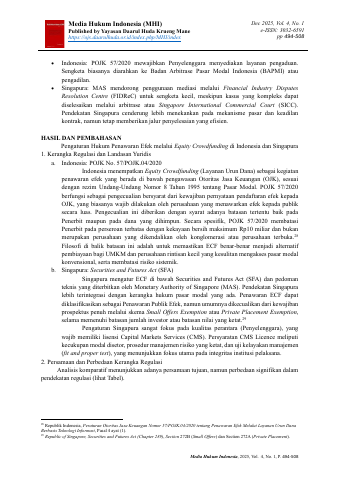
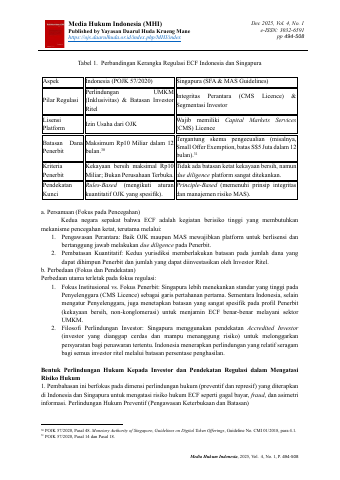
- Indonesian equity crowdfunding regulations restrict eligible issuers to non-conglomerate private entities with maximum net assets of Rp10 Miliar.p.7
- POJK 57/2020 caps total equity crowdfunding capital raising for a single issuer at Rp10 Miliar within a 12-month period.p.8
- Singapore's Small Offer Exemption permits issuers to raise up to S$5 Juta within 12 months without issuing a full prospectus.p.8
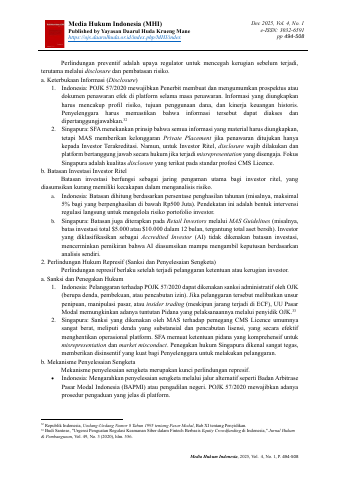
- Retail investors in Singapore face investment caps such as $5.000 or $10.000 within a 12-month period depending on their total net assets.p.9
Key insights
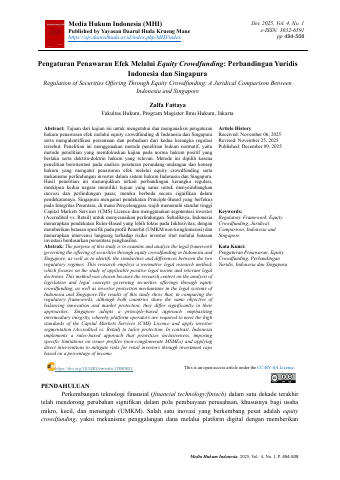
- Indonesia implements a rules-based regulatory framework prioritizing financial inclusion and direct quantitative investment limits for retail investors.p.1
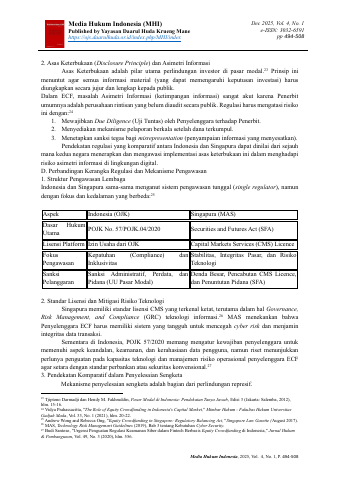
- Singapore adopts a principle-based framework focused on intermediary integrity by enforcing strict Capital Markets Services licensing standards.p.1
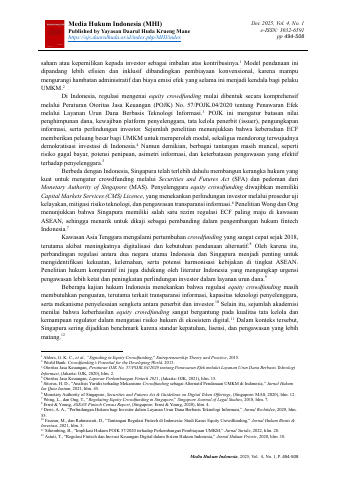
- Equity crowdfunding provides micro, small, and medium enterprises an efficient alternative financing channel by lowering administrative and issuance costs.p.4
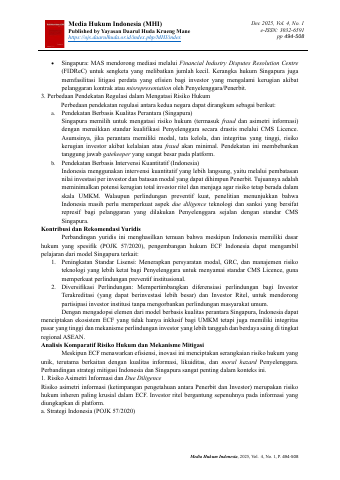
- Both Indonesian and Singaporean regulators mandate platform licensing and due diligence obligations to manage information asymmetry between issuers and investors.p.8
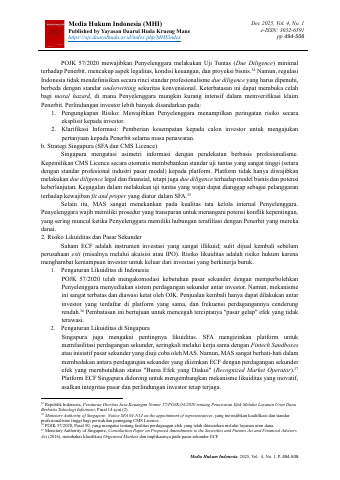
- Singapore differentiates regulatory burdens based on investor segmentation, providing broader exemptions for Accredited Investors while protecting retail investors.p.9
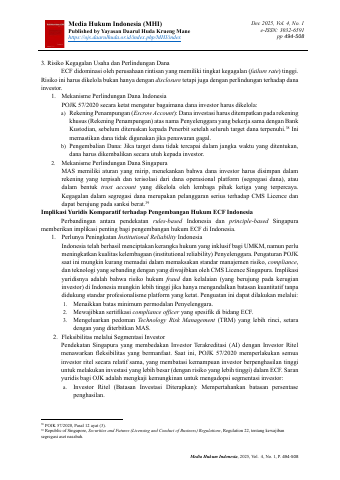
- Indonesian regulation requires raised funds to be held in an escrow account with a custodian bank until fundraising goals are fulfilled.p.12
Pages
 p.1
 p.2
 p.3
 p.4
 p.5
 p.6
 p.7
 p.8
 p.9
 p.10
 p.11
 p.12
 p.13
 p.14
 p.15
Topics and entities
Summary and figures generated from the document and checked automatically: every number shown appears on the cited page. Publishers can request removal.