Municipal Green Sukuk as an Alternative Financing Instrument for Urban Waste Management: A SWOT-TOWS Analysis in Jakarta (Golden Ratio of Finance Management)
SaveSummary
- Urban waste generation in Jakarta reaches 3.17 million tonnes per year (approximately 7,735 tonnes per day), driving the need for alternative sustainable infrastructure financing.p.2
- Jakarta Governor Regulation No. 108 of 2019 sets waste management targets of 30% waste reduction and 70% waste handling.p.2
- Jakarta's regional financial independence ratio stands at 64.00%, with a fiscal space of 62.57% and an own-source revenue (PAD) effectiveness ratio of 94.66%.p.7
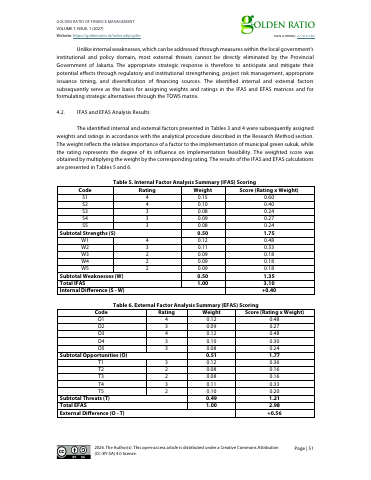
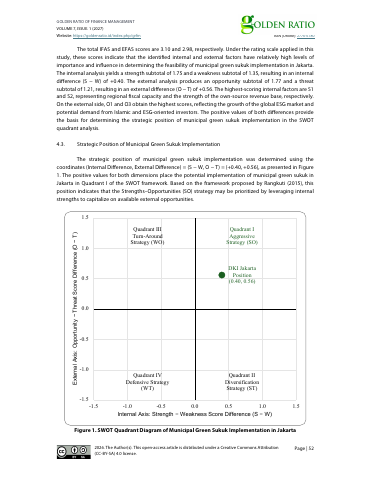
- Internal and external SWOT analysis places Jakarta in Quadrant I, with internal (S-W) and external (O-T) score differences of +0.40 and +0.56, respectively.p.9
- The total Internal Factor Analysis Summary (IFAS) score is calculated at 3.10, while the External Factor Analysis Summary (EFAS) score is 2.98.p.10
- Implementation readiness remains constrained by the absence of a regional green sukuk framework, limited institutional capacity, and underdeveloped MRV systems.p.1
Key insights
- Jakarta's placement in Quadrant I indicates strong strategic feasibility for municipal green sukuk, though immediate issuance is barred by institutional gaps.p.11
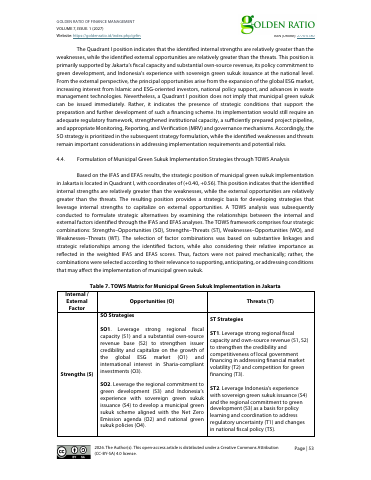
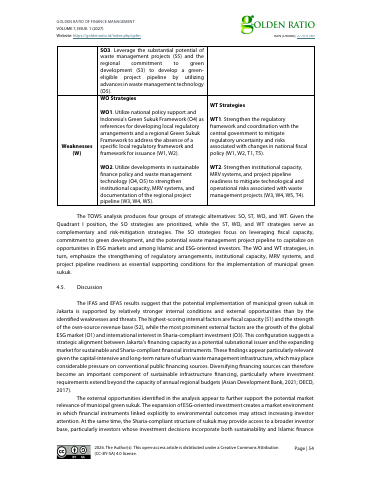
- Prioritizing Strengths-Opportunities (SO) strategies allows Jakarta to use its strong own-source revenue base to capture growing global ESG and Sharia investor interest.p.10
- Sharia-compliant financial structures such as Murabahah, Istisna', and Wakalah offer flexibility to finance diverse waste infrastructure assets like recycling and RDF facilities.p.13
- National experience with sovereign green sukuk issuance cannot be directly transferred to the subnational level due to differing subnational legal frameworks and fiscal arrangements.p.14
- Translating Jakarta's waste infrastructure needs into a bankable pipeline requires documented technical readiness, clear ownership, and verified green eligibility.p.14
- Weak monitoring, reporting, and verification (MRV) systems create risks of greenwashing accusations, which jeopardizes instrument credibility.p.13
- A staged implementation approach focusing on preparatory regulatory, institutional, and project-readiness building should precede actual market issuance.p.15
Pages
 p.1
 p.2
 p.3
 p.4
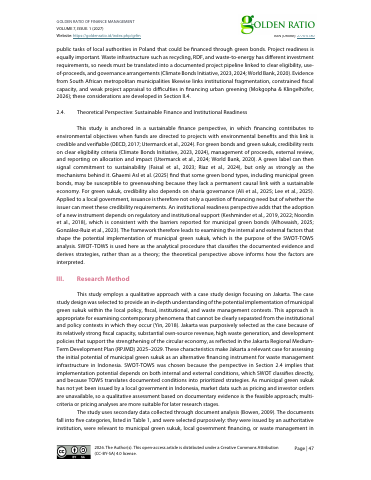 p.5
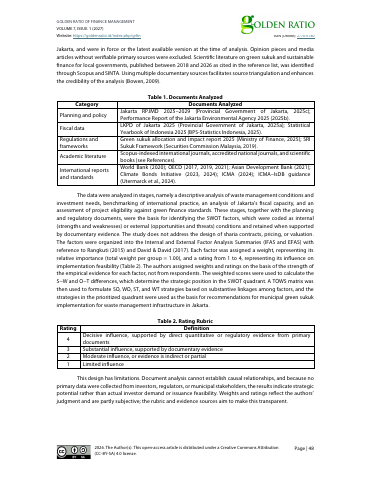 p.6
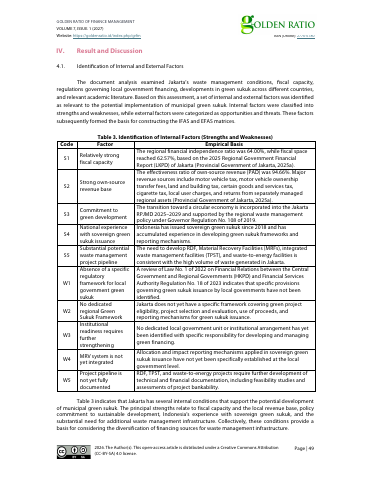 p.7
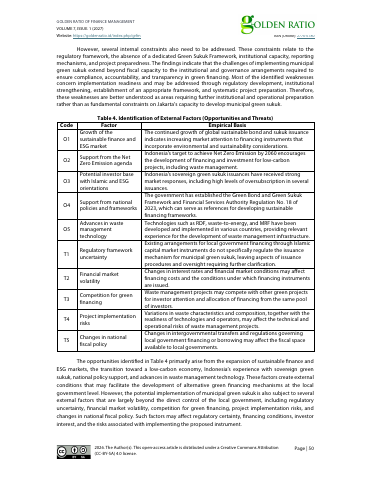 p.8
 p.9
 p.10
 p.11
 p.12
 p.13
 p.14
 p.15
 p.16
 p.17
 p.18
 p.19
Funders mentioned
Topics and entities
GlobalClimate and impact investmentInfrastructure investmentProject financePublic funding and grantsSME finance and lendingAsian Development BankBantargebang Integrated Waste Management FacilityClimate Bonds InitiativeMinistry of Finance of the Republic of IndonesiaOECDPoliteknik Keuangan Negara STANProvincial Government of JakartaWorld Bank
Summary and figures generated from the document and checked automatically: every number shown appears on the cited page. Publishers can request removal.