Liquidity-Saving Mechanisms for 24/7 Instant Payment Systems: Rolling Liquidity Bounds, Certified Offsetting, and an Open Benchmark (Zenodo)
SaveSummary
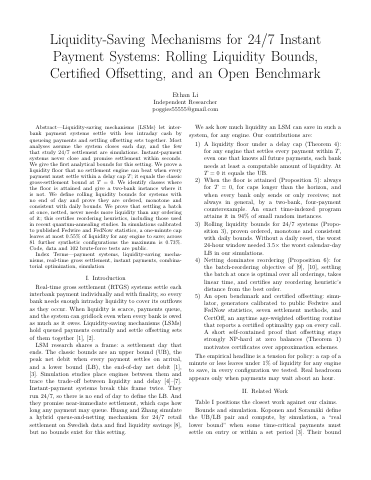
- The authors establish the first analytical bounds on liquidity for 24/7 instant payment systems where payments must be settled within a delay cap T.p.1
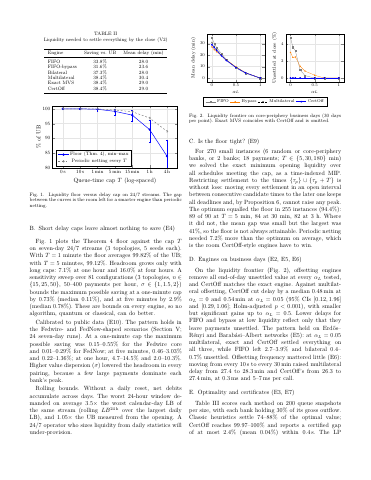
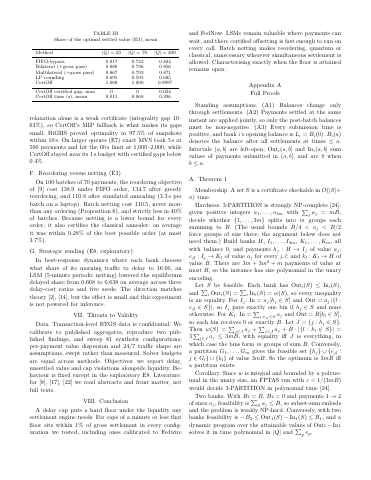
- For a 1-minute delay cap, simulations show that at most 0.55% of liquidity remains available for any engine to save, and no more than 0.73% across 81 synthetic configurations.p.1
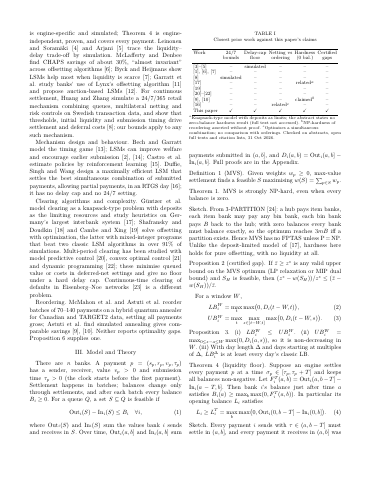
- Max-value settlement (MVS) is proven to be strongly NP-hard even when every bank balance is zero, ruling out an FPTAS unless P = NP.p.2
- Without an end-of-day reset, the worst 24-hour liquidity window required 3.5× the worst calendar-day lower bound in simulation models.p.1
- Simultaneous batch netting is mathematically proven to always perform as well as or better than any linear payment ordering.p.1
- In a time-indexed MIP test on 270 small instances, the theoretical liquidity floor was exactly attained in 255 instances (94.4%).p.4
Key insights
- Liquidity floors equal the traditional real-time gross settlement bound at T = 0 and decrease as the delay cap T increases.p.1
- Short delay caps severely limit potential liquidity savings, leaving a maximum possible saving bound of 0.73% for 1-minute caps and 2.9% for 5-minute caps across tested configurations.p.4
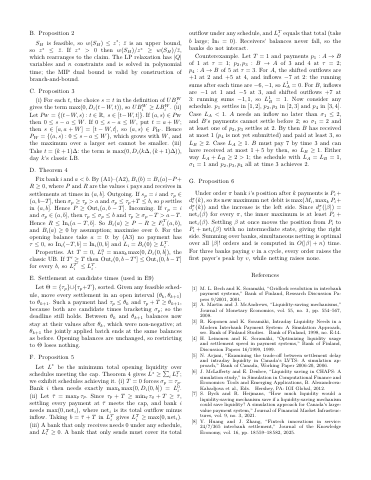
- The theoretical minimum liquidity floor is not always attainable in practice, as shown by a two-bank, four-payment counterexample.p.1
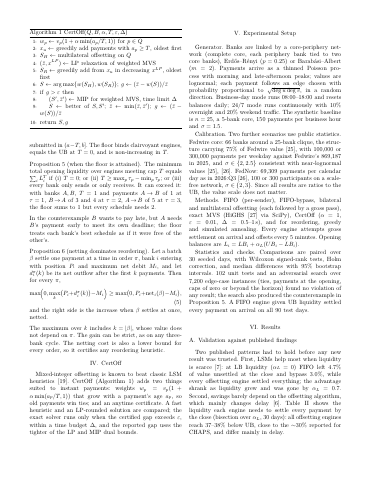
- Settling a payment batch simultaneously using netting dominates any payment reordering heuristic, executing in linear time O(|β| + n).p.6
- Rolling liquidity bounds designed for 24/7 payment flows are proven to be ordered, monotone, and consistent with classic daily bounds.p.1
- On simulated core-periphery business days, offsetting engines eliminate all unsettled value at the end of the day.p.4
- Quantum annealing reordering heuristics are rendered unnecessary whenever simultaneous batch netting is permitted.p.5
Pages
 p.1
 p.2
 p.3
 p.4
 p.5
 p.6
 p.7
Topics and entities
Summary and figures generated from the document and checked automatically: every number shown appears on the cited page. Publishers can request removal.