Improving the Financing of the Tourism Sector (American Journal of Economics and Business Management)
SaveSummary
- 11.7 million foreign citizens visited Uzbekistan for tourism purposes in 2025, an increase of 3.7 million, or 46.8%, compared with 2024.p.2
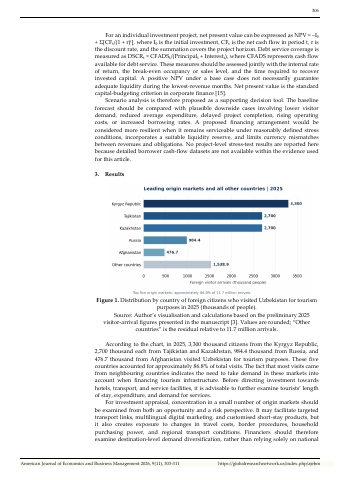
- Visitors came mainly from the Kyrgyz Republic (3.3 million), with 2.7 million each from Tajikistan and Kazakhstan.p.2
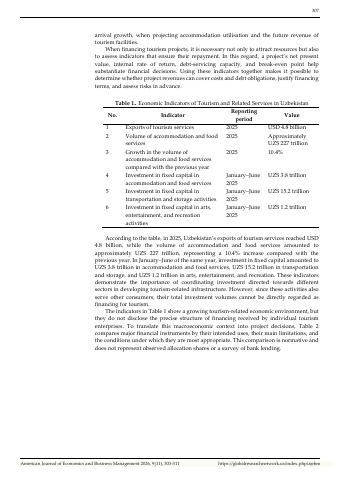
- Uzbekistan's exports of tourism services reached USD 4.8 billion in 2025.p.5
- The volume of accommodation and food services was approximately UZS 227 trillion in 2025, a 10.4% increase on the previous year.p.5
- Fixed-capital investment in January–June amounted to UZS 3.8 trillion in accommodation and food services, UZS 15.2 trillion in transportation and storage, and UZS 1.2 trillion in arts, entertainment and recreation.p.5
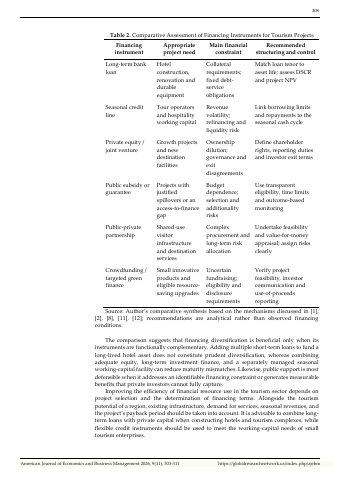
- The article compares long-term bank loans, seasonal credit lines, private equity, public subsidies and guarantees, public-private partnerships and crowdfunding for tourism projects.p.6
Key insights
- Growth in tourist arrivals increases the need for financial resources to expand accommodation, transport, catering and other services.p.2
- Border crossings should not be read as a direct measure of hotel occupancy, overnight stays or spending per visitor, so lenders need regional distribution, length of stay and seasonally adjusted occupancy data.p.2
- The proposed framework links each expenditure item to the maturity, repayment profile, risk sharing and monitoring needs of the financing instrument, and is an analytical contribution rather than an estimated model.p.3
- Net present value, debt service coverage, internal rate of return and break-even levels should be assessed jointly, because a positive base-case NPV does not guarantee liquidity in the lowest-revenue months.p.4
- Scenario analysis with downside cases is proposed, and no project-level stress-test results are reported because borrower cash-flow data were not available.p.4
- Financing diversification is beneficial only when the instruments are functionally complementary.p.6
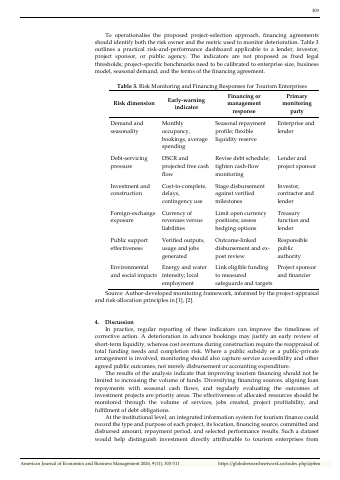
- A risk dashboard assigns a monitoring party and an early-warning indicator to demand, debt-servicing, construction, foreign-exchange, public-support and environmental risks.p.7
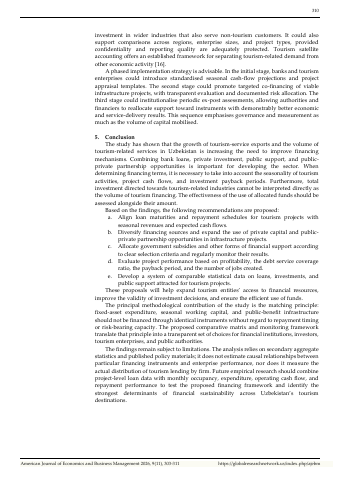
- A phased implementation is proposed, starting with standardised seasonal cash-flow projections and then targeted co-financing and periodic ex-post assessments.p.8
- Total investment in tourism-related industries cannot be interpreted directly as the volume of tourism financing.p.8
Pages
 p.1
 p.2
 p.3
 p.4
 p.5
 p.6
 p.7
 p.8
 p.9
Topics and entities
Summary and figures generated from the document and checked automatically: every number shown appears on the cited page. Publishers can request removal.