Financial Compliance as a Component of an Effective Risk Management Strategy in International Business (Herald of Khmelnytskyi National University Economic sciences)
Summary
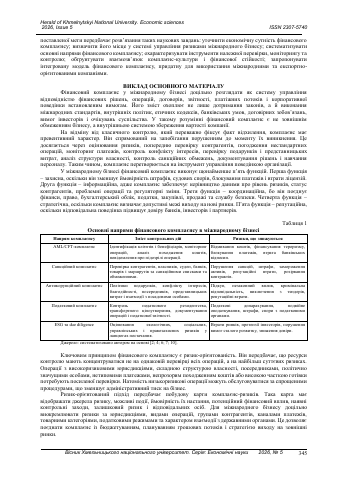
- Financial compliance in international business performs at least 5 functions, including protective, informational, coordination, strategic, and reputational roles.p.4
- Risk management and compliance frameworks rely on international standards such as ISO 31000:2018 and ISO 37301:2021.p.2
- Key European regulatory developments include Directive (EU) 2024/1760 on corporate sustainability due diligence and Directive (EU) 2022/2464 on corporate sustainability reporting.p.3
- The practical execution of financial compliance relies on a 3 lines of defense operational model dividing responsibilities across business units, risk/compliance functions, and internal audit.p.5
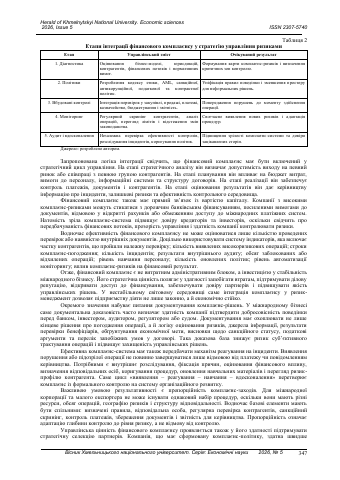
- The framework establishes 5 sequential stages for integrating financial compliance into enterprise risk management strategies.p.6
Key insights
- Financial compliance directly influences a firm's cost of capital, access to banking services, and foreign economic operation continuity.p.1
- Viewing compliance as a formal legal routine prevents companies from timely detecting multi-dimensional risks across tax, sanctions, and reputation.p.2
- Integrating compliance shifts an organization from reactive responses to proactive risk management.p.2
- RegTech adoption automates monitoring but creates model risks and reliance on data quality that require human management oversight.p.3
- Risk-based financial compliance concentrates monitoring resources on high-risk transactions and counterparties rather than equal checking.p.4
- Counterparty due diligence must investigate ultimate beneficial ownership and supply routes rather than relying solely on signed contracts.p.5
- Thorough documentation of compliance decisions provides necessary legal evidence of good faith to banks, auditors, and regulators.p.6
- Compliance acts as a screening mechanism that lowers long-term transaction costs and disputes by filtering out high-risk counterparties.p.7
Pages
 p.1
 p.2
 p.3
 p.4
 p.5
 p.6
 p.7
 p.8
 p.9
Topics and entities
Summary and figures generated from the document and checked automatically: every number shown appears on the cited page. Publishers can request removal.