Federal Reserve Dual Objectives and Conventional Monetary Policy Tools: A Review of Theory, Practice and Limitations (Advances in Economics Management and Political Sciences)
SaveSummary
- After the 2008 financial crisis the Federal Reserve refined its dual mandate of price stability and full employment, adopted a single and then an average inflation target, and returned to a traditional balance framework in 2025.p.1
- The review traces three rounds of target framework reform in 2012, 2020 and 2025.p.1
- In 2020 the Fed launched average inflation targeting, allowing inflation to run moderately above 2% for a period.p.3
- From 2020 to 2022 the Fed kept the federal funds rate near zero for a long time to support the labor market.p.3
- Conventional rate policy offers transmission efficiency, expectation management, target adaptation and policy withdrawal in stable or moderately fluctuating economies.p.4
- At the zero lower bound the policy rate is near zero, leaving no room for further easing.p.4
Key insights
- The rigid 2% single target could not fill inflation gaps built in low-inflation cycles and risked tightening too early against job recovery.p.3
- Under average inflation targeting the Fed would not rush to raise rates before broad full employment, even if inflation briefly exceeded 2%.p.3
- The federal funds rate quickly transmits to deposit and loan rates, corporate financing costs and household credit costs.p.4
- Rate decisions can be adjusted at each rate-setting meeting with a relatively short policy lag.p.4
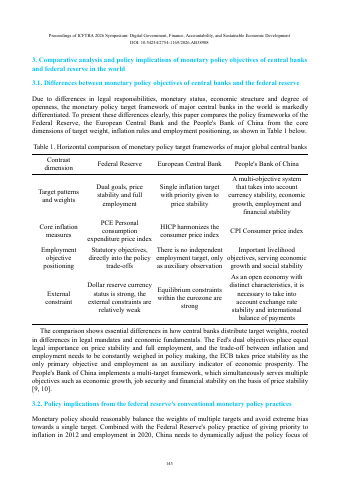
- The Fed, the European Central Bank and the People's Bank of China differ in target weights, inflation measures and employment positioning.p.5
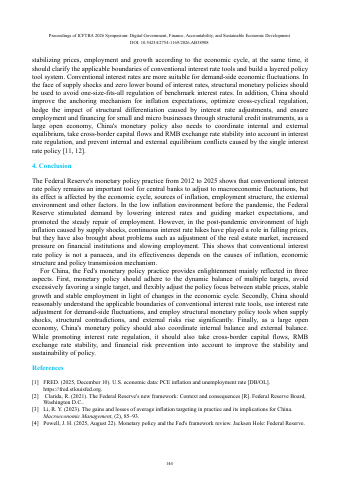
- Conventional interest rates suit demand-side fluctuations, while supply shocks and the zero lower bound call for structural monetary policies.p.6
- The paper concludes that conventional rate policy from 2012 to 2025 remains important but its effect depends on the economic cycle, the source of inflation and the external environment.p.6
Pages
 p.1
 p.2
 p.3
 p.4
 p.5
 p.6
 p.7
Funders mentioned
Topics and entities
Summary and figures generated from the document and checked automatically: every number shown appears on the cited page. Publishers can request removal.