Extreme Founder Control, Agency Conflicts, and Initial Market Reactions: Evidence from the SpaceX IPO (Advances in Economics Management and Political Sciences)
Summary
- The proportion of US technology firms adopting dual-class share structures at the IPO stage grew from 15% in 2012 to 50% in 2022.p.1
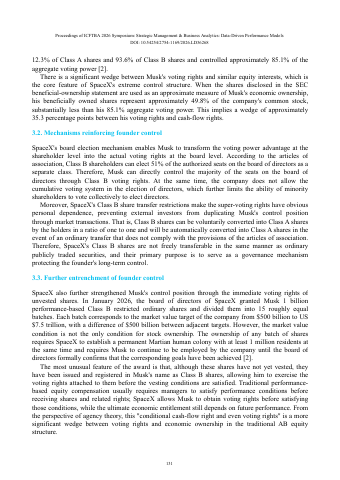
- In SpaceX's ownership structure as of May 1st, 2026, Elon Musk controlled approximately 85.1% of aggregate voting power while holding an estimated 49.8% economic ownership, creating a wedge of approximately 35.3 percentage points.p.4
- In January 2026, SpaceX granted Musk 1 billion performance-based Class B restricted shares across 15 batches tied to valuation targets between $500 billion and US $7.5 trillion, granting immediate voting rights prior to vesting.p.4
- SpaceX reported consolidated revenue of $18.674 billion in 2025, including $11.387 billion from Starlink and an operating profit of $4.423 billion.p.5
- Following its 2026 acquisition of xAI, SpaceX secured a $20 billion bridge loan and repaid approximately $18.905 billion of debt associated with X and xAI.p.5
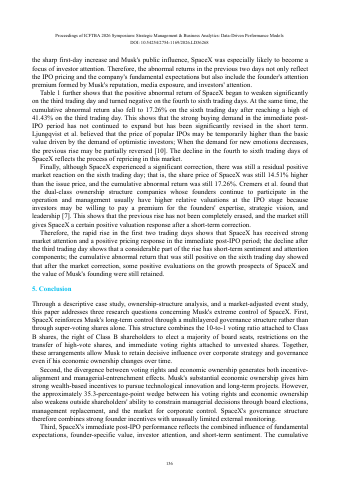
- In market-adjusted event-study analysis, SpaceX experienced a cumulative abnormal return of 41.43% by the third trading day following its IPO, which adjusted to 17.26% on the sixth trading day.p.8
Key insights
- Musk's beneficial ownership of approximately 49.8% of common stock provides wealth incentives to innovate, while excess voting power limits external shareholders' capacity to monitor or replace management.p.6
- Vesting of Musk's 2026 equity grant requires establishing a permanent Martian human colony with at least 1 million residents in addition to corporate market value targets.p.4
- Related-party transactions in 2025 included $144 million in goods and services purchased by SpaceX from Tesla and $506 million purchased by xAI from Tesla.p.5
- SpaceX's pre-IPO scale and internal cash generation reduced reliance on public equity markets, enhancing founder bargaining power against sunset clauses.p.6
- Agency costs in dual-class structures typically transmit through executive compensation, capital expenditure allocation, and related-party mergers and acquisitions.p.7
- Initial post-IPO stock returns exhibited an abnormal return of 18.92% on day one and 16.53% on day two before reversing into negative abnormal returns by day four.p.8
Pages
 p.1
 p.2
 p.3
 p.4
 p.5
 p.6
 p.7
 p.8
 p.9
 p.10
Topics and entities
Summary and figures generated from the document and checked automatically: every number shown appears on the cited page. Publishers can request removal.