Drivers and Barriers to Artificial Intelligence Adoption in the Banking Sector: Evidence from Cambodia (International Journal of Management and Economics Invention)
Summary
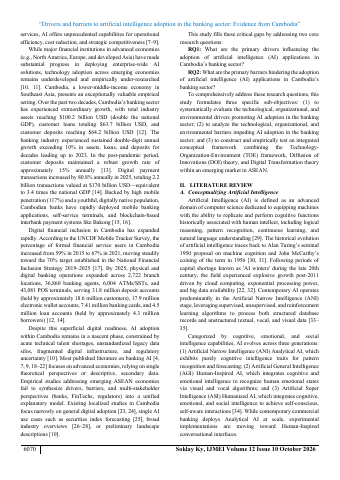
- Cambodia's banking sector total industry assets reached $100.2 billion USD, customer loans totaled $63.7 billion USD, and customer deposits reached $64.2 billion USD.p.2
- Digital payment transactions increased by 80.8% annually in 2025, totaling 2.2 billion transactions valued at $170 billion USD.p.2
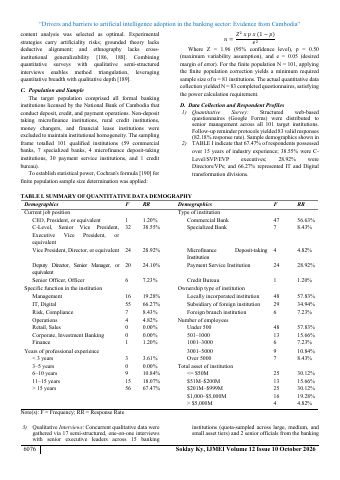
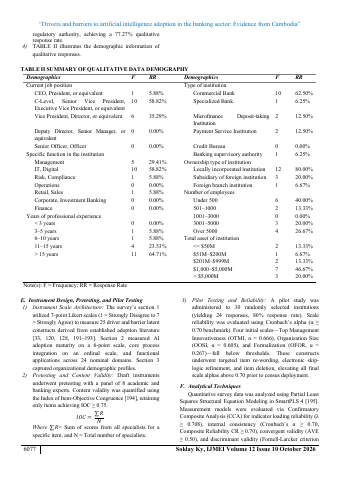
- The quantitative sampling frame comprised 101 qualified institutions, yielding 83 completed questionnaires from banking sector respondents.p.8
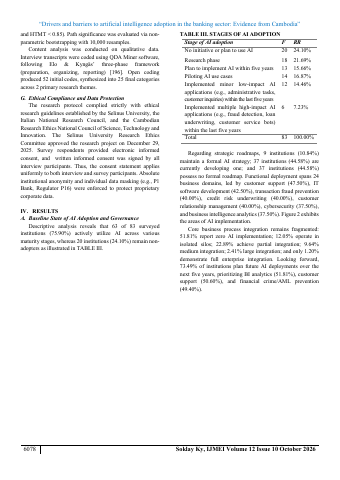
- A total of 63 of 83 surveyed institutions (75.90%) actively utilize AI across various maturity stages, whereas 20 institutions (24.10%) remain non-adopters.p.10
- Customer support represents the top area of active AI implementation across 24 business domains at 47.50%, followed by IT software development at 42.50%.p.10
- Core business process integration of AI remains fragmented, with 51.81% reporting zero AI implementation and only 1.20% demonstrating full enterprise integration.p.10
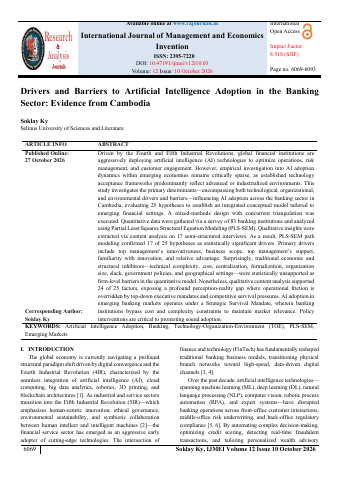
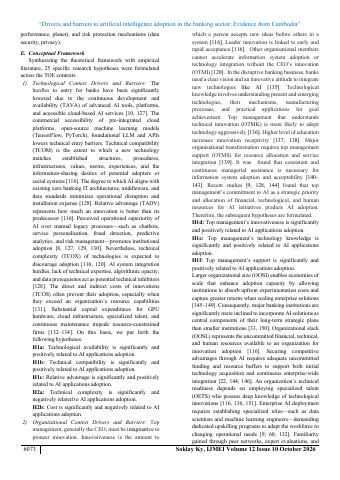
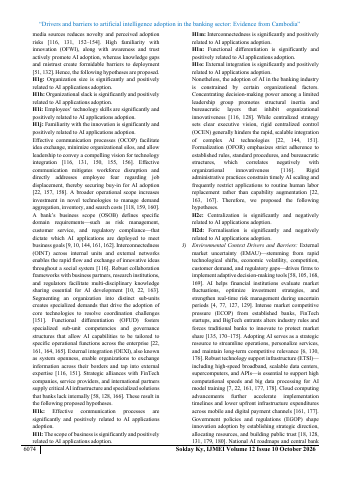
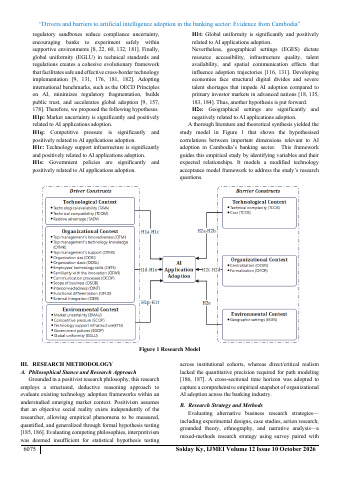
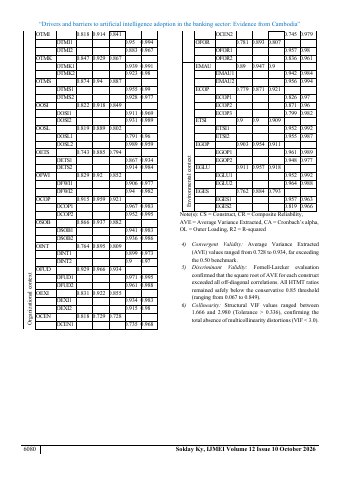
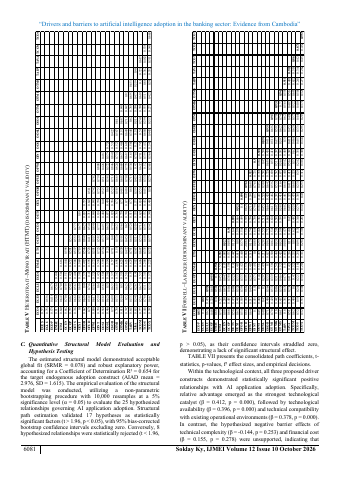
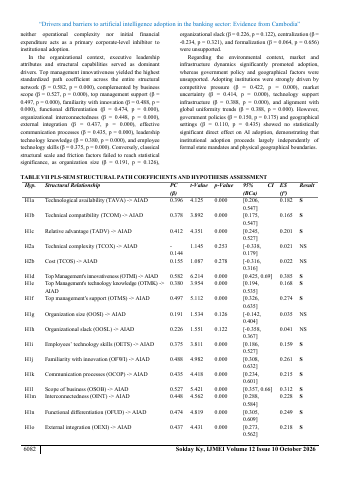
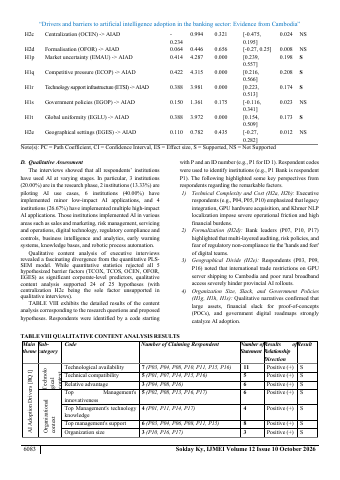
- PLS-SEM path modeling confirmed 17 of 25 hypotheses as statistically significant drivers of AI adoption in Cambodia's banking sector.p.1
Key insights
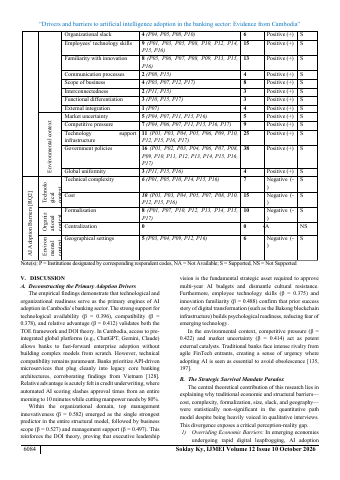
- Top management's innovativeness emerged as the strongest organizational predictor for AI adoption with a standardized path coefficient of 0.582 (p = 0.000).p.14
- Competitive pressure acts as a major environmental catalyst for adoption with a path coefficient of 0.422 (p = 0.000).p.14
- Government policies showed no statistically significant direct effect on AI adoption in the structural path model (β = 0.150, p = 0.175).p.14
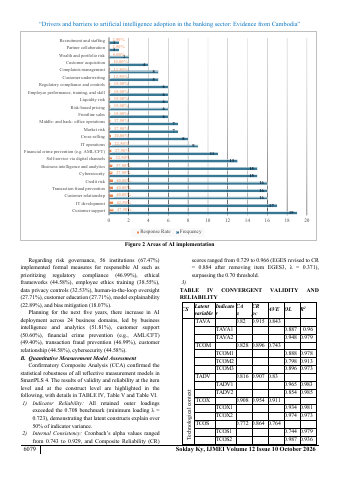
- Formal risk governance measures for responsible AI have been implemented by 56 institutions (67.47%).p.11
Pages
 p.1
 p.2
 p.3
 p.4
 p.5
 p.6
 p.7
 p.8
 p.9
 p.10
 p.11
 p.12
 p.13
 p.14
 p.15
 p.16
 p.17
 p.18
 p.19
 p.20
 p.21
 p.22
 p.23
 p.24
 p.25
Topics and entities
Summary and figures generated from the document and checked automatically: every number shown appears on the cited page. Publishers can request removal.