Corporate Management of Financial and Marketing Support for Cluster-Based Startup Entrepreneurship in Trade within an Innovation-Driven Economy (Financial and credit activity problems of theory and practice)
SaveWhat changed
0.75 probability
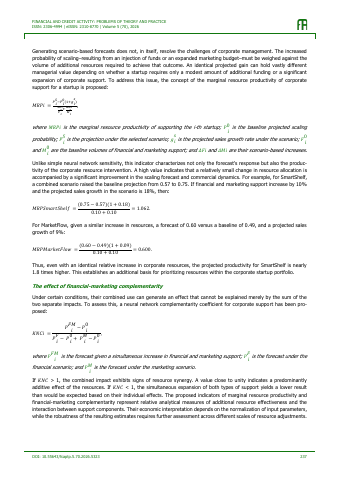
SmartShelf scaling probability under the combined scenario (baseline 0.57) p.6
Summary
- The study develops an adaptive framework for financial and marketing support of retail startup clusters, using neural network and scenario modeling.p.1
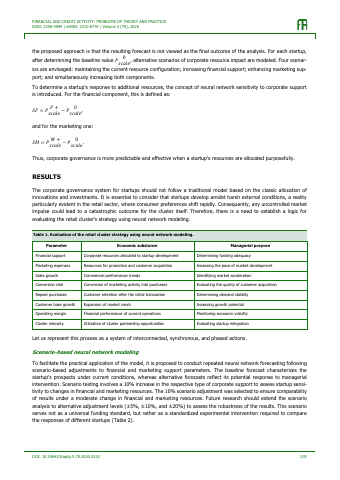
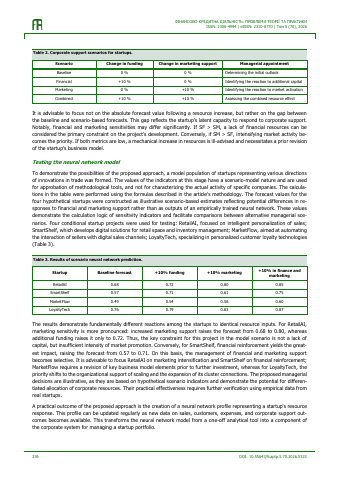
- Four scenarios are modeled: keeping the current resource configuration, increasing financial support, enhancing marketing support, and increasing both.p.4
- The test scenarios change funding and marketing support by +10%, with a baseline at 0%.p.5
- In an illustrative example, for SmartShelf a combined scenario raised the baseline projection from 0.57 to 0.75, with 10% more support and 18% projected sales growth.p.6
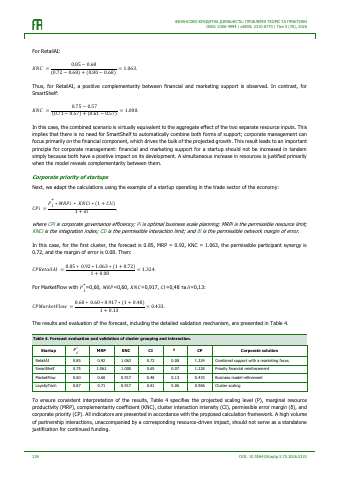
- For RetailAI the integration index KNC equals 1.063, indicating complementarity between financial and marketing support.p.7
- For SmartShelf the KNC equals 1.000, so the combined scenario is virtually equivalent to the sum of the two separate inputs.p.7
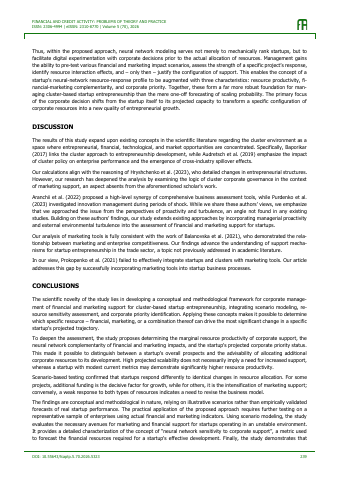
- The corporate priority indicator for the first cluster, RetailAI, is calculated at 1.324.p.7
Key insights
- Optimizing corporate support for startups does not always depend on investment funding but on a top manager's ability to adapt to market conditions.p.1
- Conventional startup assessment practices are suited to linear cluster models but not to current conditions, which motivates neural network modeling.p.2
- Neural network sensitivity to financial and marketing support is defined as the gap between scenario-based and baseline scaling forecasts.p.4
- If financial sensitivity exceeds marketing sensitivity, a lack of financial resources is the main constraint; if both are low, the startup's business model needs revision first.p.5
- The indicative values come from a model population of startups and are illustrative, not actual company data.p.5
- The marginal resource productivity indicator weighs the forecast gain against the additional resources needed to achieve it.p.6
- Financial and marketing support should not be increased in tandem unless the model reveals complementarity between them.p.7
- Neural network modeling lets management pre-test support scenarios before actually allocating resources.p.8
Pages
 p.1
 p.2
 p.3
 p.4
 p.5
 p.6
 p.7
 p.8
 p.9
 p.10
 p.11
Funders mentioned
Topics and entities
Summary and figures generated from the document and checked automatically: every number shown appears on the cited page. Publishers can request removal.