Collaborative Application Technology for Financial Risk Control Models under Privacy Preservation Constraints (Financial economics insights.)
SaveSummary
- The framework achieves 92.3% model accuracy relative to centralized baselines.p.1
- It reduces inter-party data leakage risk by 98.7% compared with conventional API-based aggregation.p.1
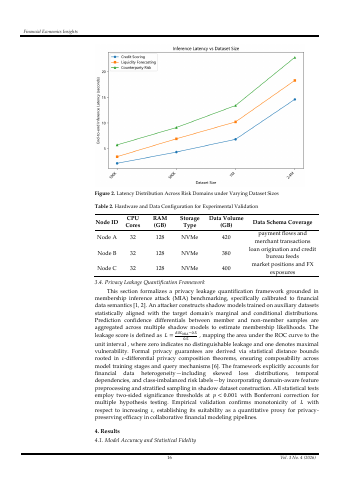
- Latency stays under 14.6 seconds per inference cycle for datasets up to 2.4 million transaction records.p.1
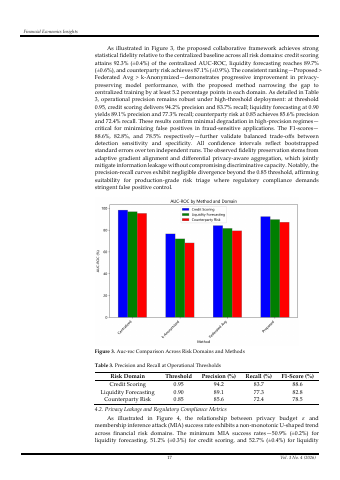
- Credit scoring reaches 92.3% of the centralized AUC-ROC, liquidity forecasting 89.7% and counterparty risk 87.1%.p.7
- F1-scores are 88.6%, 82.8% and 78.5% respectively across the three risk domains.p.7
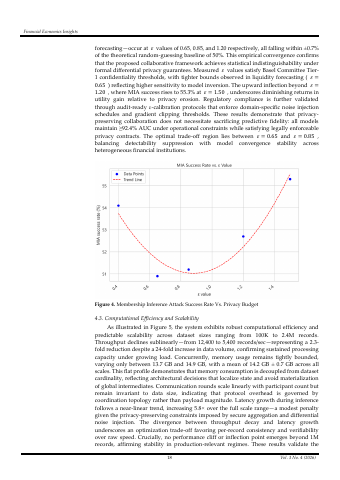
- Removing sensitivity classification raises membership inference attack success by 12.4 percentage points.p.9
Key insights
- The system combines secure multi-party computation, homomorphic encryption and differential privacy so that raw client data is never shared.p.1
- Three banking scenarios are tested: fraud pattern detection, federated stress testing and portfolio correlation analysis.p.1
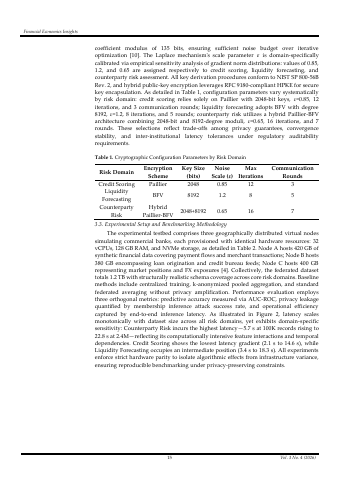
- Credit scoring uses Paillier with 2048-bit keys, 12 iterations and 3 communication rounds.p.5
- The proposed method ranks above Federated Avg and k-Anonymized in every risk domain.p.7
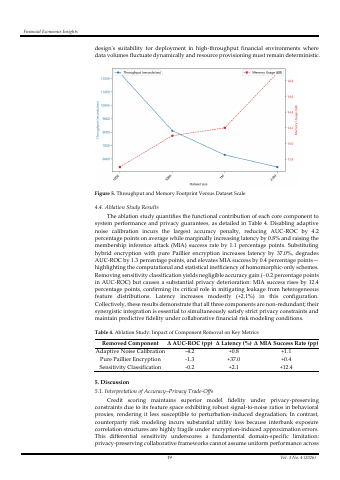
- Throughput declines from 12,400 to 5,400 records/sec as data volume grows.p.8
- Disabling adaptive noise calibration reduces AUC-ROC by 4.2 percentage points on average.p.9
- Replacing hybrid encryption with pure Paillier increases latency by 37.0%.p.9
Pages
 p.1
 p.2
 p.3
 p.4
 p.5
 p.6
 p.7
 p.8
 p.9
 p.10
 p.11
 p.12
Funders mentioned
Topics and entities
Summary and figures generated from the document and checked automatically: every number shown appears on the cited page. Publishers can request removal.