Assessment of Technological and Managerial Readiness for Economic Subsidies: A Case Study of Five Startups in Manaus (Artefactum)
Summary
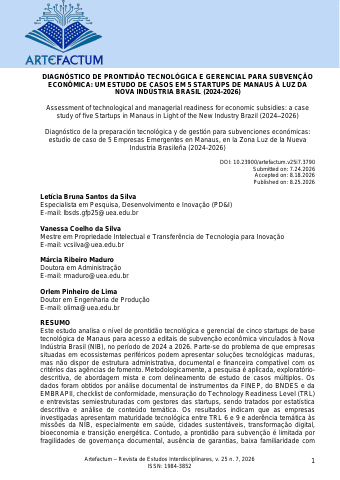
- The study evaluated 5 technology-based startups in Manaus to measure their technological and managerial readiness to access non-reimbursable public grants under the Nova Indústria Brasil (NIB) policy for 2024 to 2026.p.1
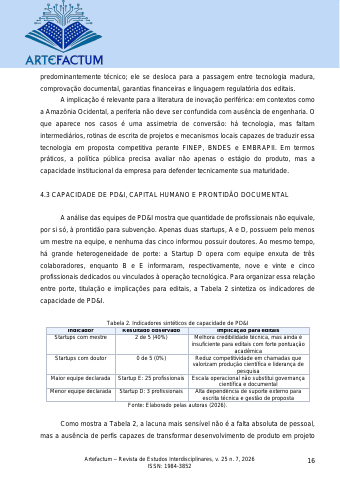
- Only 2 of 5 startups (40%) have team members with a Master's degree, while 0% have team members with a PhD.p.16
- Team sizes vary significantly across the sample, ranging from 3 professionals at Startup D to 25 professionals at Startup E.p.16
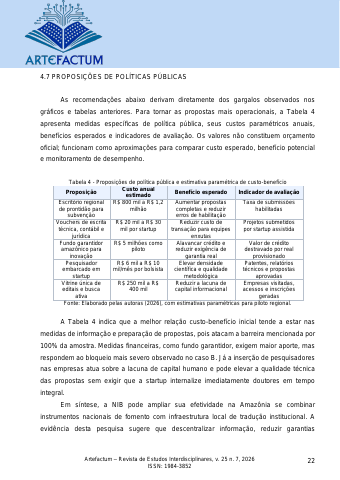
- To address these bottlenecks, the paper proposes a regional subsidy readiness office estimated at R$ 800 mil a R$ 1,2 milhão annually and technical vouchers of R$ 20 mil a R$ 30 mil per startup.p.22
Key insights
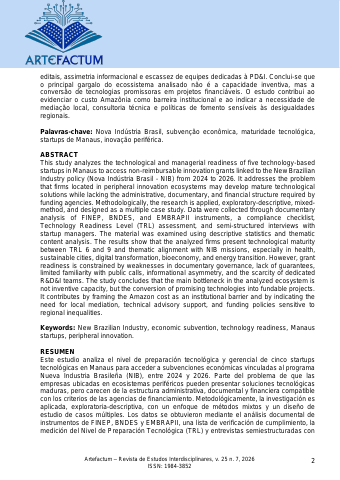
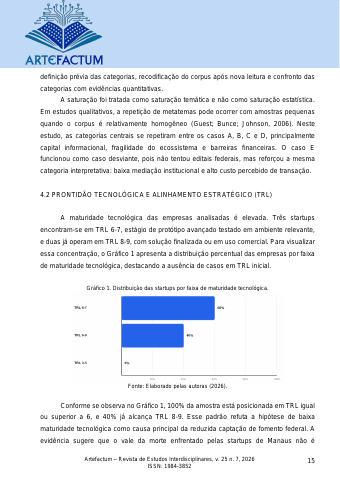
- All analyzed startups reached TRL 6 or higher, proving that inventive capability is not the main bottleneck for peripheral startups seeking innovation grants.p.15
- None of the 5 startups have a PhD on their R&D team, which penalizes their score in public calls that heavily weight scientific leadership.p.16
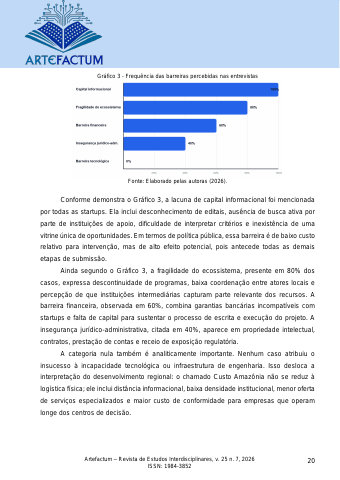
- Financial barriers such as collateral and guarantee requirements affect 60% of firms, creating a structural blocker for credit-based funding from institutions like BNDES.p.20
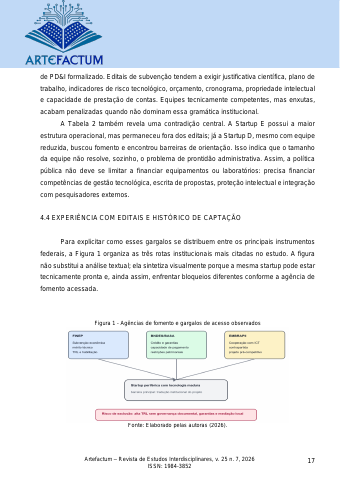
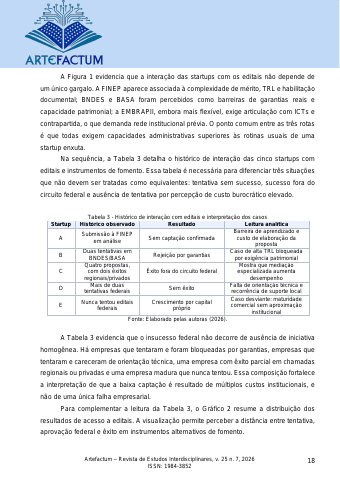
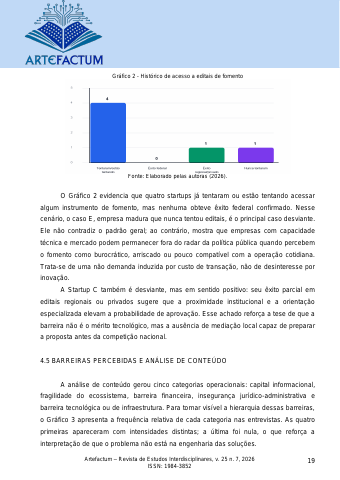
- Startup E achieved TRL 8-9 and built a 25-person team via bootstrapping but never applied for federal grants due to perceived administrative costs.p.16
- Startup C successfully secured funding in regional and private calls by using specialized technical mediation, illustrating the impact of structured proposal guidance.p.18
- The Custo Amazônia acts as an institutional barrier, imposing higher compliance costs, informational distance, and lower density of technical advisors.p.20
Pages
 p.1
 p.2
 p.3
 p.4
 p.5
 p.6
 p.7
 p.8
 p.9
 p.10
 p.11
 p.12
 p.13
 p.14
 p.15
 p.16
 p.17
 p.18
 p.19
 p.20
 p.21
 p.22
 p.23
 p.24
 p.25
 p.26
Topics and entities
Summary and figures generated from the document and checked automatically: every number shown appears on the cited page. Publishers can request removal.