Adaptive Credit Risk Prediction Under Concept Drift Using Graph Neural Networks and Gradient Boosting (Research Square)
SaveSummary
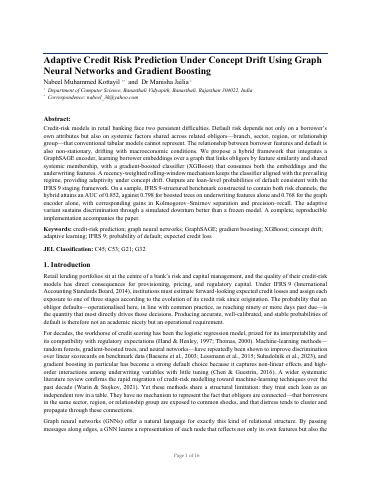
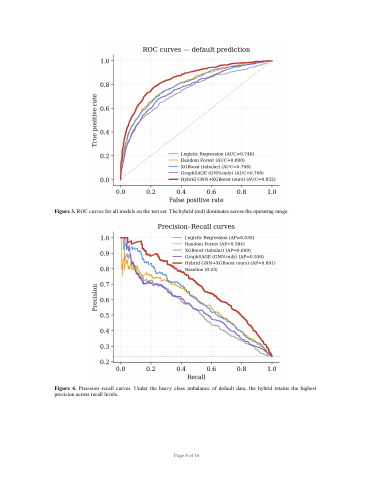
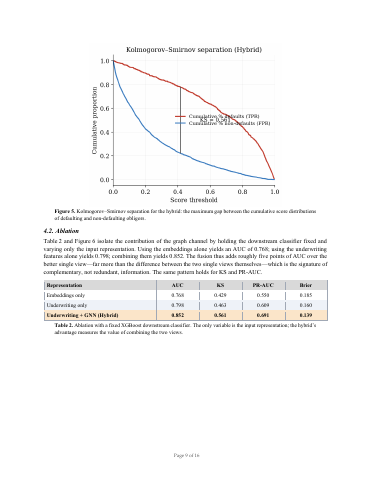
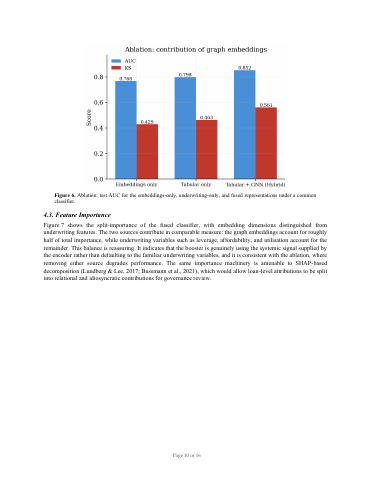
- The proposed hybrid model combining a GraphSAGE encoder and XGBoost achieves an AUC of 0.852, outperforming standalone boosted trees on underwriting features (0.798) and a graph encoder alone (0.768).p.2
- The credit risk framework outputs loan-level probabilities of default aligned with the IFRS 9 staging requirements for expected credit loss calculations.p.2
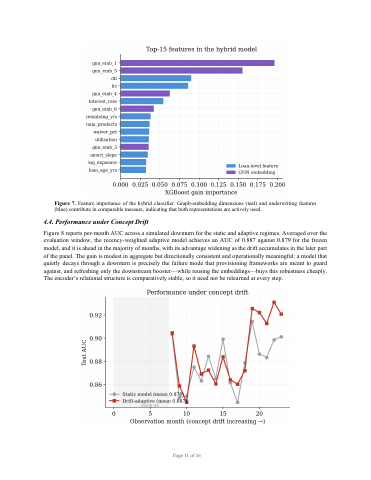
- Under concept drift in a simulated panel, the recency-weighted adaptive model maintains an average AUC of 0.887 compared to 0.879 for a frozen static model.p.12
- Feature importance analysis shows that graph-embedding dimensions account for roughly half of total split importance in the fused downstream booster.p.11
- The adaptive scheme uses an eight-month rolling window with an exponential recency time constant of three months to dynamically retrain only the classifier.p.8
Key insights
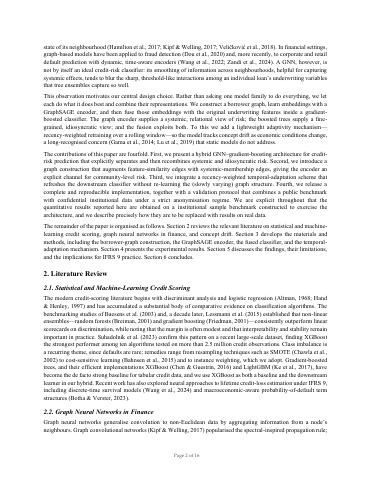
- Combining relational systemic borrower embeddings with fine-grained tabular underwriting variables overcomes the individual limitations of GNNs and tree ensembles.p.3
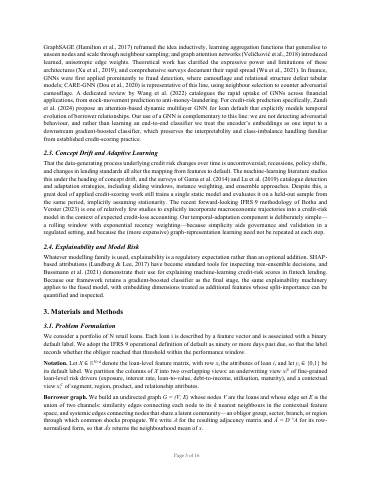
- Constructing borrower graphs using both feature similarity edges and systemic-membership edges allows models to recover community-level risk signals.p.3
- Separating the adaptation timescales by updating only the downstream classifier allows inexpensive tracking of concept drift without re-learning slow-moving graph structures.p.6
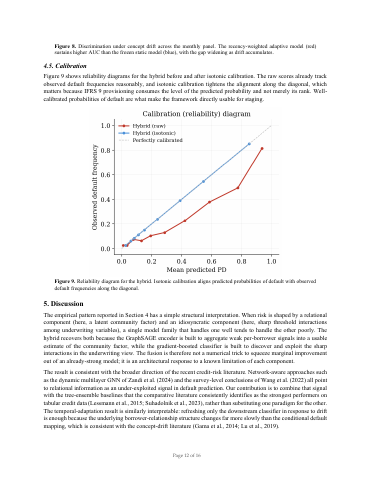
- Isotonic regression effectively calibrates raw boosting scores to align predicted default probabilities with observed frequencies for regulatory IFRS 9 staging.p.7
- Static credit scoring models suffer performance degradation during economic downturns compared to rolling-window models with recency weighting.p.12
Pages
 p.1
 p.2
 p.3
 p.4
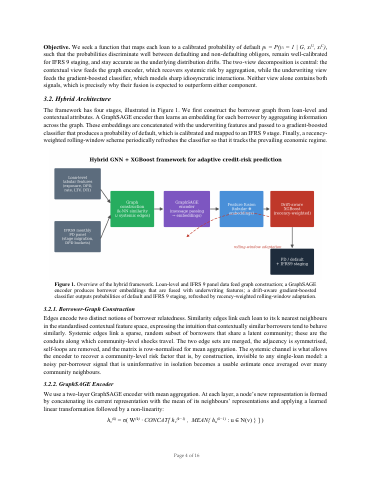 p.5
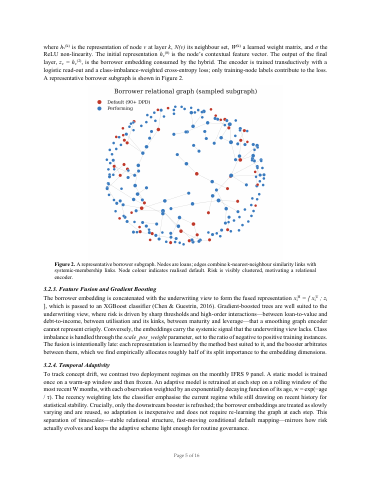 p.6
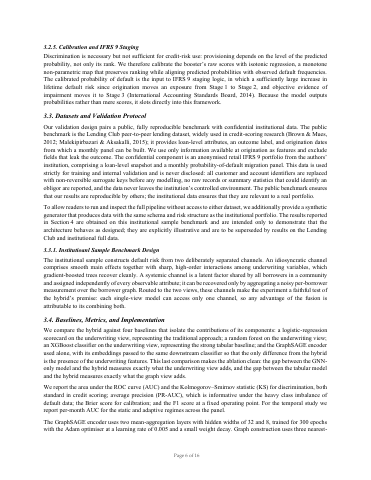 p.7
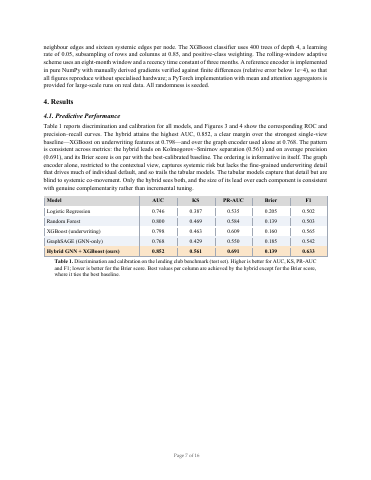 p.8
 p.9
 p.10
 p.11
 p.12
 p.13
 p.14
 p.15
 p.16
 p.17
Funders mentioned
Topics and entities
Summary and figures generated from the document and checked automatically: every number shown appears on the cited page. Publishers can request removal.