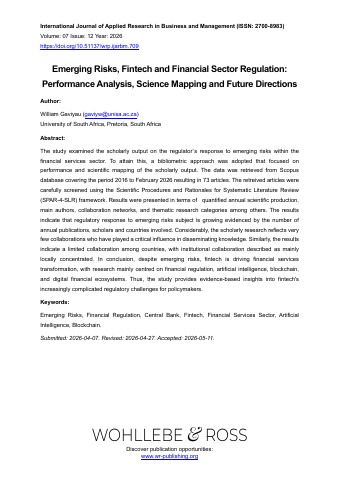
Emerging Risks, Fintech and Financial Sector Regulation: Performance Analysis, Science Mapping and Future Directions
The document dataset involved 177 authors with an average citation rate of 18.79 per document and an average age of 3.56 years.
58 documents
The document dataset involved 177 authors with an average citation rate of 18.79 per document and an average age of 3.56 years.
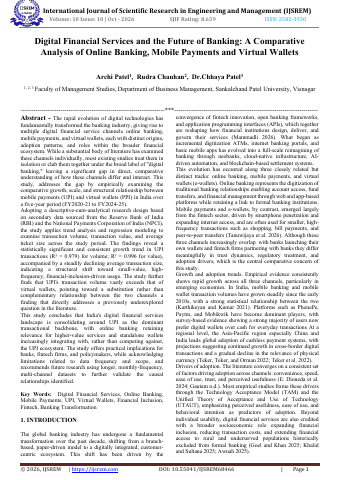
UPI transaction volume grew continuously over five years from 2,233 crore transactions in FY2020-21 to 18,585 crore transactions in FY2024-25.
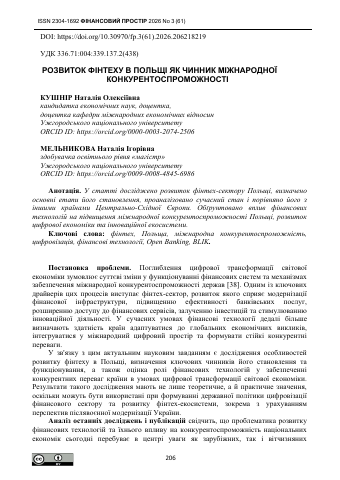
Poland's fintech ecosystem includes over 400 active companies employing over 22,000 people.
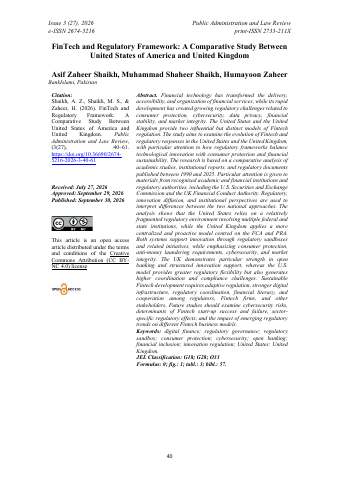
In 1967, Barclays introduced an early automated teller machine (ATM) in the United Kingdom, establishing 24/7 self-service consumer banking access.
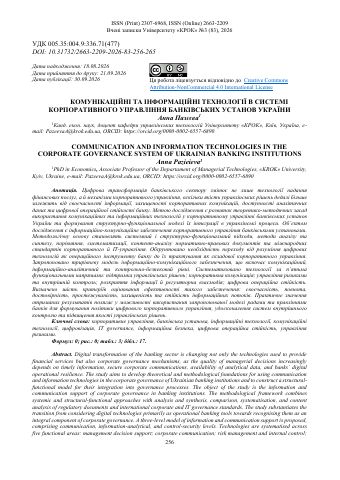
The paper presents a structural-functional model featuring 3 levels of information and communication support for corporate governance in banks.
In 2024, private banks closed 856 physical branch units across Brazil.
Automated teller machines (ATMs) introduced in the 1970s marked the first major shift toward remote banking access.
Cashless payment card transactions accounted for 65.4% of the total value of payment card transactions in Ukraine as of 1 January 2026.
The global FinTech market is projected to reach 938–1250 млрд дол. США in the 2026–2035 period.
The study analyzes Market Sophistication indicators based on data from the Global Innovation Index 2025 across CEE economies.
Global bank investments in corporate lending reached $37.3 trillion as of early 2026, marking an increase of almost 70% over a 10-year period.
The deployment of AI-powered intelligent customer service systems has reduced the inquiry volume handled by human representatives by 30% to 40% in many commercial banks.
The study evaluates the dynamics of remote banking service users and digital transaction volume in Uzbekistan across the 2021–2025 period.
Directive (EU) 2023/2225 of 18 October 2023 expands European Union consumer credit regulations to cover loans under €200 which were previously excluded.
In Full Year 2025, the Open Banking fraud rate by volume was 0.017% compared to 0.043% for the wider industry.
In 2024, approximately 37 million adults in Colombia, accounting for 96 % of the adult population, held at least one financial product, while active usage reached 79 %.
In the Riksbank's survey, 91 per cent of respondents used Swish in the past month, making mobile payments increasingly widespread.
Investment firms with total consolidated assets of €30 billion or more are categorized as credit institutions under Article 4 of Regulation (EU) No 575/2013.
Major South Korean banks demonstrate foreign exchange markups that are typically less than 1% over mid-market rates.
A total of 8 G20 members achieved the highest score of 5/5 for direct access of non-bank payment service providers in 2025.
In a survey of 1,553 small retail and service businesses conducted in autumn 2024, card payments were the most accepted payment method.
The document outlines next steps for commercial variable recurring payments across a total of 31 pages.
The G20 Roadmap for Enhancing Cross-Border Payments (2020 - 2027) focuses on 5 main priority focus areas divided into 19 building blocks.
In 2021, there were more than 300 million users of digital payments and more than 30 million users of digital banks across Latin America.
Financial executive sentiment towards open banking increased from 55% in 2019 to 71% in 2021, with 83% agreeing it is a revolution for the industry.
European ecommerce sales are projected by JP Morgan to reach €940 billion by 2023.
Global fintech investment across M&A, PE, and VC reached $135.7 billion across 2,693 deals in 2019.
Venture capital investment in private cloud companies in Europe and Israel reached $9-9.5bn YTD 2020, up from $7-7.5bn in 2019 YTD.