Venture Capital in India: A Critical Analysis of the Legal and Regulatory Framework (Zenodo)
SaveSummary
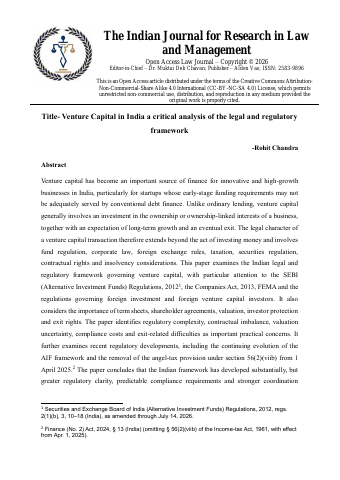
- Venture capital in India operates under a multi-layered framework encompassing SEBI's AIF Regulations, the Companies Act, 2013, FEMA, and tax laws.p.1
- Category I AIFs under SEBI regulations encompass venture capital funds and other funds operating in socially or economically desirable sectors.p.5
- SEBI issued a Master Circular for AIFs in June 2026 and introduced regulatory amendments to the AIF Regulations as recently as July 2026.p.5
- Private placement capital raising by private startups is governed primarily under section 42 and section 62 of the Companies Act, 2013.p.5
- Investments by non-residents require adherence to FEMA and the Foreign Exchange Management (Non-Debt Instruments) Rules, 2019.p.6
- Foreign venture capital investment is governed under the Foreign Venture Capital Investors Regulations, 2000, which were amended in July 2026.p.7
Key insights
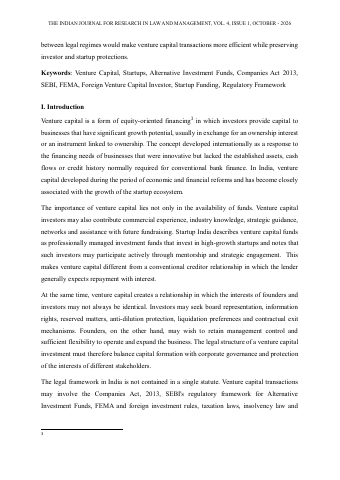
- Venture capital provides equity-oriented financing to high-growth startups lacking conventional debt collateral or established cash flows.p.2
- The SEBI AIF Regulations, 2012 shifted venture capital from informal investment channels into a regulated fund structure.p.5
- Private company fundraising requires careful structuring to avoid unintentionally crossing the threshold into a regulated public offering.p.6
- Foreign investor transactions must be analyzed for foreign exchange pricing and reporting rules in addition to corporate law compliance.p.6
- Omission of the angel-tax provision mitigates tax risks on share issuances above fair value but leaves core valuation requirements intact.p.7
- Equity venture capital investors do not automatically hold the standing of secured creditors under the Insolvency and Bankruptcy Code, 2016.p.7
- Contractual investor protections in shareholders' agreements must align with mandatory company-law and statutory corporate governance requirements.p.8
- Bargaining imbalances in early-stage rounds can lead founders to accept overly restrictive veto, anti-dilution, and liquidation preference terms.p.10
Pages
 p.1
 p.2
 p.3
 p.4
 p.5
 p.6
 p.7
 p.8
 p.9
 p.10
 p.11
 p.12
 p.13
Topics and entities
Summary and figures generated from the document and checked automatically: every number shown appears on the cited page. Publishers can request removal.