Value-Up Initiatives as a Strategy for Corporate Governance and Capital Market Development: Lessons from Asia (Academic research)
SaveSummary
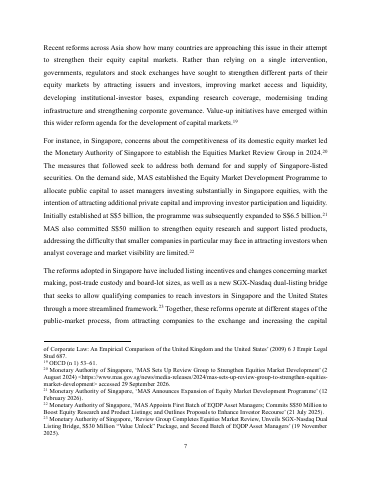
- The Monetary Authority of Singapore expanded its Equity Market Development Programme from an initial S$5 billion to S$6.5 billion to allocate public capital to asset managers investing in domestic equities.p.10
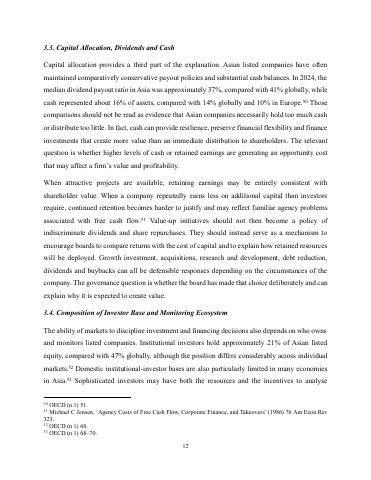
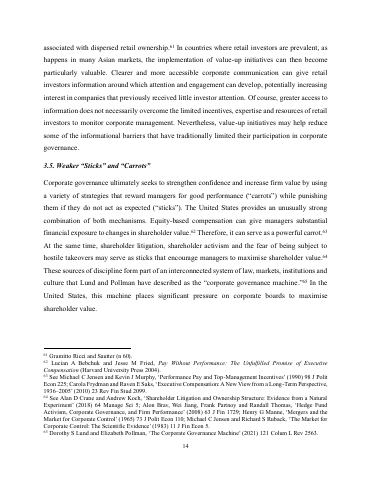
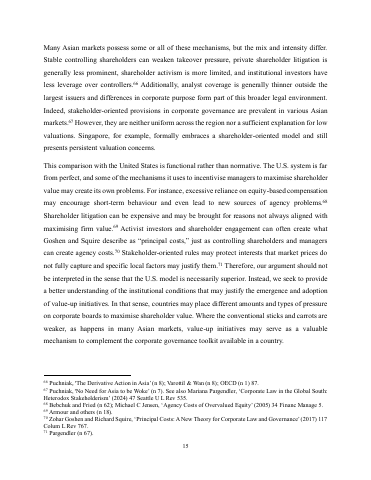
- In 2024, Asian listed companies recorded a median dividend payout ratio of approximately 37% compared with 41% globally, while cash balances represented about 16% of total assets.p.15
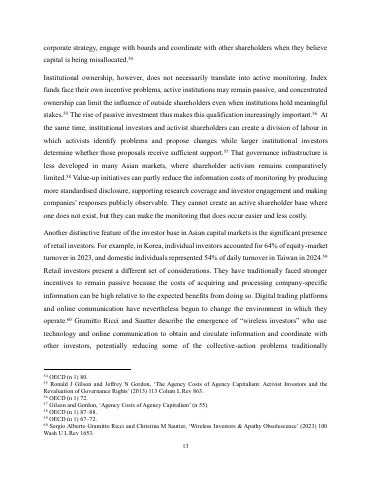
- Institutional investors accounted for approximately 21% of Asian listed equity in contrast to 47% globally, reflecting a shallower institutional monitoring base across regional markets.p.15
- By the end of February 2026, 93% of Tokyo Stock Exchange Prime Market companies (1,472 of 1,590) and 51% of Standard Market companies (807 of 1,570) had published disclosures under the capital efficiency request.p.22
- Between July 2022 and March 2026, the share of Prime Market companies trading with a PBR below 1.0 decreased from roughly 50% to 27%, while the Standard Market share dropped from 64% to 49%.p.22
Key insights
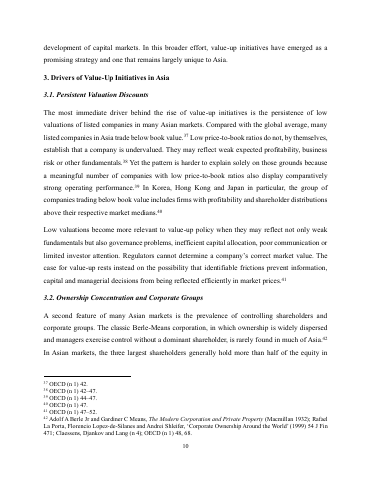
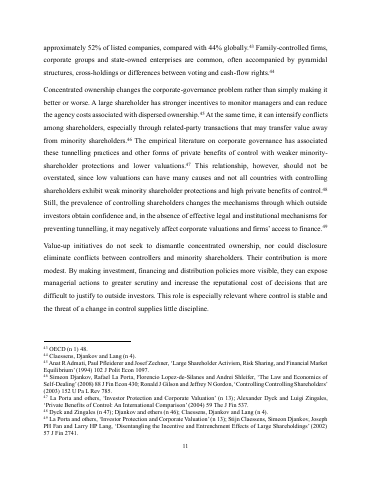
- Value-up initiatives have spread across Asian jurisdictions to mitigate persistent valuation discounts driven by ownership concentration, conservative capital allocation, and limited institutional investor monitoring.p.8
- Rather than relying on mandatory capital distributions, value-up initiatives operate as a distinctive corporate governance mechanism that prompts boards to evaluate capital costs and communicate long-term strategy.p.7
- The Tokyo Stock Exchange reinforced its valuation framework by launching the JPX Prime 150 Index on 3 July 2023 to highlight value-creating companies based on equity spread and price-to-book metrics.p.21
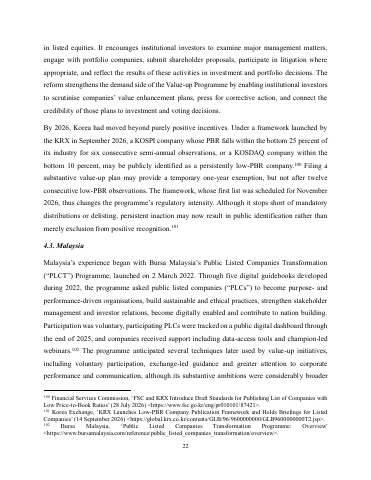
- Korea established a framework in September 2026 under which companies in the bottom 25 percent of PBR on KOSPI or bottom 10 percent on KOSDAQ over six consecutive observations are publicly identified.p.25
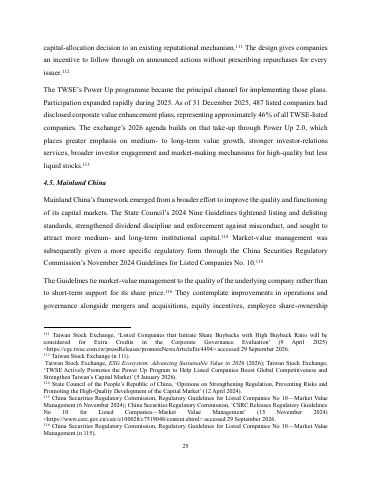
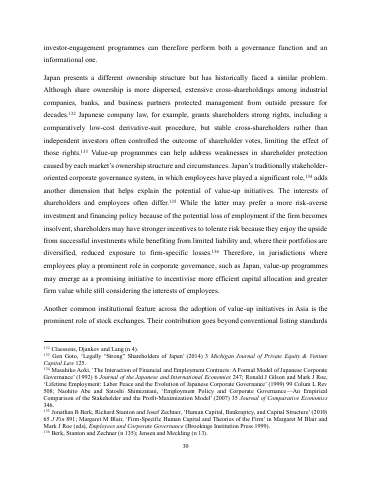
- Mainland China adopted a prescriptive regulatory model requiring index constituents and companies persistently trading below book value to establish internal market-value management systems.p.29
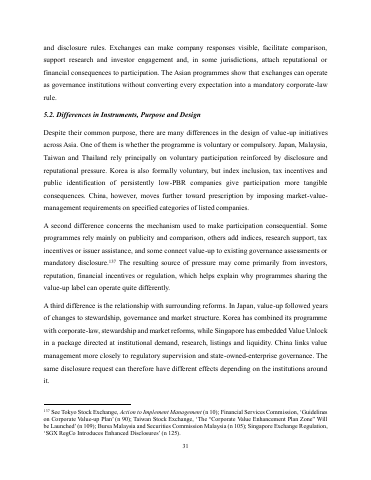
- Singapore introduced mandatory SGX listing rule amendments effective 1 January 2027 requiring issuers to disclose links between executive pay and long-term value creation alongside explicit dividend and investor relations policies.p.31
- In the first half of 2026, Japan recorded 52 new shareholder activist campaigns out of 184 worldwide, setting a historical record for the period.p.39
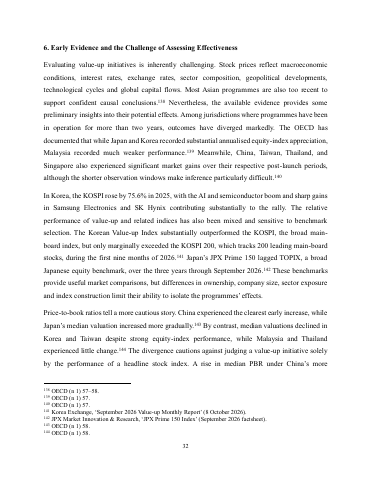
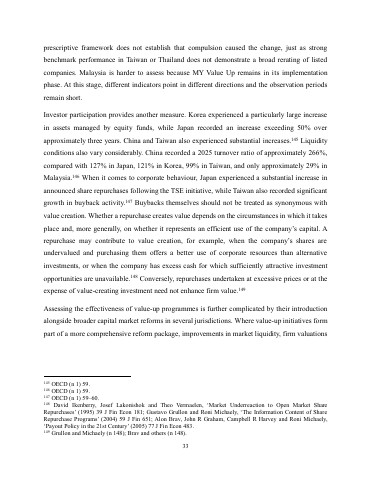
- Early empirical evidence shows that strong broad equity index performance across Asia has not consistently produced widespread increases in median corporate price-to-book ratios.p.35
Pages
 p.1
 p.2
 p.3
 p.4
 p.5
 p.6
 p.7
 p.8
 p.9
 p.10
 p.11
 p.12
 p.13
 p.14
 p.15
 p.16
 p.17
 p.18
 p.19
 p.20
 p.21
 p.22
 p.23
 p.24
 p.25
 p.26
 p.27
 p.28
 p.29
 p.30
 p.31
 p.32
 p.33
 p.34
 p.35
 p.36
 p.37
 p.38
 p.39
 p.40
 p.41
 p.42
 p.43
 p.44
 p.45
 p.46
 p.47
Funders mentioned
Topics and entities
Summary and figures generated from the document and checked automatically: every number shown appears on the cited page. Publishers can request removal.