The Role of the International Financial Center in Transforming Vietnam's Growth Model (Zenodo)
SaveSummary
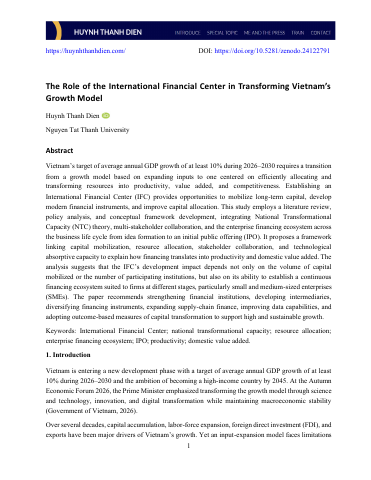
- Vietnam's target of average annual GDP growth of at least 10% during 2026–2030 requires a shift from expanding inputs to efficiently transforming resources into productivity and value added.p.1
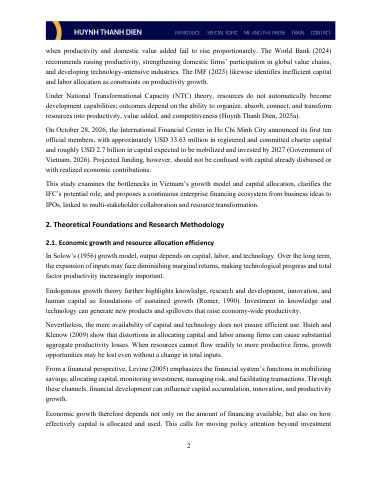
- The International Financial Center in Ho Chi Minh City announced its first ten official members, with approximately $33.63 million in registered and committed charter capital.p.2
- Roughly $2.7 billion in capital is expected to be mobilized and invested by 2027, but projected funding should not be confused with capital already disbursed.p.2
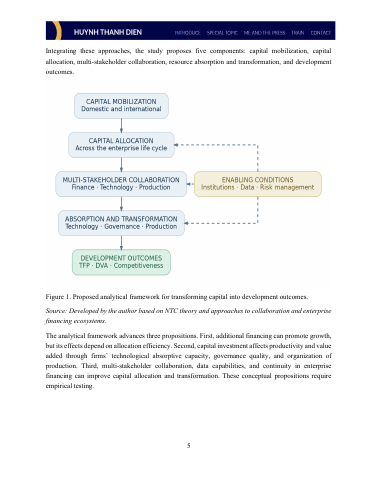
- Vietnam's financial system relies substantially on bank credit, while equity markets, corporate bonds and investment funds have not fully developed as long-term financing channels.p.6
- The study identifies three core developmental functions of the IFC: broadening access to long-term capital, improving allocation efficiency, and transforming capital into productive capabilities.p.8
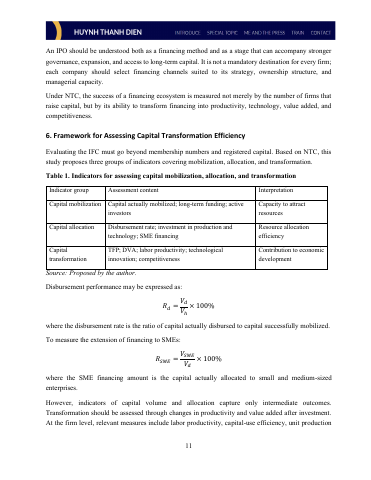
- The paper proposes three groups of indicators covering capital mobilization, allocation and transformation to assess the IFC beyond membership numbers and registered capital.p.11
Key insights
- The IFC's development impact depends not only on the volume of capital mobilized but on building a continuous financing ecosystem suited to firms at different stages, particularly SMEs.p.1
- Projected funding should not be confused with capital already disbursed or with realized economic contributions.p.2
- Credit decisions in Vietnam often place considerable weight on collateral, which favors asset-rich firms over innovative firms with intangible assets.p.6
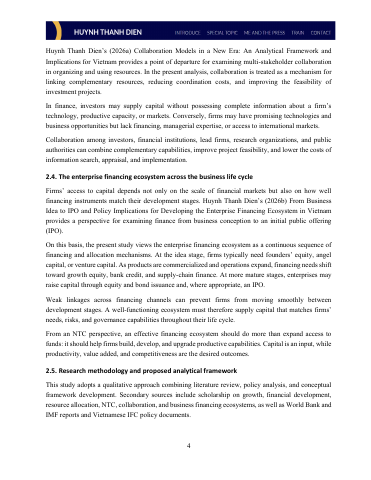
- Gaps between financing stages can interrupt firm development and leave promising technology-intensive businesses unable to scale.p.7
- Registered capital, committed capital, successfully mobilized funds and actual disbursements must be clearly distinguished.p.8
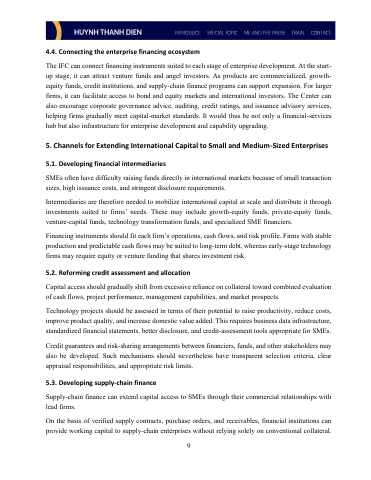
- The IFC can connect venture funds, growth-equity funds, credit institutions and bond and equity markets to firms at each stage of development.p.9
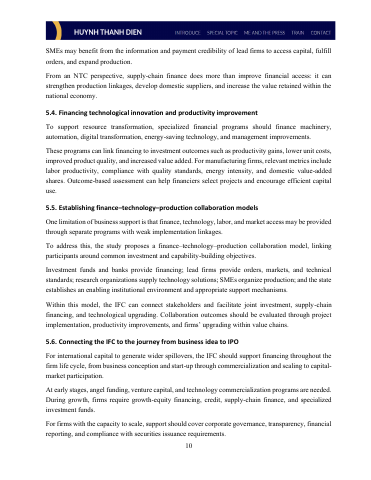
- Supply-chain finance can strengthen production linkages and increase the value retained within the national economy.p.10
- An IPO is not a mandatory destination for every firm; each company should select financing channels suited to its strategy and capacity.p.11
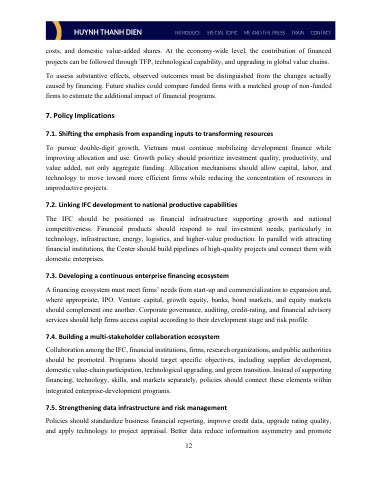
- Future studies could compare funded firms with a matched group of non-funded firms to estimate the additional impact of financial programs.p.12
Pages
 p.1
 p.2
 p.3
 p.4
 p.5
 p.6
 p.7
 p.8
 p.9
 p.10
 p.11
 p.12
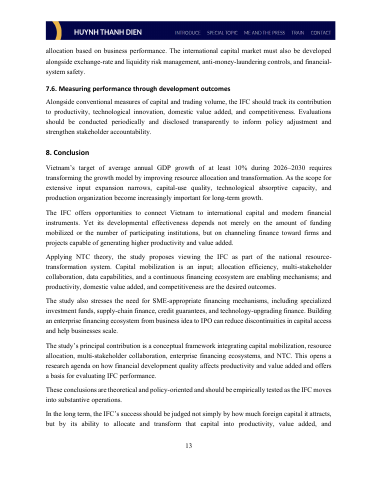 p.13
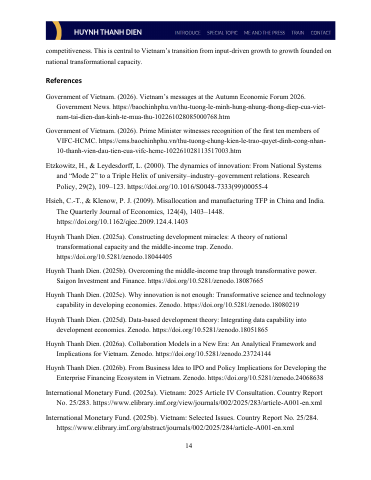 p.14
 p.15
Funders mentioned
Topics and entities
Summary and figures generated from the document and checked automatically: every number shown appears on the cited page. Publishers can request removal.