The Impact of Sustainability Rating Scores, Greenhouse Gas Intensity, and Financial Performance on Firm Value of Listed Companies in the Stock Exchange of Thailand Sustainability Index (International Business Research)
SaveSummary
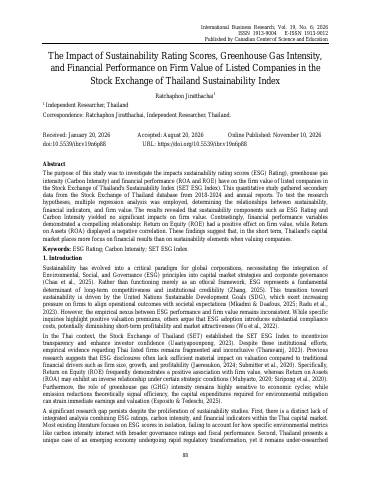
- The study uses secondary data from the Stock Exchange of Thailand database for 2018-2024 and annual reports.p.1
- ESG Rating and Carbon Intensity had no significant impact on firm value.p.1
- Return on Equity had a positive effect on firm value, while Return on Assets showed a negative relationship.p.1
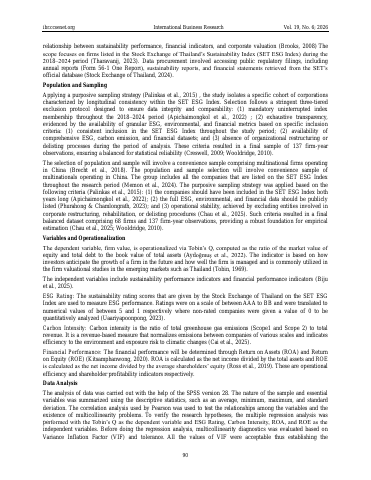
- The final sample comprises 137 firm-year observations.p.3
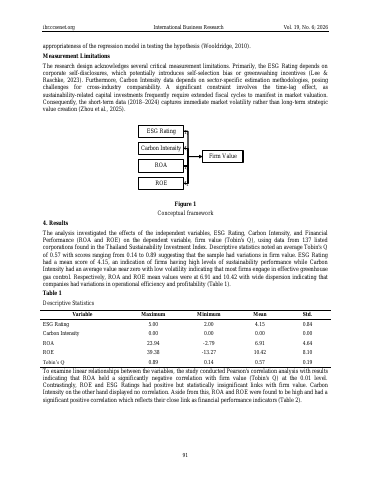
- Average Tobin's Q was 0.57, ranging from 0.14 to 0.89.p.4
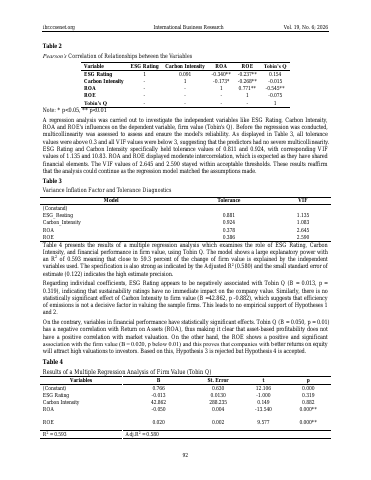
- The regression model reports an R2 of 0.593, about 59.3 percent of the change in firm value.p.5
Key insights
- Thailand's capital market places more focus on financial results than on sustainability elements when valuing companies in the short term.p.1
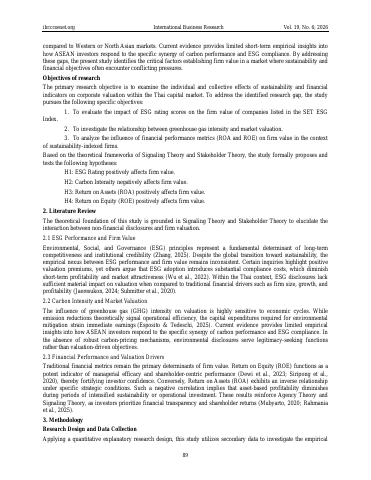
- The study tests four hypotheses on ESG Rating, Carbon Intensity, ROA and ROE.p.2
- ESG Rating depends on corporate self-disclosures, which may introduce self-selection bias or greenwashing incentives.p.4
- Mean ROA and ROE values were 6.91 and 10.42, with wide dispersion.p.4
- ROA is negatively correlated with Tobin's Q at -0.545.p.5
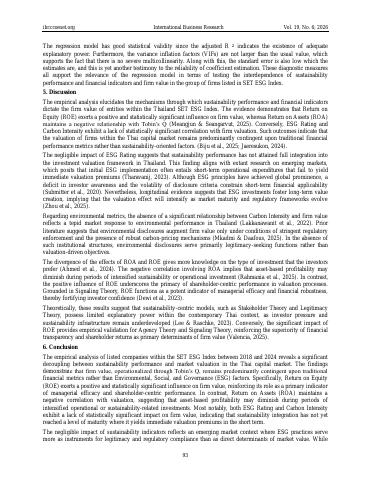
- ESG Rating has not been fully integrated into the investment valuation framework in Thailand.p.6
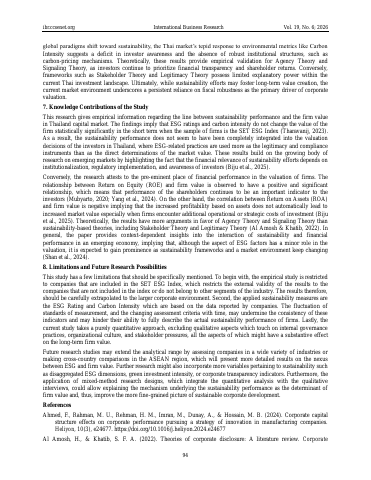
- The lack of carbon-pricing mechanisms and investor awareness is suggested as a reason for the weak response to Carbon Intensity.p.7
Pages
 p.1
 p.2
 p.3
 p.4
 p.5
 p.6
 p.7
 p.8
 p.9
 p.10
 p.11
Funders mentioned
Topics and entities
Summary and figures generated from the document and checked automatically: every number shown appears on the cited page. Publishers can request removal.