The Economic Impacts of Regulating Artificial Intelligence on Latin American Emerging Markets: Innovation, Compliance Costs, and Digital Competitiveness (Artefactum)
SaveSummary
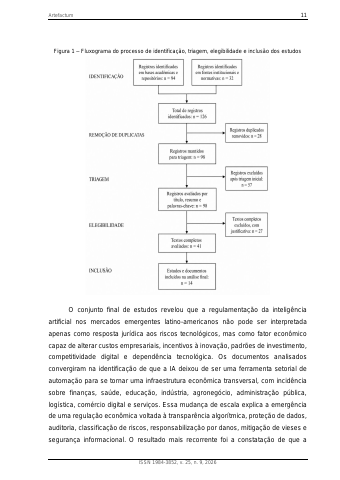
- The literature and documentary search identified 126 records on AI regulation, the digital economy and Latin American emerging markets.p.10
- After 41 full texts were assessed, 14 studies and documents were included in the final corpus.p.10
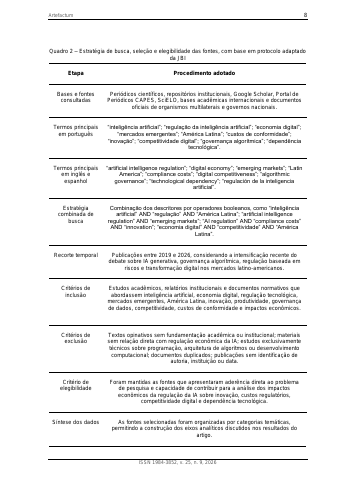
- The review covers publications between 2019 and 2026.p.8
- Among the 14 included studies, results cluster into three main lines: productivity and competitiveness, barriers to AI adoption, and compliance costs.p.12
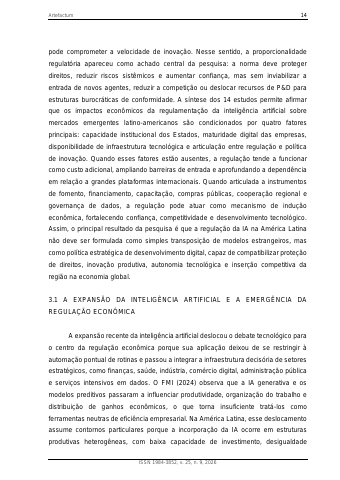
- Economic impacts of AI regulation are conditioned by four main factors: institutional capacity, digital maturity of firms, technological infrastructure and alignment between regulation and innovation policy.p.14
Key insights
- The absence of regulation produces legal uncertainty and reduces consumer and investor confidence, but overly costly regulation can restrict local innovation.p.12
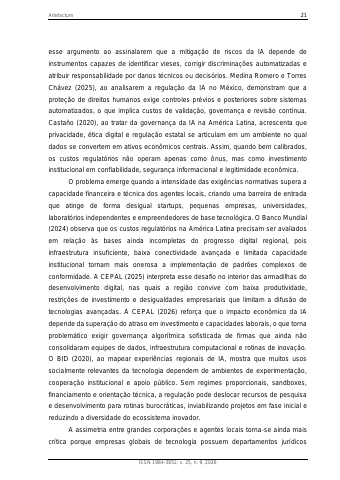
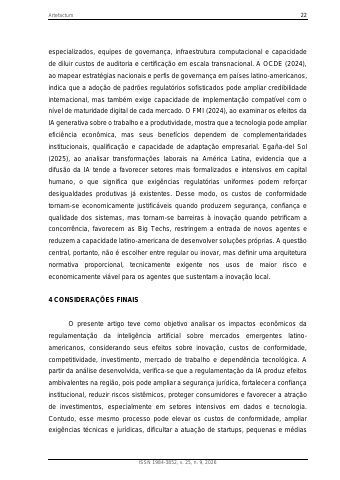
- Compliance costs include independent audits, impact reports, dataset curation, continuous monitoring and algorithmic governance structures.p.12
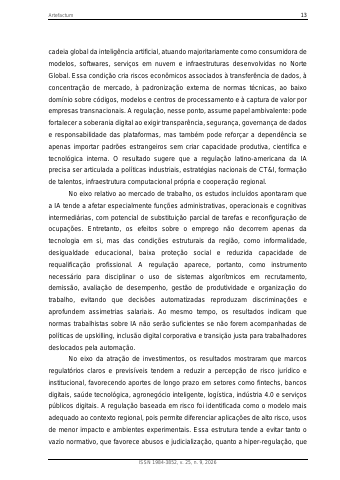
- Latin America acts mostly as a consumer of models, software and cloud services developed in the Global North, creating technological dependence risks.p.13
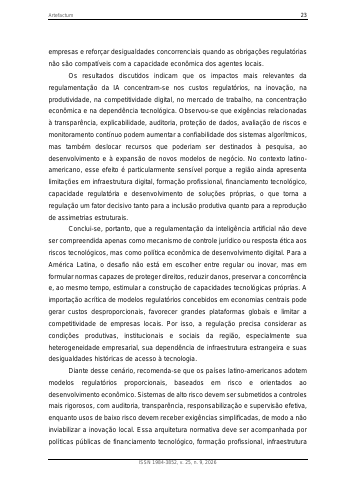
- Regulatory proportionality emerged as a central finding of the research.p.14
- Large banks, insurers and technology firms are better able to absorb compliance requirements than smaller agents.p.12
- Banks and fintechs have greater capacity to incorporate AI and respond to regulation, while smaller agents face higher technical and legal costs.p.19
- Regulation should be a strategic digital development policy rather than a transposition of foreign models.p.14
Pages
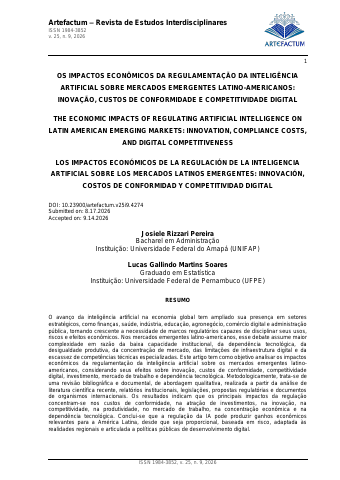 p.1
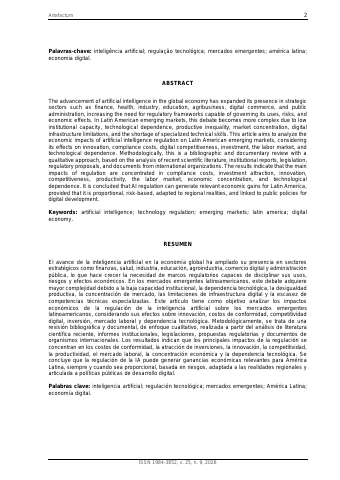 p.2
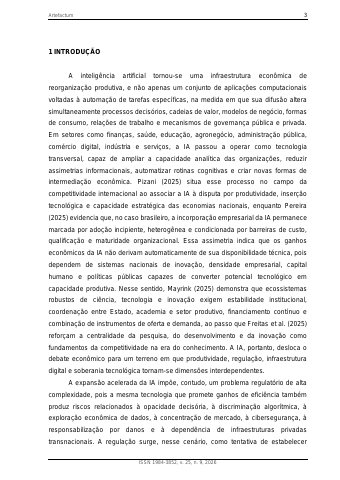 p.3
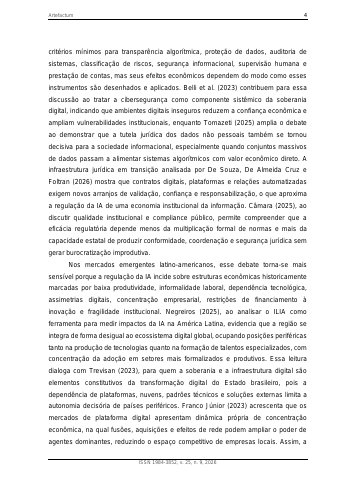 p.4
 p.5
 p.6
 p.7
 p.8
 p.9
 p.10
 p.11
 p.12
 p.13
 p.14
 p.15
 p.16
 p.17
 p.18
 p.19
 p.20
 p.21
 p.22
 p.23
 p.24
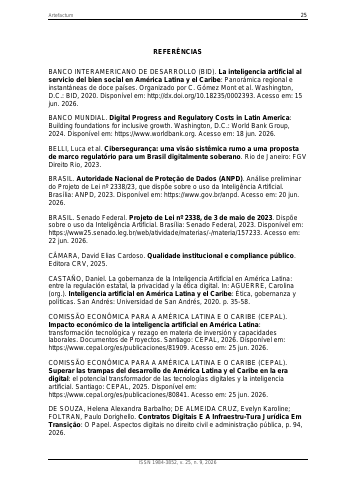 p.25
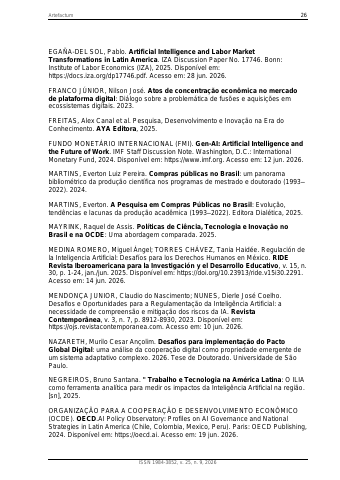 p.26
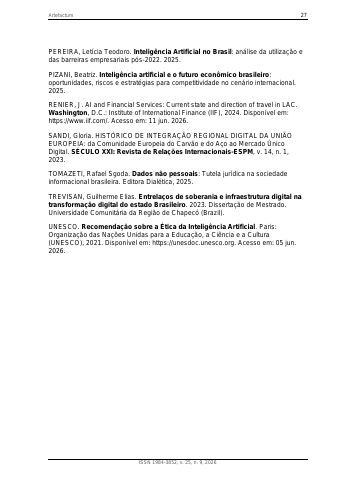 p.27
Topics and entities
Summary and figures generated from the document and checked automatically: every number shown appears on the cited page. Publishers can request removal.