Microsoft’s Acquisition of VC-Backed Startups: A Case Study of Build-or-Buy Strategy in Cloud and AI (Advances in Economics Management and Political Sciences)
SaveSummary
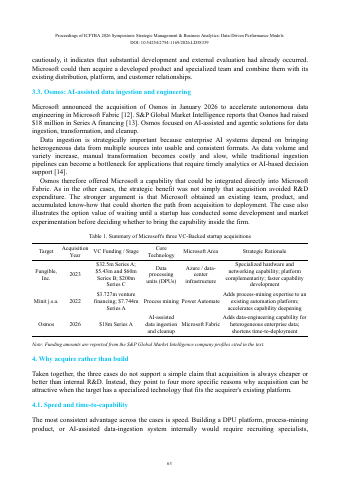
- The study analyzes Microsoft's build-or-buy acquisition strategy through three venture-capital-backed technology startups: Fungible (acquired in 2023), Minit (acquired in 2022), and Osmos (acquired in 2026).p.4
- Fungible raised $32.5m in Series A, $5.43m and $60m across Series B rounds, and $200m in Series C before its acquisition by Microsoft to enhance Azure data-center infrastructure.p.4
- Minit raised $3.727m in venture financing and $7.744m in Series A financing prior to being acquired to provide process-mining capabilities for Microsoft Power Automate.p.4
- Osmos raised $18 million in Series A funding before Microsoft announced its acquisition in January 2026 to accelerate autonomous data engineering in Microsoft Fabric.p.4
- Acquisitions shorten time-to-capability and allow incumbents to evaluate technology after initial experimentation has been financed by venture capital investors.p.2
- Post-acquisition success remains constrained by execution risks, notably retaining technical founders and key talent, organizational cultural integration, and antitrust regulatory scrutiny.p.5
Key insights
- Acquisition serves as a selective complement to internal research and development rather than an automatic or universally cheaper substitute.p.1
- VC-backed startups conduct early technical and market experimentation, allowing corporate acquirers to make entry decisions at lower initial technological uncertainty.p.2
- Fungible's data-processing-unit (DPU) technology provides Azure with specialized networking and storage acceleration that is costly and slow to build internally.p.3
- Minit's acquisition expanded Power Automate by integrating pre-built process-mining software designed to identify workflow bottlenecks.p.3
- Osmos's acquisition added AI-assisted data-ingestion capabilities directly into Microsoft Fabric to address data transformation bottlenecks in enterprise AI systems.p.4
- The primary strategic value driver across all three cases is speed and compressed time-to-capability rather than guaranteed cost savings.p.5
- Acquired technologies generate higher value inside the acquiring incumbent due to direct complementarity with installed customer bases, distribution networks, and existing cloud platforms.p.5
- Failure to retain founders and key technical staff poses a primary risk of losing accumulated knowledge and routines.p.5
- Scrutiny from antitrust authorities constitutes a material risk for dominant platforms engaging in programmatic technology acquisitions.p.6
Pages
 p.1
 p.2
 p.3
 p.4
 p.5
 p.6
 p.7
Topics and entities
Summary and figures generated from the document and checked automatically: every number shown appears on the cited page. Publishers can request removal.