Matching Risk Attitude to Investment Behaviour: Insights from Self-Reported Responses (Journal of the Economic Science Association)
SaveSummary
- The paper uses the 2004–2022 waves of the Italian Survey of Household Income and Wealth (SHIW) to test whether self-assessed financial risk attitude matches reported investment choices.p.1
- Consistency between stated risk attitude and reported portfolio holdings supports the reliability of the risk-aversion measure.p.1
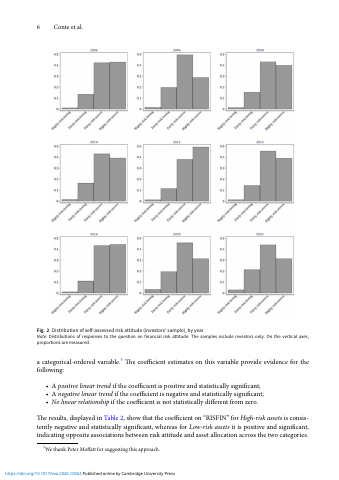
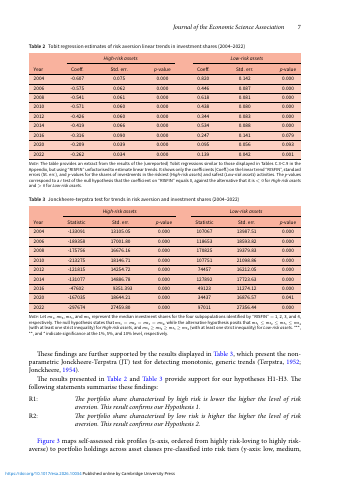
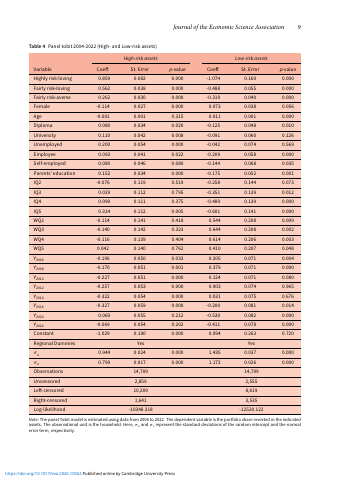
- The coefficient on risk aversion is consistently negative and significant for high-risk assets and positive for low-risk assets.p.6
- Highly risk-loving individuals allocate larger portfolio shares to high-risk assets, while risk-averse individuals favour low-risk assets.p.10
Key insights
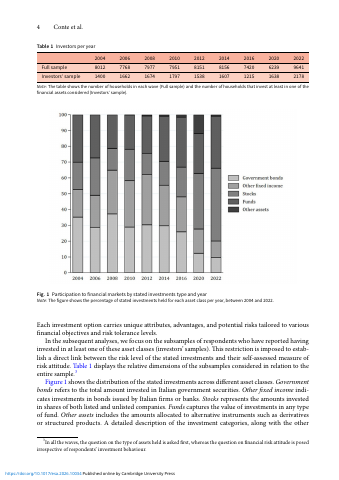
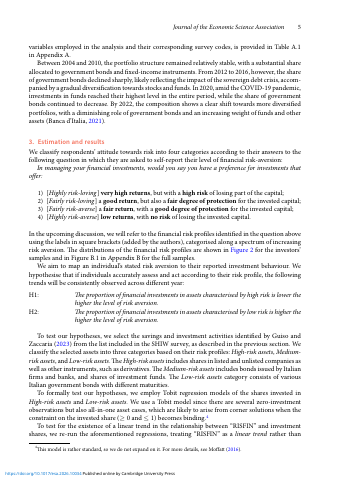
- Government bonds declined sharply from 2012 to 2016, with diversification towards stocks and funds.p.5
- Investments in funds reached their highest level in 2020, amid the COVID-19 pandemic.p.5
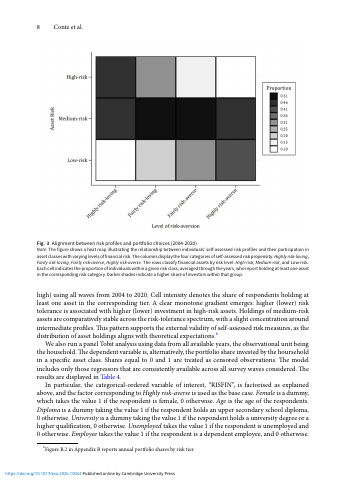
- A clear monotone gradient emerges: higher risk tolerance is associated with higher investment in high-risk assets.p.8
- Holdings of medium-risk assets are comparatively stable across the risk-tolerance spectrum.p.8
- Females allocate less to high-risk assets than males.p.10
- Higher educational attainment and higher parental education are associated with increased holdings in high- and medium-risk assets.p.10
- Individuals with higher financial literacy tend to invest more in high-risk, high-return assets, while those with lower literacy allocate more to safer assets.p.11
Pages
 p.1
 p.2
 p.3
 p.4
 p.5
 p.6
 p.7
 p.8
 p.9
 p.10
 p.11
 p.12
 p.13
Funders mentioned
Topics and entities
Summary and figures generated from the document and checked automatically: every number shown appears on the cited page. Publishers can request removal.