Knowledge gaps, behaviour parity: gender differences in financial literacy in Europe
The report analyzes gender gaps in financial knowledge and behaviour across 20 EU Member States using 2022 OECD/INFE survey data.
Central bank · IT · 9 documents
The report analyzes gender gaps in financial knowledge and behaviour across 20 EU Member States using 2022 OECD/INFE survey data.
The paper proposes replacing structural asset correlation in the Merton-Vasicek framework with the linear correlation between credit survival logits, enabling the modeling of unlisted corporate credit risk from standard bank rating systems.
Directive 2023/2225/UE regulates consumer creditworthiness evaluation under Article 18 and will apply from 20 November 2026.
The study conducts a systematic literature review analyzing 95 papers published between 2002 and 2025.
Between 1950 and the present, aggregate per capita national wealth in France, Germany, Italy, and Spain multiplied by 18 times, rising from 37% to 83% of US per capita national wealth.
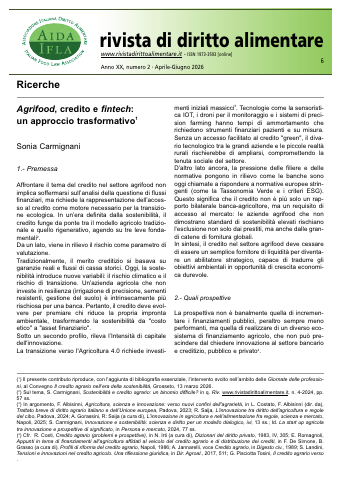
Access to agricultural credit must serve as a driver for the ecological transition to Agriculture 4.0, which requires substantial upfront capital.
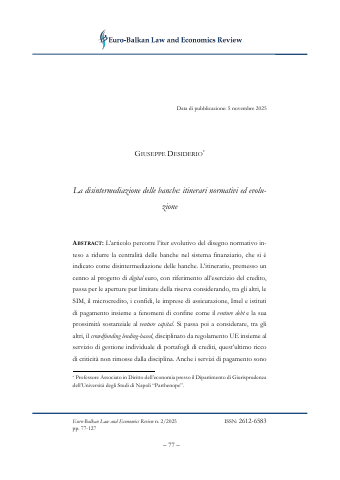
Investment firms with total consolidated assets of €30 billion or more are categorized as credit institutions under Article 4 of Regulation (EU) No 575/2013.
The note categorizes single-ledger arrangements into 4 operating models: integration, distribution, separation, and permissionless.
Eight G20 members achieved the highest rating of 5/5 for direct access of non-bank payment service providers in 2025.