Lending Expansion and Funding Pressure in Uzbekistan's State-Owned Banks: Evidence from 2017–2024 (Academic Journal of Digital Economics and Stability)
SaveSummary
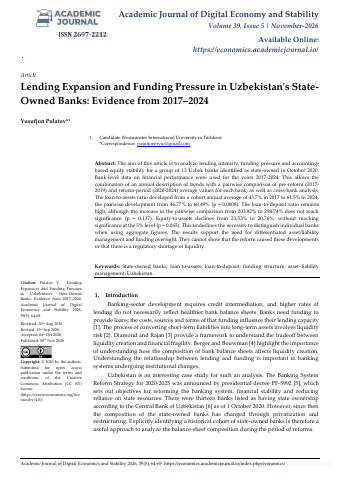
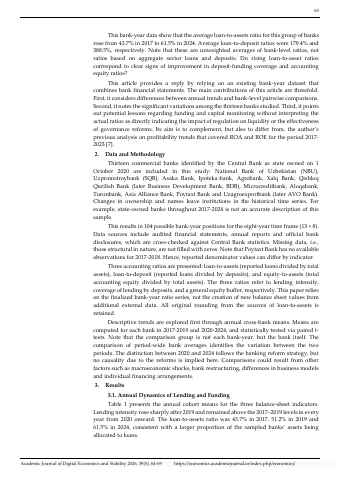
- The study analyzes financial performance across 13 Uzbek state-owned banks from 2017 to 2024.p.1
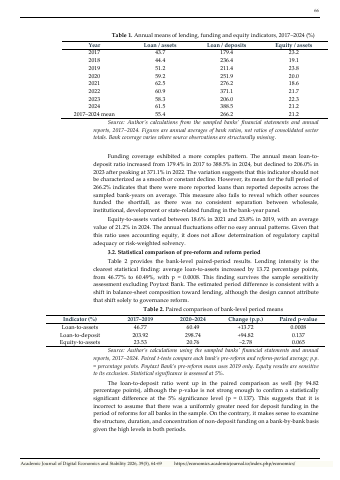
- The cohort average loan-to-assets ratio expanded from 43.7% in 2017 to 61.5% in 2024.p.1
- The average loan-to-deposit ratio increased from 179.4% in 2017 to 388.5% in 2024, reaching a full-period mean of 266.2%.p.3
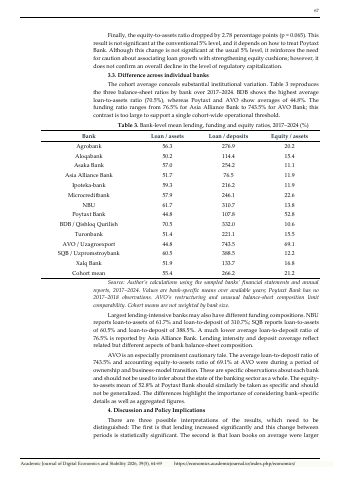
- Substantial institutional variations exist, with 2017–2024 loan-to-deposit ratios ranging from 76.5% at Asia Alliance Bank to 743.5% at AVO Bank.p.4
Key insights
- Lending intensity increased significantly among state-owned banks, moving from a pre-reform average of 46.77% to 60.49% during the reform period (p = 0.0008).p.3
- The pairwise increase in the loan-to-deposit ratio by +94.82 percentage points did not achieve statistical significance at the 5% level (p = 0.137).p.3
- The decline of -2.78 percentage points in the pairwise equity-to-assets ratio was not statistically significant at the 5% level (p = 0.065).p.4
- BDB recorded the highest average loan-to-assets ratio among the studied banks at 70.5%.p.4
- Poytaxt Bank and AVO Bank recorded the lowest average loan-to-assets ratios in the sample at 44.8%.p.4
- AVO Bank exhibited an unusually high average loan-to-deposit ratio of 743.5% alongside an average equity-to-assets ratio of 69.1% during its transition period.p.4
- Poytaxt Bank showed an elevated average equity-to-assets ratio of 52.8%.p.4
- Aggregate sector cohort averages conceal major underlying balance-sheet and operational differences across individual institutions.p.4
Pages
 p.1
 p.2
 p.3
 p.4
 p.5
 p.6
Funders mentioned
Topics and entities
Summary and figures generated from the document and checked automatically: every number shown appears on the cited page. Publishers can request removal.