Improving the Evaluation of Monetization Efficiency of Innovative Services in Commercial Banks (Innovations in Science and Technologies)
Summary
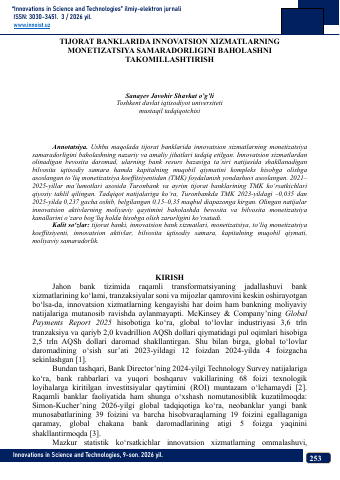
- Global payments industry revenues reached 2,5 trln AQSh dollari, but revenue growth decelerated from 12 foiz in 2023 to 4 foiz in 2024.p.1
- According to Bank Director, 68 foiz of bank executives do not regularly measure tech investment ROI.p.1
- Neobanks hold 39 foiz of new banking relationships and 19 foiz of all accounts, yet generate only nearly 5 foiz of global retail banking revenue.p.1
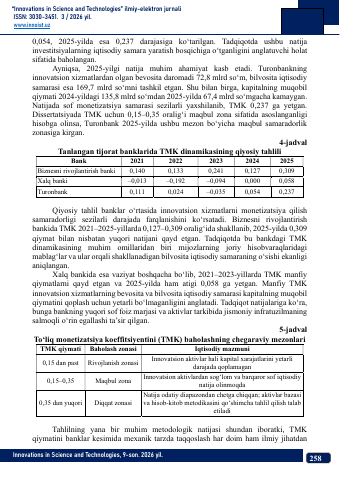
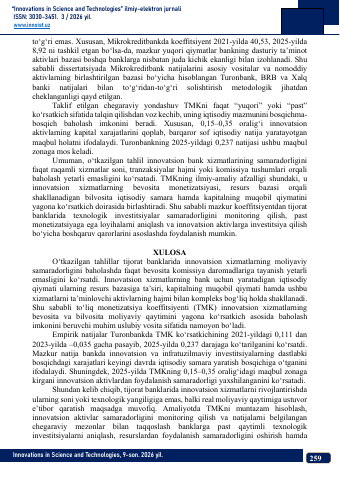
- Turonbank's Full Monetization Coefficient (TMK) improved from -0,035 in 2023 to 0,237 in 2025, reaching the optimal range.p.1
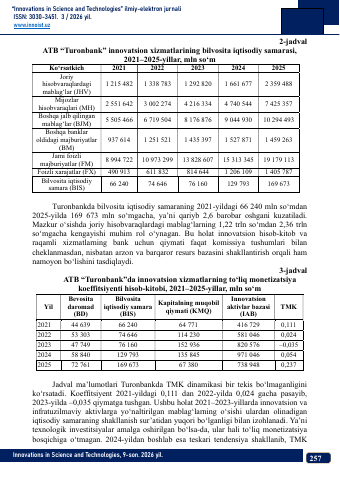
- Turonbank's indirect economic effect grew from 66 240 mln so‘m in 2021 to 169 673 mln so‘m in 2025.p.5
- In comparative analysis for 2025, Biznesni rivojlantirish banki recorded a TMK of 0,309 while Xalq banki recorded 0,058.p.6
Key insights
- Direct commission revenues alone fail to capture the full economic contribution of innovative banking services.p.3
- Neobanks demonstrate strong account acquisition but lag significantly in revenue monetization efficiency globally.p.1
- Turonbank increased its indirect economic effect created by low-cost current accounts from 66 240 mln so‘m in 2021 to 169 673 mln so‘m in 2025.p.5
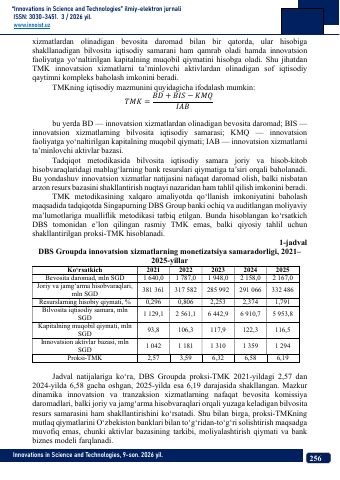
- Proxy-TMK metrics applied to Singapore's DBS Group peaked at 6,58 in 2024 before adjusting to 6,19 in 2025.p.4
- The proposed standard evaluation benchmark defines a TMK range of 0,15–0,35 as the optimal efficiency zone.p.6
- Xalq banki registered negative TMK values between 2021 and 2023 due to high capital costs and extensive physical infrastructure.p.6
Pages
 p.1
 p.2
 p.3
 p.4
 p.5
 p.6
 p.7
 p.8
Topics and entities
Summary and figures generated from the document and checked automatically: every number shown appears on the cited page. Publishers can request removal.